


A Brief Discussion of the DSA Platform
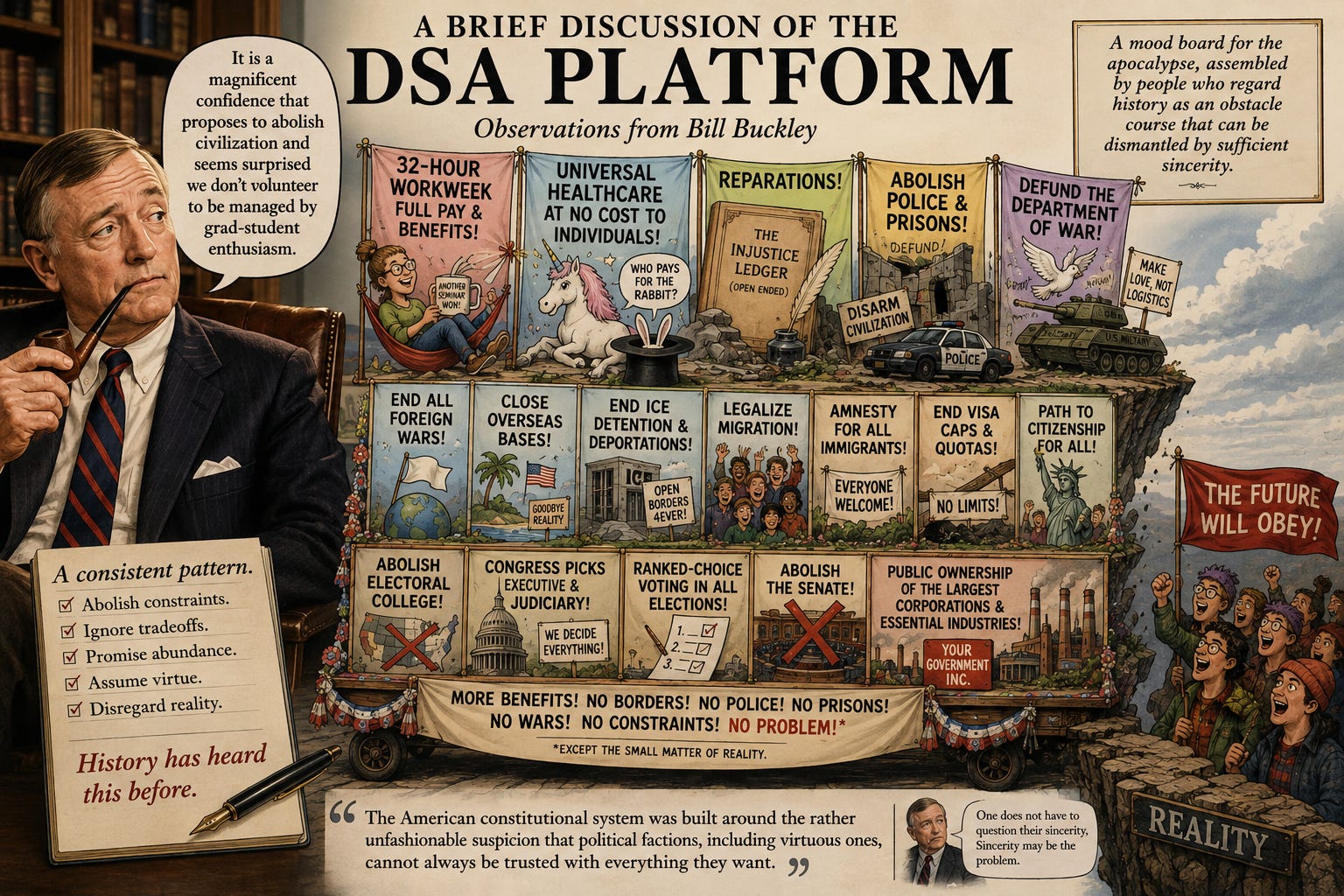
What if Bill Buckley were given the opportunity to observe and critique the DSA?
By Jim Reynolds | www.reynolds.com
August 21, 2026
It might look something like this.
Before we proceed, it is worth admiring the DSA platform in its native habitat: a document of such magnificent confidence that it proposes to abolish substantial portions of civilization and then seems mildly surprised that the rest of us do not volunteer to be managed by grad-student enthusiasm.
For reference, these are not archaeological fragments from socialist pamphlets of another era. They come from DSA’s current 2026 national program, Workers Deserve More.
Here are the highlights:
Establish paid family leave for all workers and a 32-hour workweek with full pay and benefits.
Guarantee universal healthcare at no cost to individuals, including gender-affirming care.
Enact reparations.
Disempower police unions and redirect funding to public services as steps toward fully abolishing the police and prison system.
Defund the Department of War.
End all foreign wars and close overseas military bases.
End ICE detention and deportations and punish federal agents’ brutality.
Legalize migration.
Grant amnesty for all immigrants regardless of status.
Provide a path to citizenship for all permanent residents.
End visa caps and quotas.
Abolish the Electoral College.
Replace the President and Supreme Court with an executive and judiciary chosen by and subordinate to Congress.
Implement proportional representation and ranked-choice voting in all elections.
Abolish the Senate.
Establish public ownership of the largest corporations and essential industries.
Now then.
If one were looking for a platform that mistakes desire for policy, this would be a respectable candidate. It offers the familiar socialist miracle: more benefits, fewer hours, no border, no police, no prisons, no Electoral College, no Senate, no foreign wars, no private ownership of the commanding heights and, one gathers, no unpleasant interruptions from arithmetic.
Consider first the 32-hour workweek at full pay and benefits, a proposal possessing the innocent charm of something devised by people for whom payroll is largely theoretical. Wages would remain intact, hours would fall by 20 percent, benefits would continue, and productivity would presumably rise to meet the occasion out of ideological courtesy.
The difficulty is not moral but mathematical. Businesses faced with substantially higher labor costs must respond somehow: through prices, hiring, automation, reduced service, lower margins, fewer hours elsewhere, or closure. One may dislike those choices. One may legislate furiously against them. One may even organize a symposium. They remain choices.

Universal healthcare ‘at no cost to individuals’ has the same appeal as any good magic trick—right up until someone asks who paid for the rabbit.
There is always a cost. The question is merely where it appears: taxes, rationing, wait times, reduced access, lower reimbursement, bureaucratic permission, or some combination thereof. The DSA formulation attempts the pleasant trick of abolishing the price while retaining all the advantages of scarcity-free abundance. It is rather like repealing gravity while preserving the staircase.
Then come reparations, an idea whose moral certainty tends to be inversely proportional to the number of practical questions asked about it.
Who pays? Who receives? How is eligibility determined? By ancestry? By documented injury? By racial classification? Across how many generations? What of recent immigrants? What of descendants whose family histories include both victims and beneficiaries of earlier injustice?
And how much does each qualified recipient receive compared with everyone else—and why?
History, regrettably, is less tidy than a slogan. The people most insistent that society recognize infinite shades of identity become unexpectedly enthusiastic about ledger books when the moral accounting suits the occasion.
The proposal to “disempower police unions,” redirect funding and proceed toward “fully abolishing the police and prison system” marks the point at which the platform abandons reform for anthropology.
The premise appears to be that civilization may dispense with coercive institutions and that coercive people, impressed by the gesture, will voluntarily follow suit.
They will not.
Abolishing police does not abolish predation. Abolishing prisons does not abolish people from whom society must occasionally be protected. It merely transfers power from accountable institutions, however imperfect, to whoever is most willing to exercise force without them.
The criminal does not disappear when the police do. He enjoys a promotion.
The foreign-policy section suffers from the same romantic difficulty.
“Defund the Department of War” has a pleasing pacifist ring until one remembers that other nations possess armies, missiles, territorial ambitions and occasionally rather firm opinions about us. “End all foreign wars” is not, strictly speaking, a strategy. Wars involve at least two parties, one of whom may prove uncooperative.
Closing overseas military bases sounds equally attractive if one assumes that geography will observe the resolution.
The world has never been especially courteous toward nations that announce in advance what they are unwilling to defend. The DSA foreign-policy doctrine seems to hold that if America ceases taking the world seriously, the world may become embarrassed and leave us alone.
History contains limited evidence for this proposition.
Immigration is handled with similar breeziness. End detention. End deportation. Legalize migration. Grant amnesty regardless of status. Remove visa caps and quotas.
At some point one has not liberalized immigration policy so much as abolished the distinction between immigration policy and arrival.
A nation that cannot distinguish between lawful entry and unlawful entry is not especially compassionate. It has simply surrendered the right to decide who may enter and under what conditions.
Borders are not a moral defect. They are one of the features by which a country demonstrates that it intends to remain a country.
Then comes the constitutional demolition project.
Abolish the Electoral College. Subordinate the executive and judiciary to Congress. Abolish the Senate.
This is presented as an enlargement of democracy, though it has the curious characteristic of eliminating precisely those institutions designed to prevent transient majorities from acquiring unchecked power.
The American constitutional system was built around the rather unfashionable suspicion that political factions, including virtuous ones, cannot always be trusted with everything they want.
The DSA response is simpler: if an institution frustrates the desired political outcome, abolish the institution.
This is democracy interpreted as appetite.
Its great weakness becomes apparent the instant the opposition wins.
And finally we arrive at public ownership of the largest corporations and essential industries.
The old faith survives remarkably intact: whatever one’s complaints about private concentrations of power, the solution is apparently to create concentrations of power administered by government and made considerably more difficult to escape.
Private monopolies are dangerous because they can become inefficient, unresponsive and abusive. Public monopolies possess the same possibilities with the additional power of sovereign authority.
Anyone who has spent time with public procurement, public payrolls, regulatory delays or government information systems may reasonably hesitate before handing the same machinery the commanding heights of the economy.
If an institution has difficulty keeping a website operational, assigning it the steel, energy, transportation, communications and pharmaceutical sectors may be regarded as optimism of an unusually muscular kind.

So yes, the DSA platform is ambitious.
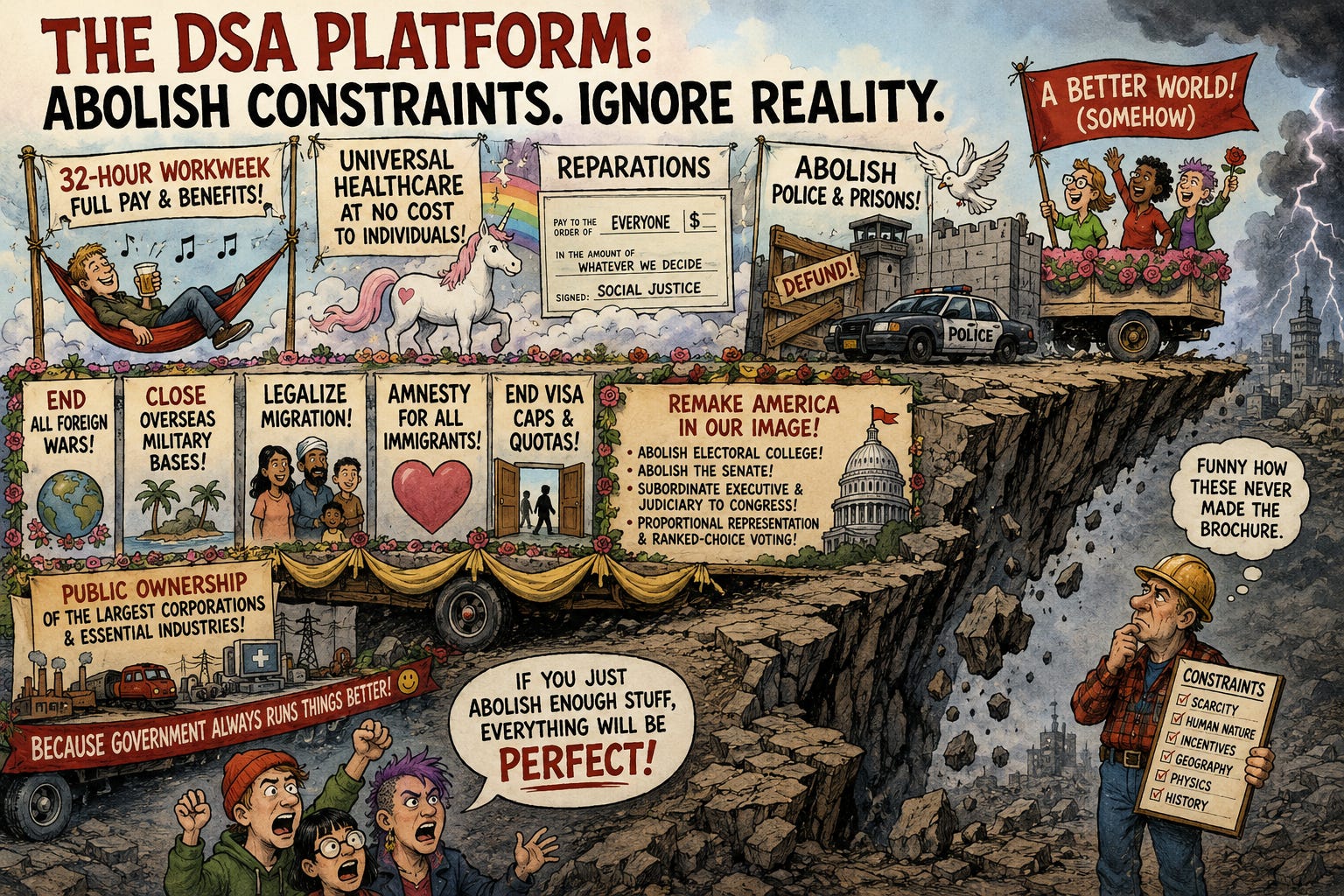
It is also the sort of ambition that prefers abolishing constraints to reconsidering premises.
It promises abundance without tradeoffs, equality without incentives, safety without enforcement, openness without borders and democracy without institutions capable of saying no.
That is the common thread running through the entire document. Scarcity is treated as a political choice. Human nature is treated as an administrative inconvenience. Incentives are treated as bourgeois superstition. Opposition is treated not as something democratic government must accommodate but as evidence that democratic institutions require improvement until they stop producing opposition.
One need not question the sincerity of the people proposing all this.
Sincerity may be the problem.
A civilization is not a seminar in which every contradiction can be resolved by drafting a more compassionate resolution. It is an arrangement among millions of imperfect people possessing conflicting interests, limited resources, divergent ambitions and an occasionally stubborn attachment to reality.
The DSA platform is therefore not merely a collection of extravagant policies.
It is a mood board for the apocalypse, assembled by people who regard history as an obstacle course that can be dismantled by sufficient sincerity.
One suspects history has heard this before.
I just wanted to say that I am delighted to find myself on your distribution list. RIP had your column on very often, but not everyday. Now that I am getting to know you, I very much look forward each day for what you have to say about current events. I am particularly intrigued by the way you paragraph. If that makes sense! But I am most pleased to see more of you!!