


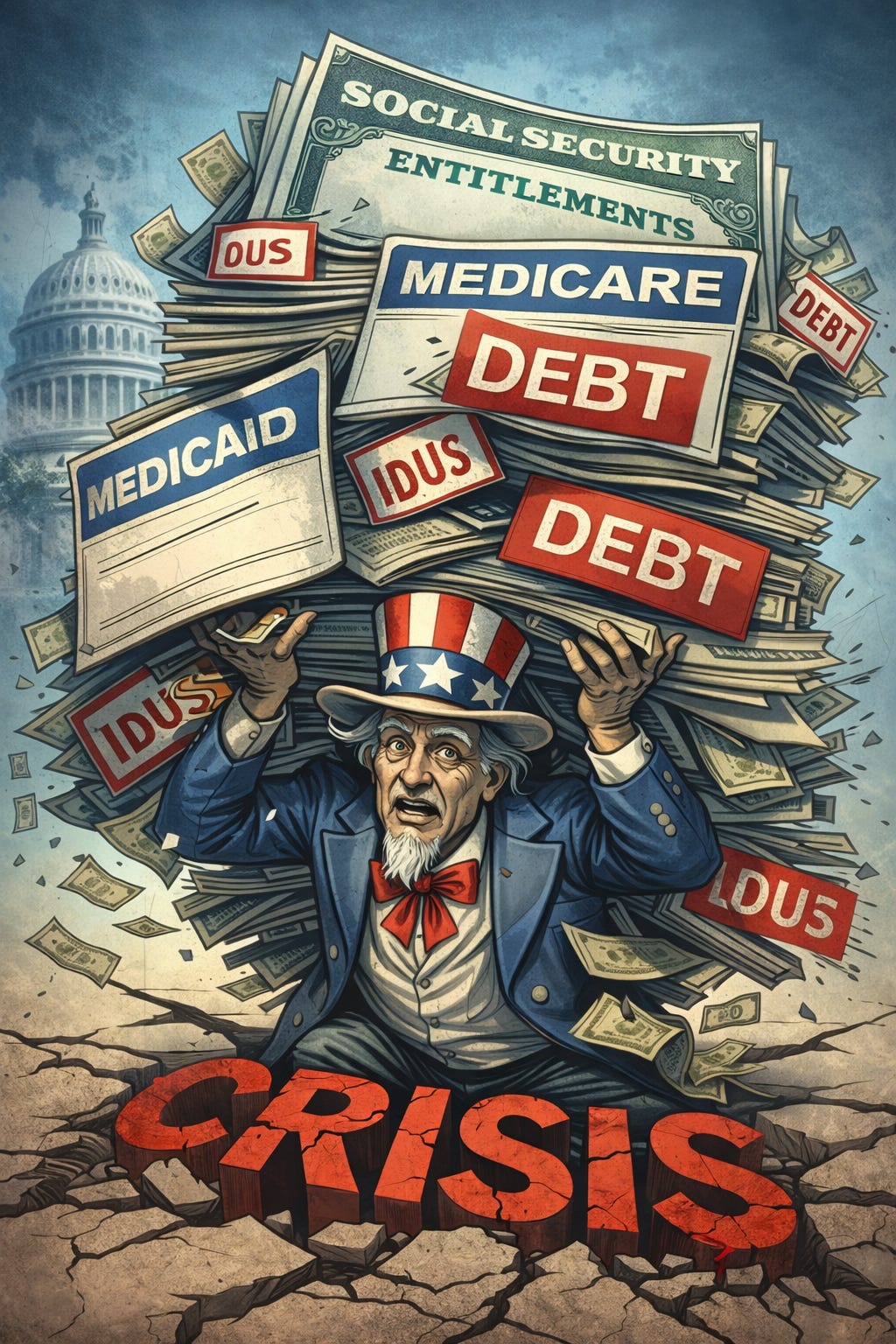
A Looming Entitlement Crisis — Reframed
By Jim Reynolds | www.reynolds.com
March 20, 2026
A recent RealClearMarkets piece gets the math right. We’re promising more than we can deliver. But the real question isn’t whether the system is unsustainable. It’s why we continue it anyway.
The federal government is on track to spend nearly every dollar it collects on a small set of obligations: Social Security, Medicare, Medicaid, and interest on the debt.
That is not a forecast.
It is a trajectory.
And trajectories, unlike promises, do not bend on their own.
This is not simply a budgeting problem. It is a structural one. The government has committed to transfer more resources than the economy can reliably produce for it, and the difference is covered with debt.
Debt is not wealth.
It is a claim on future wealth.
And those claims are accumulating faster than the future can plausibly deliver.
We tend to obscure this reality because we measure everything in dollars. But the underlying issue is not monetary—it is physical. Real goods and services must be produced, and there are limits to how much can be produced and transferred at any given time.
Those limits have not disappeared.
They have been deferred.
Working Americans are told they are contributing to a system that will later provide for them. But those contributions are not stored or invested. They are used immediately to fund current obligations. What builds up is not capital, but expectations.
The system does not accumulate resources.
It accumulates promises.
Financial markets extend the illusion. Government bonds are treated as assets, as if they represent stored value. In reality, they represent claims on future production that must be extracted later through taxes, inflation, or reduced benefits.
Either the underlying wealth will exist.
Or it won’t.
⸻
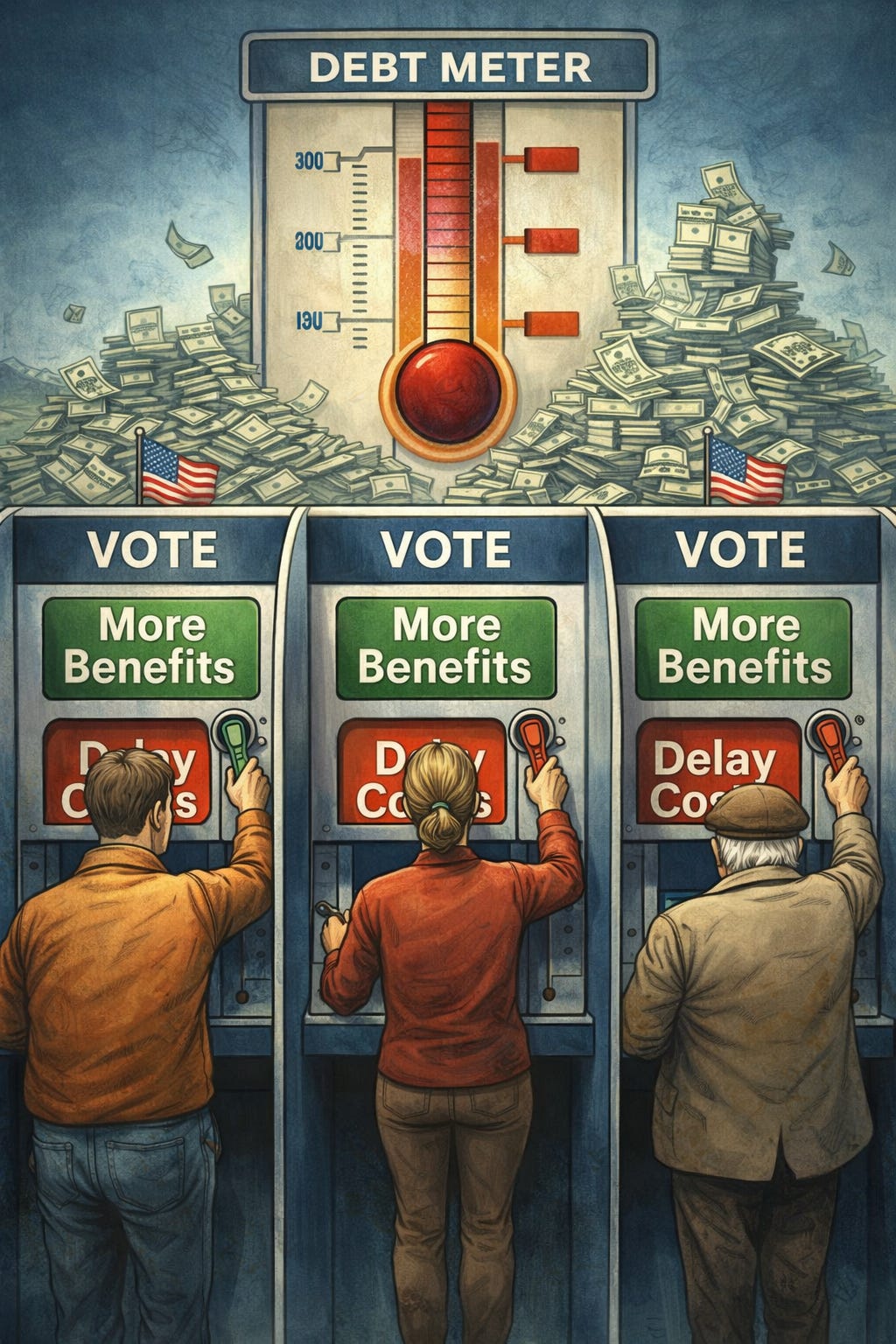
Why We Do Not Solve It
The constraint is clear.
The behavior is clearer.
No administration is rewarded for restraint. The gains from discipline arrive later, often under someone else’s leadership. The losses arrive immediately—reduced benefits, higher taxes, political backlash.
Cut, and you lose.
Spend, and you survive.
So the system spends.
Bob: “If the fix costs votes, it’s not getting fixed.”
But the deeper logic sits with the public.
This is not a system that drifted off course. It is one that people have learned to navigate. Voters increasingly experience government not as a set of trade-offs, but as a source of benefits. The connection between contribution and receipt has weakened to the point where it barely factors into decision-making.
The question is no longer what can be sustained.
It is what can be obtained.
Bob: “If it’s available, someone thinks they’re owed it.”
That shift is reinforced by what we do not teach.
Citizens learn how to vote. They do not learn what happens when obligations compound beyond capacity. There is no shared understanding of what fiscal collapse looks like, how it develops, or how broadly it spreads.
So the system runs on assumption.
The bill will be handled later.
It won’t be handled.
It will be transferred.
From the future to the present. From those not yet voting to those who are.
We are not just borrowing money.
We are reallocating time.
Bob: “Future’s open. Help yourself.”
⸻
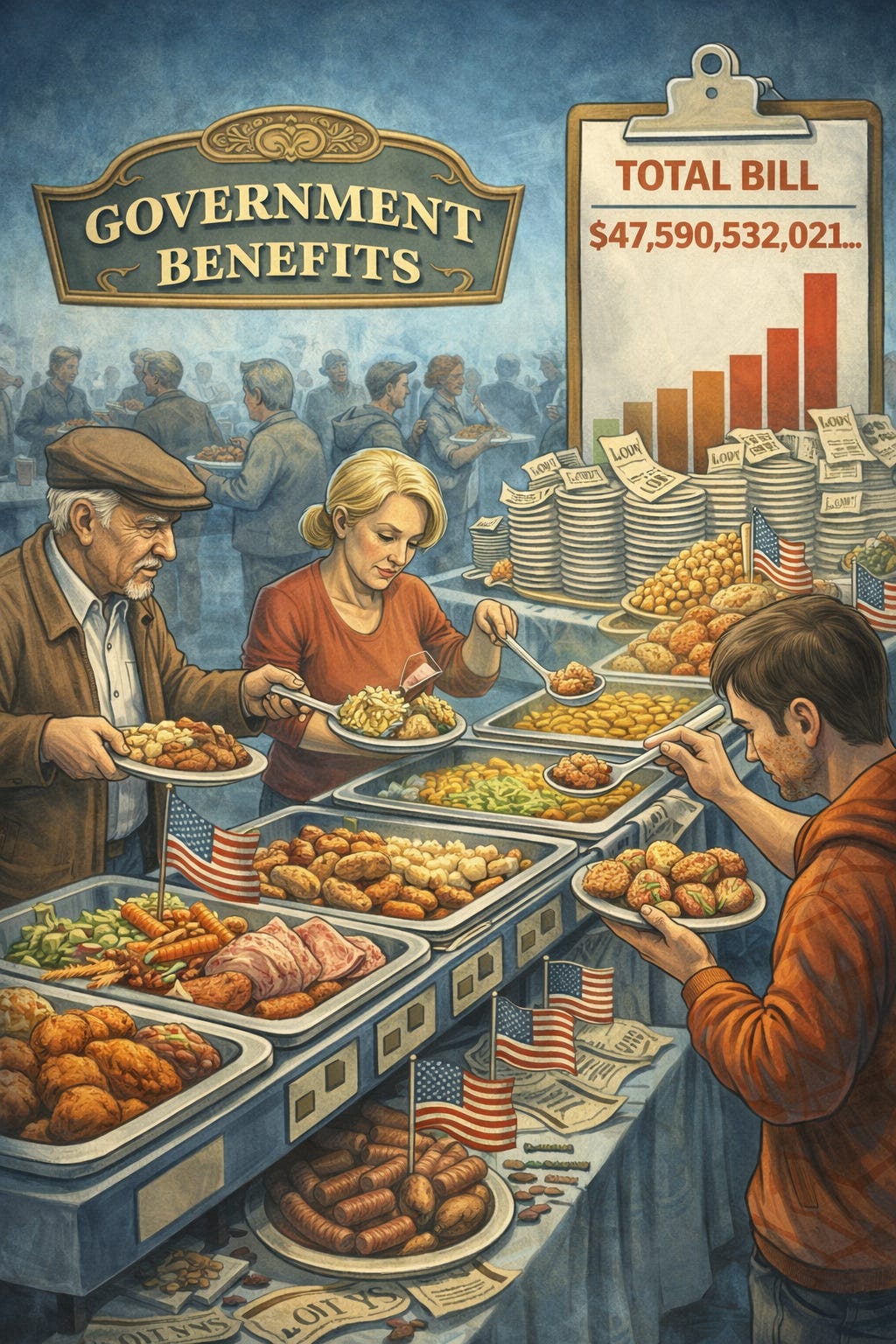
The Trap of Fairness
This is where the system locks in place.
People feel entitled to what they were promised. They organized their lives around those expectations. To change the terms now feels like a violation.
At the same time, many understand—if only privately—that the system delivers more than it collects for most participants.
So two beliefs coexist:
This is mine.
And this exceeds what is mine.
Both feel justified.
Neither is stable.
That contradiction makes reform nearly impossible. Any adjustment can be framed as taking something away. And in a political system built on representation, taking away is the one move that consistently fails.
⸻
What It Would Actually Take
The obstacle is not a lack of ideas.
It is the cost of acting on them.
A real correction would not be targeted. It would be shared.
Benefits would be lower than currently promised. Health care would require greater personal contribution. Retirement timelines would extend. Some programs would disappear entirely.
Taxes would not rise narrowly.
They would rise broadly.
The effects would not stop with government.
Businesses dependent on public spending would fail. Asset values would adjust. Growth would slow before stabilizing. Public services would contract, and maintenance would be deferred.
The change would be visible.
And uncomfortable.
The country would feel poorer.
Because it is poorer than it believed.
Bob: “The math didn’t change. The story did.”
Everyone senses this.
That is why nothing happens.
Each group recognizes the need for adjustment. Each group also recognizes that adjustment will reduce its own position. So each waits.
And the waiting becomes policy.
⸻
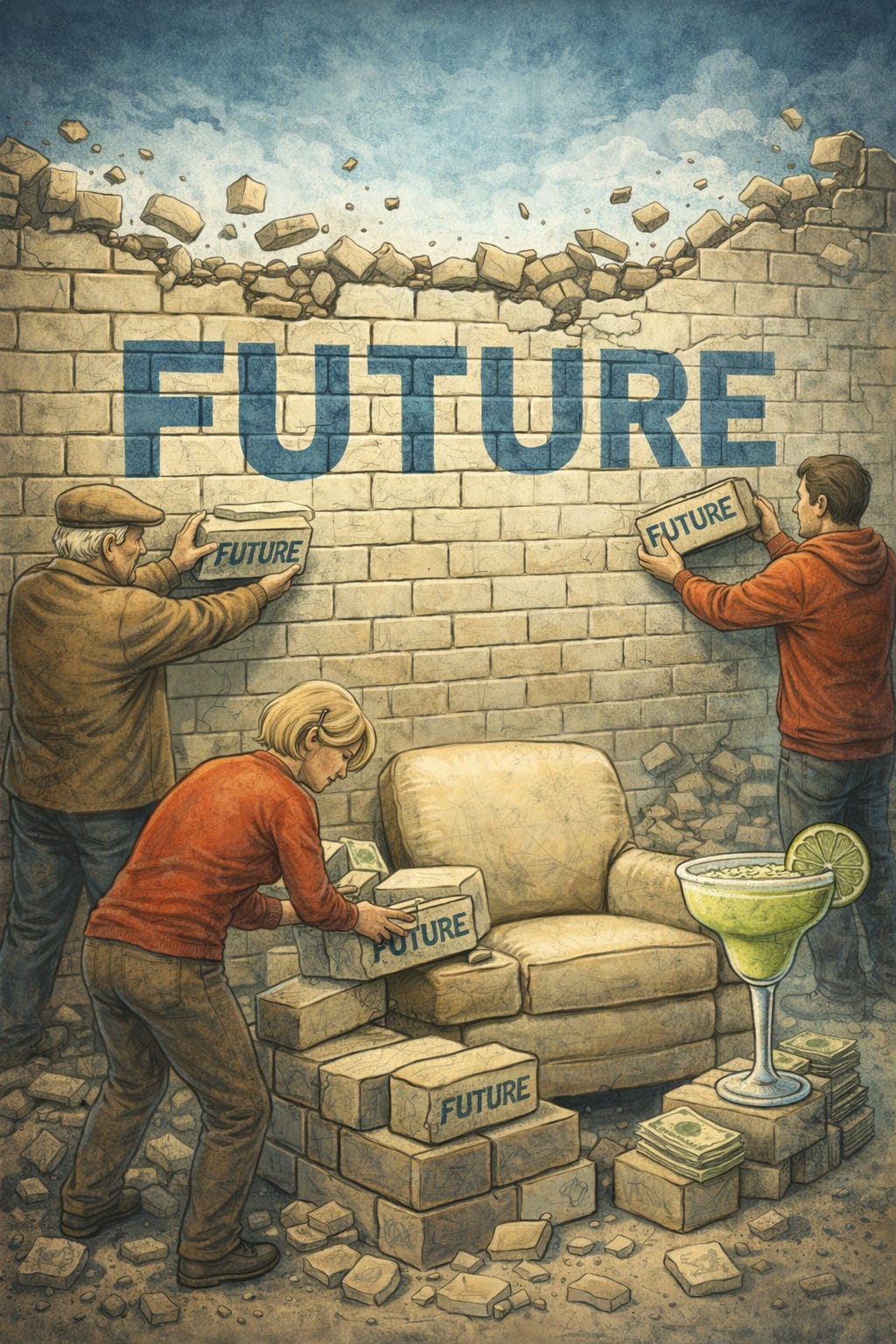
The Only Path Forward
Incremental reform fails because it concentrates losses.
Comprehensive reform distributes them.
An entitlement reset would replace the current system with something simpler: a baseline guarantee to prevent poverty, combined with benefits more closely tied to actual contributions.
No illusions.
Fewer transfers hidden in complexity.
Applied broadly, it could feel fair enough to pass.
That is the only real requirement.
⸻
The Real Risk
The danger is not ignorance.
It is deferral.
A system that promises more than it can deliver will correct. The only question is whether that correction is chosen or imposed.
If chosen, it is managed.
If imposed, it is not.
Until the cost of delay exceeds the cost of action, delay will continue.
That is the equilibrium.
And it holds—right up until it doesn’t.
Bob: “You don’t beat the bill. You just decide when to open it.”
⸻
“The American Republic will endure until the day Congress discovers that it can bribe the public with the public’s money.”
That is a paraphrased version of some famous guy talking about America. That was a LONG time ago. Chickens? Roosting? That has been one extended flight to my barn. Historic arcs do not bend due to feelings.
As my mother used to say, “you can wish in one hand and crap in the other hand, then see which fills up the fastest.“
She also used the saying “the chickens are coming home to roost.” your points are frightening to think about because they are true. Are the socialists winning?
Our politicians continue to play games and protect their behinds. They know they will always be first in line for their promised benefits. They made it so.