


Action Over Talk — Results Over Narrative
By Jim Reynolds | www.reynolds.com
May 27, 2026
Note: I read Jeff Childers about half the time. I recommend his work. This is loosely based on what he wrote today. I snuck in a couple of his metaphors.
The old political résumé no longer works.
For years, voters were told that experience, seniority, fundraising, committee assignments, and institutional respectability were the marks of seriousness. Occupy the chair long enough, avoid embarrassing yourself on cable news, vote correctly most of the time, and eventually the system would reward you with permanence.
That model is breaking down everywhere at once.
John Cornyn just learned this the hard way in Texas.
Cornyn wasn’t some wild-eyed liberal Republican. He voted with Trump roughly ninety percent of the time. Under the old GOP formula, that should have been enough. Raise money. Keep the seat warm. Stay respectable. Let leadership handle the fighting.
Instead, Republican voters flattened him by twenty-eight points.
Not because he was insufficiently conservative.
Because he looked like a man occupying space while other people fought.
That distinction matters now.
During Covid, the public watched a dividing line emerge inside institutions, politics, media, medicine, and government itself. Some people issued statements, formed committees, and carefully calibrated their language while waiting for permission from “experts.”
Other people acted.
Ken Paxton spent those years suing lockdown regimes, vaccine mandates, counties, hospitals, and the Biden administration itself. Whether one agrees with every lawsuit is almost beside the point politically. Voters saw movement. Resistance. Risk. Conflict.
Meanwhile, many institutional Republicans behaved like cautious museum guards politely monitoring the collapse of public trust from behind velvet ropes.
The old system rewarded caretakers.
The new electorate increasingly rewards fighters.
And then came Trump’s late endorsement.
That was the real accelerant. Once Trump endorsed Paxton, the race psychologically changed overnight. Because Trump no longer functions merely as a politician inside the Republican base. He functions as an authenticity validator.
His endorsement doesn’t simply say:
“I prefer this candidate.”
It says:
“This person is actually willing to fight.”
And increasingly, that is the only credential many voters still trust.
The same pattern is appearing elsewhere. Louisiana just saw another establishment Republican stumble under the same pressure. Across the country, long-entrenched officeholders are discovering that seniority no longer automatically translates into legitimacy. The old résumé — donor support, committee rank, institutional approval — has weakened dramatically as a trust signal.
For my mature readers: you might say Sen. Cassidy mounted his white horse Topper and quietly disappeared into the woods.
Because voters now ask a different question:
What did you actually DO when things went bad?
Not:
What was your position paper?
Not:
Did you express concern?
Not:
Did you issue a carefully worded statement after consulting communications staff?
Did you act?
That same pressure is now appearing far outside Republican politics.
Consider Los Angeles
Spencer Pratt — yes, that Spencer Pratt from reality television — has suddenly become a serious factor in the LA mayor’s race. Under normal political rules, this should be absurd. A celebrity candidate with no traditional governing résumé should not be polling competitively against institutional politicians backed by the full machinery of the city.
But the old rules are breaking down.
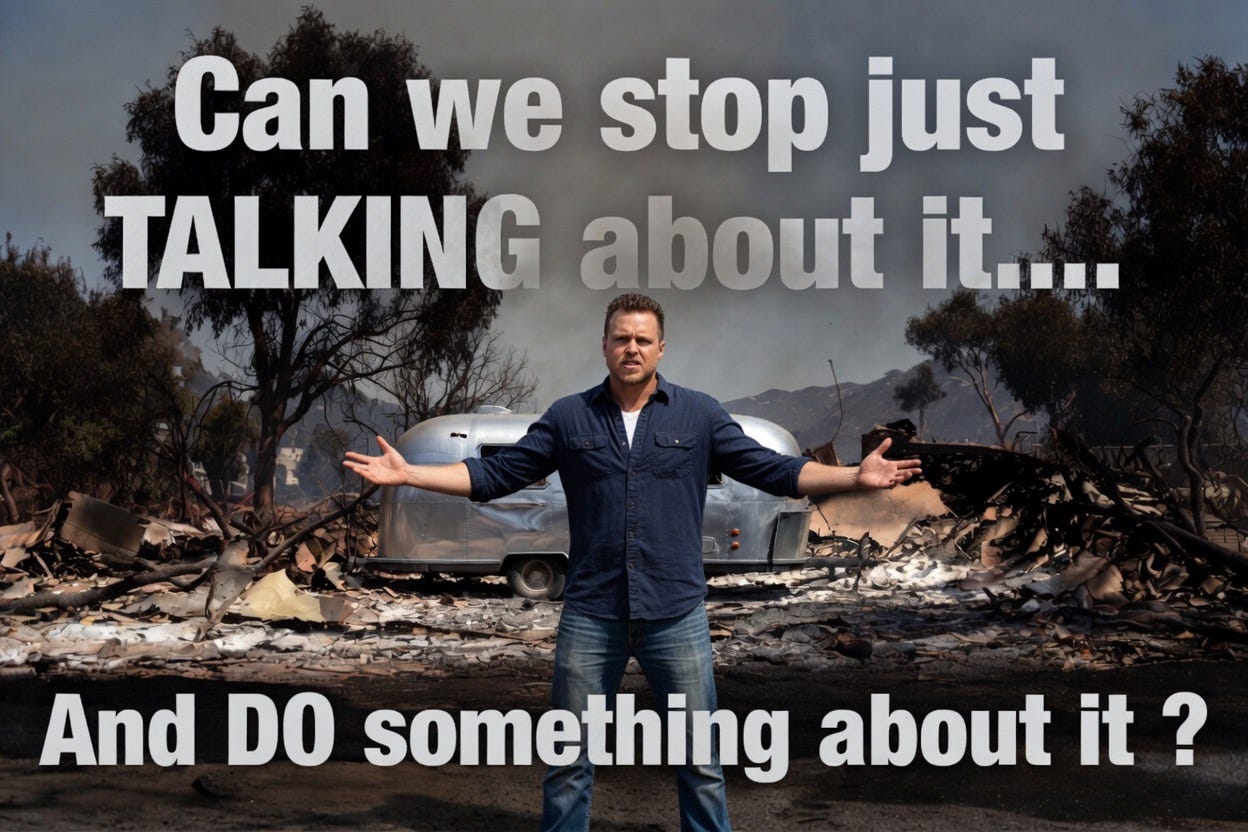
Pratt’s house burned down in the Palisades fire. He still lives in a trailer on the property. Every voter understands instantly what that means: this is no longer abstract politics for him. He isn’t issuing statements about urban failure from a donor luncheon downtown. He is literally living inside the wreckage.
And then he started swinging.
Crime.
Homelessness.
Fire response.
Emergency preparedness.
Bureaucratic incompetence.
Not with white papers and carefully calibrated language, but with blunt promises about enforcement, staffing, accountability, and visible order.
Whether one agrees with every proposal is almost secondary politically. Voters again see movement. Action. Consequence. Somebody who appears emotionally invested in solving the problem rather than narrating it.
Even his campaign style reflects the shift. Pratt bypasses traditional media almost entirely and floods social media with rapid-fire clips, memes, AI-generated videos, and confrontational messaging. Career politicians still behave as if carefully managed press conferences determine public opinion. Pratt behaves like somebody who understands modern political attention is now velocity-based.
Again: movement over maintenance.
And the establishment reaction tells the story. Instead of dismissing him entirely, they have started reacting emotionally to him. That is usually the first sign an insurgent candidacy is becoming dangerous.
The Squad Backs Into the Hedge
Meanwhile, Democrats are quietly confronting a version of the same problem internally.
The Squad-aligned progressives who dominated headlines a few years ago are suddenly getting abandoned by their own party apparatus. Not publicly. Not dramatically. No formal ideological reckoning. Democratic leadership simply stopped watering the plant.
Funding dries up.
Endorsements disappear.
Phone calls stop getting returned.
As Jeff Childers aptly observed, Democratic leadership now seems to be Homer-Simpsoning backward into the hedge.
Gone.
Again, the mechanism is legitimacy. Democrat leadership understands something the activist class does not: online ideological performance is not the same thing as governing competence. Slogans, outrage cycles, and social media moral theater eventually collide with actual voters living inside actual systems.
That is the throughline connecting all these stories.
Return of the Problem Zoo
Americans are losing patience with what might be called the Problem Zoo — the sprawling ecosystem of experts, consultants, institutional caretakers, procedural managers, and professional explainers who endlessly narrate crises while rarely resolving them.
The Problem Zoo studies problems.
Brands problems.
Convenes panels about problems.
Creates task forces around problems.
Funds research into problems.
But increasingly, voters want people who fix things.
Or at least visibly try to.
That is why Trump’s Cabinet matters too. Whatever one thinks of the individual choices, the broader pattern is unmistakable: movement, disruption, implementation, action. Personnel as philosophy.
The Cabinet reflects the same political instinct that elevated Paxton over Cornyn.
Movement over maintenance.
Action over talk.
Results over narrative.
And once voters internalize that framework, the old political model starts collapsing very quickly.
Because occupying the chair is no longer enough.
Bob:
Turns out voters noticed who hid under the desk during Covid.
CNN will say it was neck and neck all the way to the finish.
Texas has 254 counties.
Paxton carried 252 of them.
Game over.