


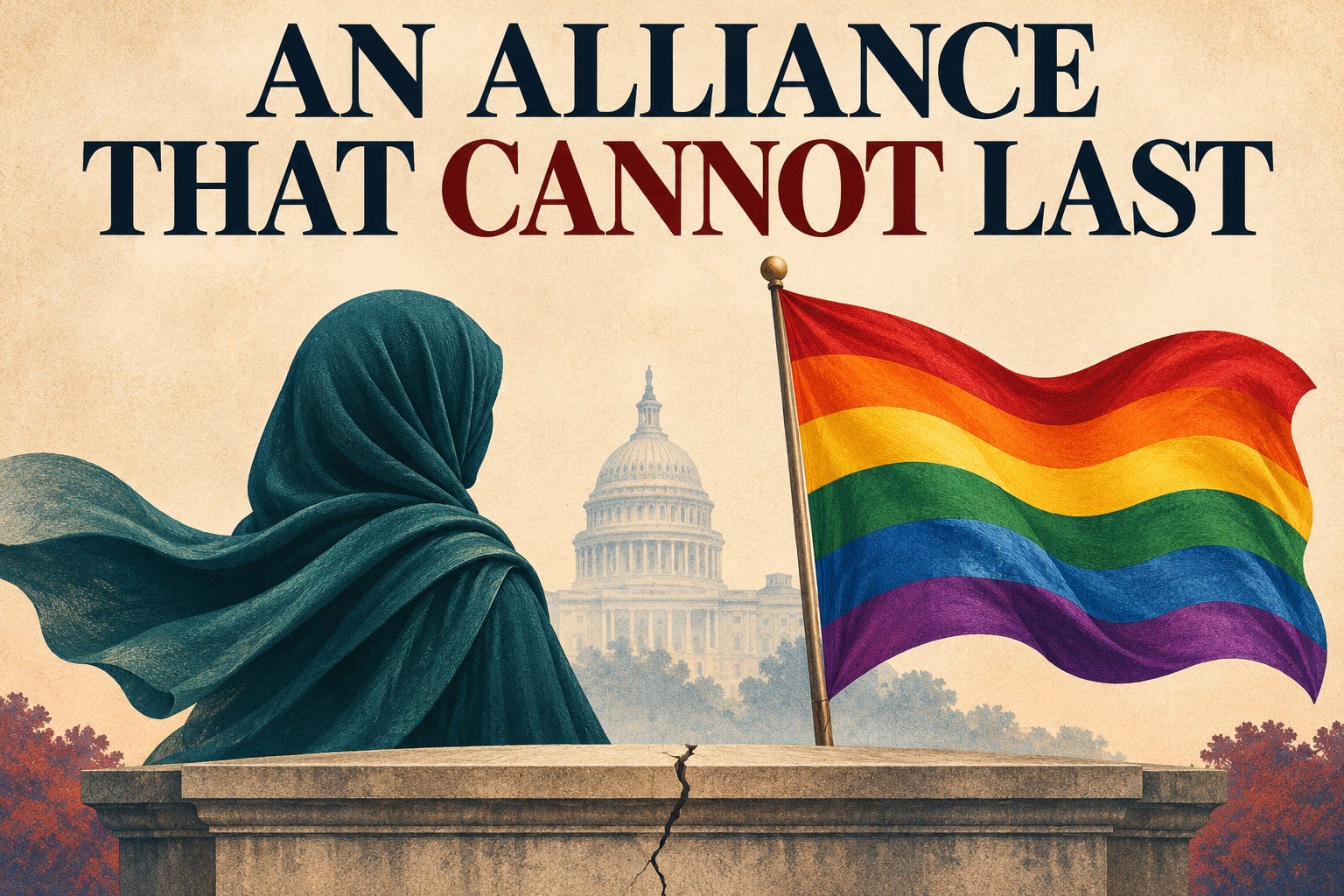
An Alliance That Cannot Last
The hijab, the rainbow flag, and the coming collision within the political Left.
By Jim Reynolds | www.reynolds.com
November 15, 2026
Consider two symbols increasingly familiar in progressive American politics: the rainbow flag and the Muslim hijab.
One celebrates sexual liberation and the rejection of traditional restrictions on gender and sexuality. The other represents a religious tradition that places considerable importance on modesty, prescribed sexual conduct, and distinct roles for men and women.
Both are celebrated under the progressive banner of diversity and inclusion.
There is just one problem.
The beliefs behind them are fundamentally incompatible when either side insists on making its moral principles the rules for everyone else.
And the Democratic Party has embraced both.
The Feminist Revolution
For half a century, feminism has worked to dismantle traditional male authority. In the family, workplace, schools, churches, and government, established distinctions between men and women have been challenged, weakened, or eliminated.
The contemporary progressive movement has carried that revolution still further. Gender itself has become negotiable. Traditional sexual morality is treated as repression. Religious opposition to progressive social doctrines is increasingly characterized as discrimination.
Now consider the growing influence of Muslim Americans within the same political coalition.
Conservative Islam approaches these questions from almost the opposite direction. It preserves traditional family structures, recognizes distinct obligations for men and women, condemns homosexual conduct, and regards religious authority as superior to changing social fashion.
Progressives spent decades fighting precisely those ideas.
Now they are forming political alliances with people who believe them.
The Hijab
Nothing captures this contradiction quite like the hijab.
In America, progressives frequently celebrate the hijab as a symbol of diversity, religious identity, and female empowerment. A Muslim woman choosing to cover her hair is exercising a liberty that every American should enjoy.
But the hijab also has a history and a religious meaning that cannot be separated from traditional expectations concerning women.
In Iran, women have been imprisoned and brutalized for refusing to wear it. The compulsory hijab is not a statement of female independence. It is the opposite: the enforcement of a religious obligation through state power.
Under the Taliban in Afghanistan, restrictions on women’s dress are part of a much larger system that has stripped women of educational, professional, and personal freedoms.
These are extreme examples of religious authority exercised through government. But they expose the underlying philosophical conflict.
Feminism demands that women determine their own lives. Conservative religious doctrine maintains that certain obligations are established by God rather than individual preference.
The progressive answer has been to celebrate the hijab when it represents minority identity while condemning the traditional authority from which the practice derives.
That contradiction becomes difficult to sustain when religious believers acquire political power and begin acting on their convictions.
The Rainbow Flag
Hamtramck, Michigan, provided an early warning.
As its Muslim population grew, the city elected an all-Muslim city council and a Muslim mayor in 2021. The achievement was celebrated as a victory for diversity and minority representation.
Then the new political leadership did something progressives had not anticipated.
In 2023, the city council unanimously adopted a policy barring Pride flags and other political, religious, ethnic, and identity-group flags from city-owned flagpoles.
LGBTQ activists were furious. The council defended its decision as government neutrality. The dispute eventually reached federal court, and in August 2026, the Sixth Circuit upheld the city’s policy.
The city had not prohibited private citizens from displaying Pride flags. The controversy concerned government property.
But the political significance went far beyond a municipal flagpole.
A religious minority had gained political authority and exercised it in a way that collided with progressive cultural expectations.
The diversity that progressives celebrated had produced a government whose values they opposed.
That was not an accident. It was the predictable result of assembling a political coalition whose members hold contradictory convictions about morality and social authority.
The Classroom Collision
The same conflict erupted in Montgomery County, Maryland.
Muslim parents joined Christian and other religious parents in challenging a public school policy that denied them the opportunity to excuse their elementary-school children from instruction using LGBTQ-inclusive storybooks.
The progressive school board insisted on its educational program. Religious parents insisted on their authority to determine what moral instruction their young children should receive.
In June 2025, the Supreme Court sided with the parents, granting preliminary relief on religious-freedom grounds.
Here was the Democratic coalition turning against itself.
Muslim families had joined conservative Christians in opposing a progressive policy concerning sexuality and education.
Two groups ordinarily found on opposite sides of American politics discovered that they shared more with each other on this question than either shared with the progressive establishment.
The supposed alliance of shared values was beginning to look like an alliance of political convenience.
The Numbers
Pew Research Center’s 2025 findings reveal just how wide the divide has become.
Among American Muslims, 55 percent said homosexuality should be discouraged by society. Among Democrats generally, only 13 percent held that position.
On transgender acceptance, 48 percent of Muslims viewed growing acceptance as a change for the worse. Among Democrats, the figure was just 17 percent.
On abortion, 57 percent of Muslims supported legality in all or most cases, compared with 86 percent of Democrats.
These are enormous ideological differences within a political coalition.
On several defining issues of contemporary progressivism, a substantial portion of the Muslim electorate stands far closer to religious conservatives than to the progressive activists who claim them as allies.
And Muslim political influence is growing.
What Happens When They Win?
Political alliances can conceal enormous contradictions when their members share a common enemy. Democrats and Muslim activists have found common ground on immigration, discrimination, foreign policy, and opposition to conservative Republicans.
That is enough to win elections.
It is not necessarily enough to govern.
Winning changes everything. Suddenly the coalition must decide what children will be taught, which values public institutions will endorse, how religious objections will be accommodated, and whether progressive social doctrines take precedence over traditional religious convictions.
Someone must make those decisions.
And someone will lose.
The feminist who regards traditional gender roles as oppression will not suddenly embrace them because the person defending them belongs to a religious minority.
The conservative Muslim parent who considers homosexuality sinful will not necessarily abandon that belief because progressive activists insist that acceptance is a condition of inclusion.
These are not disagreements that can be settled by distributing another diversity statement.
They concern convictions about morality, religion, family, sexuality, and authority that people have defended for centuries.
The Democratic Party has brought these constituencies together by emphasizing what they share politically while ignoring what divides them philosophically.
That strategy works until the coalition must exercise power.
The Reckoning
The progressive Left has spent decades attacking traditional authority while simultaneously building a political coalition that includes religious traditionalists.
It celebrates women’s liberation while embracing constituencies whose conservative members reject important elements of modern feminism. It elevates LGBTQ rights while courting voters who consider homosexual conduct immoral. It condemns patriarchal religious institutions while celebrating the political advance of communities in which those traditions remain influential.
The contradiction has been obscured by a shared opposition to Republicans.
But the more successful the coalition becomes, the more difficult it will be to avoid confronting its internal disagreements.
The Left can preserve the alliance by accepting genuine ideological diversity, including beliefs that directly contradict progressive orthodoxy. Or it can demand conformity and risk driving away the religious constituencies it worked so hard to attract.
Neither choice is easy.
The hijab and the rainbow flag can coexist in a country that protects individual liberty. The American constitutional system was built to accommodate precisely such differences.
But a political movement that demands ideological agreement on questions of gender, sexuality, and religious authority faces a much more difficult assignment.
The alliance was built on what its members could agree to oppose. It may collapse over what they cannot agree to support.
And the more political power they acquire together, the sooner that reckoning will arrive.
