


Analysis of Rubio’s Munich Address
By Jim Reynolds | www.reynolds.com
This speech is significant because it marks a formal ideological reset of U.S. foreign policy framing — delivered not at a rally, but at Munich, the symbolic cathedral of post-war transatlantic liberalism.
Rubio did three big things.
He redefined what the alliance is for.
For decades, Munich speeches centered on:
rules-based order
multilateralism
institutional cooperation
technocratic security architecture
Rubio reframed the core question:
“What exactly are we defending?”
His answer was not “the rules-based order.”
It was “Western civilization.”
That is a profound shift.
He grounded the alliance not in procedure but in identity:
shared heritage
Christianity
culture
civilizational continuity
That is not accidental rhetoric. It replaces universalist liberalism with civilizational nationalism as the alliance’s organizing principle.
That’s new in this venue.
He declared the “end of the end of history.”
Rubio explicitly attacked:
“end of history” optimism
global citizenship ideology
borderless economics
climate absolutism
mass migration as moral imperative
trade as ideology
He labeled them delusions.
That’s not tweaking policy.
That’s repudiating the philosophical foundation of post-Cold War globalization.
Munich has long been a shrine to that worldview.
Delivering that critique there is symbolic confrontation — but framed as reform, not rupture.
He repeatedly reassured Europe:
“We want to do this together.”
That’s key.
This was not isolationism.
It was:
Reform the alliance or risk managed decline.
He shifted enforcement language back to power.
On the UN, Ukraine, Gaza, Iran, Venezuela — Rubio’s pattern was consistent:
Institutions failed.
American power acted.
That is explicit rejection of proceduralism as a substitute for action.
He did not say dismantle institutions.
He said reform them — and subordinate them to national interest.
That’s a hierarchy shift.
National interest > global order.
Again: significant.
Now, why this matters strategically.
Munich audiences are typically skeptical of Trump-world rhetoric.
The Q&A reaction that followed — “sigh of relief” — tells us something important.
Europe expected rupture.
Rubio offered firmness + partnership.
He essentially said:
We are not abandoning you.
But we are done pretending decline is progress.
That balance is politically sophisticated.
He attacked:
deindustrialization
supply chain dependency
energy self-restriction
migration policy
institutional overreach
But he wrapped it in:
shared history,
shared sacrifice,
shared destiny.
That’s how you sell a paradigm shift without detonating the alliance.
The speech also signals something internal:
Rubio is not freelancing.
This is coordinated Trump doctrine.
You can distill the doctrine into five pillars:
Civilizational identity over universal abstraction
National sovereignty over institutional deference
Reciprocity over guilt
Industrial capacity over financialization
Power-backed diplomacy over resolution-backed diplomacy
That’s a coherent framework.
Here is where the speech is most strategically sharp:
He did not retreat from China engagement.
He did not promise unconditional Ukraine outcomes.
He did not dismantle NATO.
He did not embrace isolationism.
Instead he framed everything through interest management.
That’s realism with civilizational language layered on top.
Why this is significant long-term:
If sustained, this reframes the transatlantic alliance from:
“guardian of global liberal order”
to
“defender of Western sovereignty and industrial revival.”
That’s a different mission.
And missions matter.
Now, here is the deeper tension.
European elites are more comfortable with:
supranational institutions
migration normalization
climate-first policy
post-national rhetoric
Rubio just challenged that architecture — politely, but directly.
The applause suggests Europe hears reassurance.
The subtext suggests conditionality.
That duality is the significance.
This was not a break.
It was a renegotiation.
And it was delivered from the center of the old order.
That’s why it matters.
This was not routine.
It was an ideological line drawn — calmly, confidently, and on European soil.
Deeper Analysis
I. What European leaders likely heard beneath the reassurance
On the surface, they heard:
America is not leaving.
The alliance stands.
We want to do this together.
That produced the audible relief.
But beneath that, they heard four harder messages.
1. Pay and arm yourselves seriously.
When Rubio says “we want allies who can defend themselves,” that is not poetic. It is a budgetary demand wrapped in civilizational language. Europe heard conditional partnership, not automatic subsidy.
2. Migration and sovereignty are now security issues.
He explicitly tied borders to civilizational survival. That is politically radioactive in parts of Europe. Leaders heard: Washington will no longer treat migration as a humanitarian-only issue. It is strategic.
3. Climate cannot override energy security.
He labeled prior energy policy self-imposed impoverishment. European leaders heard: do not expect U.S. alignment on aggressive decarbonization if it undermines industrial strength.
4. Institutions are subordinate to power.
When he said the UN failed and American force resolved matters, that was a polite demotion of procedural multilateralism. Europe heard: legitimacy now flows from capability.
In short, they heard reassurance — but also recalibration.
II. Is this doctrine sustainable in practice?
That depends on three stress tests.
1. Can Europe actually reindustrialize and rearm?
That requires political will that may not exist uniformly. Some states can. Some cannot. Demographics and debt complicate it.
2. Can civilizational rhetoric coexist with diverse electorates?
Western identity language resonates differently in Warsaw than in Brussels. Sustainability depends on whether it can unify rather than fracture.
3. Can power-first diplomacy avoid overextension?
If every institutional failure is replaced with American force projection, sustainability weakens. If enforcement is selective and strategic, sustainability improves.
The doctrine is sustainable if it becomes disciplined realism.
It becomes unstable if it becomes constant confrontation.
III. Is this rhetoric masking continuity?
There is continuity.
The U.S. is still:
funding Ukraine indirectly
sanctioning Russia
engaging China
operating through NATO
working with institutions rather than abandoning them
What changed is hierarchy.
Old model:
Institutions first, power reluctantly.
New model:
Power first, institutions if useful.
That’s not revolution.
It’s reordering.
Continuity exists in structure.
Shift exists in tone and priority.
The real question isn’t whether this is real.
It’s whether Europe adjusts.
If Europe meets spending targets, tightens borders, secures energy, and aligns on China risk — the doctrine will look collaborative.
If Europe resists and doubles down on the prior paradigm — friction will grow.
So the significance of the speech isn’t just what it said.
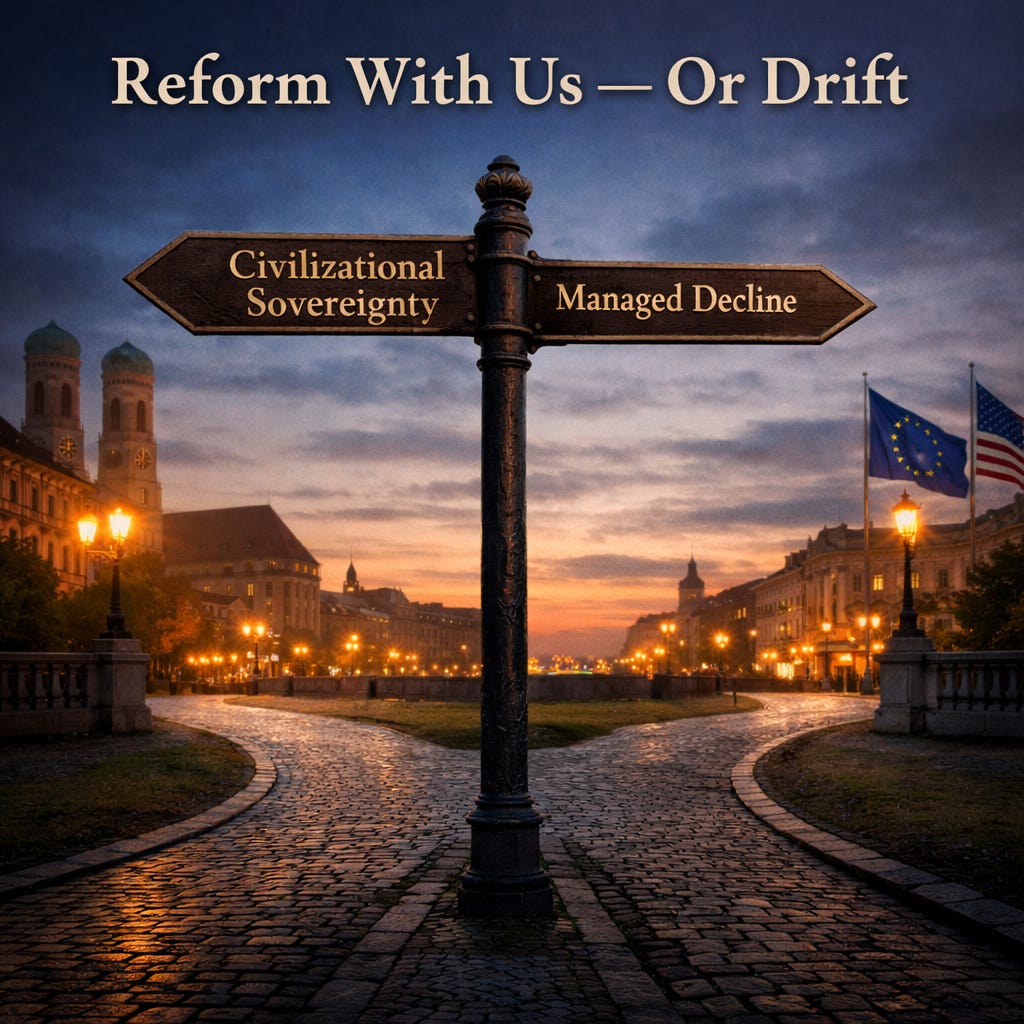
It’s that it placed Europe at a crossroads:
Reform with us.
Or drift politely apart.
And Rubio delivered that without hostility.
That’s why the sigh of relief matters.
They heard the conditions.
They also heard the door was still open.
If this doctrine holds, the alliance becomes stronger but narrower. If it fails, the transatlantic relationship drifts into polite irrelevance.
==== Secretary of State Marco Rubio’s Speech ====
HomeOffice of the SpokespersonPress ReleasesSecretary of State Marco Rubio at the Munich Security Conference
Secretary of State Marco Rubio at the Munich Security Conference
REMARKS
MARCO RUBIO, SECRETARY OF STATE
HOTEL BAYERISCHER HOF
MUNICH, GERMANY
FEBRUARY 14, 2026
SECRETARY RUBIO: Thank you very much. We gather here today as members of a historic alliance, an alliance that saved and changed the world. When this conference began in 1963, it was in a nation – actually, it was on a continent – that was divided against itself. The line between communism and freedom ran through the heart of Germany. The first barbed fences of the Berlin Wall had gone up just two years prior.
And just months before that first conference, before our predecessors first met here, here in Munich, the Cuban Missile Crisis had brought the world to the brink of nuclear destruction. Even as World War II still burned fresh in the memory of Americans and Europeans alike, we found ourselves staring down the barrel of a new global catastrophe – one with the potential for a new kind of destruction, more apocalyptic and final than anything before in the history of mankind.
At the time of that first gathering, Soviet communism was on the march. Thousands of years of Western civilization hung in the balance. At that time, victory was far from certain. But we were driven by a common purpose. We were unified not just by what we were fighting against; we were unified by what we were fighting for. And together, Europe and America prevailed and a continent was rebuilt. Our people prospered. In time, the East and West blocs were reunited. A civilization was once again made whole.
That infamous wall that had cleaved this nation into two came down, and with it an evil empire, and the East and West became one again. But the euphoria of this triumph led us to a dangerous delusion: that we had entered, quote, “the end of history;” that every nation would now be a liberal democracy; that the ties formed by trade and by commerce alone would now replace nationhood; that the rules-based global order – an overused term – would now replace the national interest; and that we would now live in a world without borders where everyone became a citizen of the world.
This was a foolish idea that ignored both human nature and it ignored the lessons of over 5,000 years of recorded human history. And it has cost us dearly. In this delusion, we embraced a dogmatic vision of free and unfettered trade, even as some nations protected their economies and subsidized their companies to systematically undercut ours – shuttering our plants, resulting in large parts of our societies being deindustrialized, shipping millions of working and middle-class jobs overseas, and handing control of our critical supply chains to both adversaries and rivals.
We increasingly outsourced our sovereignty to international institutions while many nations invested in massive welfare states at the cost of maintaining the ability to defend themselves. This, even as other countries have invested in the most rapid military buildup in all of human history and have not hesitated to use hard power to pursue their own interests. To appease a climate cult, we have imposed energy policies on ourselves that are impoverishing our people, even as our competitors exploit oil and coal and natural gas and anything else – not just to power their economies, but to use as leverage against our own.
And in a pursuit of a world without borders, we opened our doors to an unprecedented wave of mass migration that threatens the cohesion of our societies, the continuity of our culture, and the future of our people. We made these mistakes together, and now, together, we owe it to our people to face those facts and to move forward, to rebuild.
Under President Trump, the United States of America will once again take on the task of renewal and restoration, driven by a vision of a future as proud, as sovereign, and as vital as our civilization’s past. And while we are prepared, if necessary, to do this alone, it is our preference and it is our hope to do this together with you, our friends here in Europe.
For the United States and Europe, we belong together. America was founded 250 years ago, but the roots began here on this continent long before. The man who settled and built the nation of my birth arrived on our shores carrying the memories and the traditions and the Christian faith of their ancestors as a sacred inheritance, an unbreakable link between the old world and the new.
We are part of one civilization – Western civilization. We are bound to one another by the deepest bonds that nations could share, forged by centuries of shared history, Christian faith, culture, heritage, language, ancestry, and the sacrifices our forefathers made together for the common civilization to which we have fallen heir.
And so this is why we Americans may sometimes come off as a little direct and urgent in our counsel. This is why President Trump demands seriousness and reciprocity from our friends here in Europe. The reason why, my friends, is because we care deeply. We care deeply about your future and ours. And if at times we disagree, our disagreements come from our profound sense of concern about a Europe with which we are connected – not just economically, not just militarily. We are connected spiritually and we are connected culturally. We want Europe to be strong. We believe that Europe must survive, because the two great wars of the last century serve for us as history’s constant reminder that ultimately, our destiny is and will always be intertwined with yours, because we know – (applause) – because we know that the fate of Europe will never be irrelevant to our own.
National security, which this conference is largely about, is not merely series of technical questions – how much we spend on defense or where, how we deploy it, these are important questions. They are. But they are not the fundamental one. The fundamental question we must answer at the outset is what exactly are we defending, because armies do not fight for abstractions. Armies fight for a people; armies fight for a nation. Armies fight for a way of life. And that is what we are defending: a great civilization that has every reason to be proud of its history, confident of its future, and aims to always be the master of its own economic and political destiny.
It was here in Europe where the ideas that planted the seeds of liberty that changed the world were born. It was here in Europe where the world – which gave the world the rule of law, the universities, and the scientific revolution. It was this continent that produced the genius of Mozart and Beethoven, of Dante and Shakespeare, of Michelangelo and Da Vinci, of the Beatles and the Rolling Stones. And this is the place where the vaulted ceilings of the Sistine Chapel and the towering spires of the great cathedral in Cologne, they testify not just to the greatness of our past or to a faith in God that inspired these marvels. They foreshadow the wonders that await us in our future. But only if we are unapologetic in our heritage and proud of this common inheritance can we together begin the work of envisioning and shaping our economic and our political future.
Deindustrialization was not inevitable. It was a conscious policy choice, a decades-long economic undertaking that stripped our nations of their wealth, of their productive capacity, and of their independence. And the loss of our supply chain sovereignty was not a function of a prosperous and healthy system of global trade. It was foolish. It was a foolish but voluntary transformation of our economy that left us dependent on others for our needs and dangerously vulnerable to crisis.
Mass migration is not, was not, isn’t some fringe concern of little consequence. It was and continues to be a crisis which is transforming and destabilizing societies all across the West. Together we can reindustrialize our economies and rebuild our capacity to defend our people. But the work of this new alliance should not be focused just on military cooperation and reclaiming the industries of the past. It should also be focused on, together, advancing our mutual interests and new frontiers, unshackling our ingenuity, our creativity, and the dynamic spirit to build a new Western century. Commercial space travel and cutting-edge artificial intelligence; industrial automation and flex manufacturing; creating a Western supply chain for critical minerals not vulnerable to extortion from other powers; and a unified effort to compete for market share in the economies of the Global South. Together we can not only take back control of our own industries and supply chains – we can prosper in the areas that will define the 21st century.
But we must also gain control of our national borders. Controlling who and how many people enter our countries, this is not an expression of xenophobia. It is not hate. It is a fundamental act of national sovereignty. And the failure to do so is not just an abdication of one of our most basic duties owed to our people. It is an urgent threat to the fabric of our societies and the survival of our civilization itself.
And finally, we can no longer place the so-called global order above the vital interests of our people and our nations. We do not need to abandon the system of international cooperation we authored, and we don’t need to dismantle the global institutions of the old order that together we built. But these must be reformed. These must be rebuilt.
For example, the United Nations still has tremendous potential to be a tool for good in the world. But we cannot ignore that today, on the most pressing matters before us, it has no answers and has played virtually no role. It could not solve the war in Gaza. Instead, it was American leadership that freed captives from barbarians and brought about a fragile truce. It had not solved the war in Ukraine. It took American leadership and partnership with many of the countries here today just to bring the two sides to the table in search of a still-elusive peace.
It was powerless to constrain the nuclear program of radical Shia clerics in Tehran. That required 14 bombs dropped with precision from American B-2 bombers. And it was unable to address the threat to our security from a narcoterrorist dictator in Venezuela. Instead, it took American Special Forces to bring this fugitive to justice.
In a perfect world, all of these problems and more would be solved by diplomats and strongly worded resolutions. But we do not live in a perfect world, and we cannot continue to allow those who blatantly and openly threaten our citizens and endanger our global stability to shield themselves behind abstractions of international law which they themselves routinely violate.
This is the path that President Trump and the United States has embarked upon. It is the path we ask you here in Europe to join us on. It is a path we have walked together before and hope to walk together again. For five centuries, before the end of the Second World War, the West had been expanding – its missionaries, its pilgrims, its soldiers, its explorers pouring out from its shores to cross oceans, settle new continents, build vast empires extending out across the globe.
But in 1945, for the first time since the age of Columbus, it was contracting. Europe was in ruins. Half of it lived behind an Iron Curtain and the rest looked like it would soon follow. The great Western empires had entered into terminal decline, accelerated by godless communist revolutions and by anti-colonial uprisings that would transform the world and drape the red hammer and sickle across vast swaths of the map in the years to come.
Against that backdrop, then, as now, many came to believe that the West’s age of dominance had come to an end and that our future was destined to be a faint and feeble echo of our past. But together, our predecessors recognized that decline was a choice, and it was a choice they refused to make. This is what we did together once before, and this is what President Trump and the United States want to do again now, together with you.
And this is why we do not want our allies to be weak, because that makes us weaker. We want allies who can defend themselves so that no adversary will ever be tempted to test our collective strength. This is why we do not want our allies to be shackled by guilt and shame. We want allies who are proud of their culture and of their heritage, who understand that we are heirs to the same great and noble civilization, and who, together with us, are willing and able to defend it.
And this is why we do not want allies to rationalize the broken status quo rather than reckon with what is necessary to fix it, for we in America have no interest in being polite and orderly caretakers of the West’s managed decline. We do not seek to separate, but to revitalize an old friendship and renew the greatest civilization in human history. What we want is a reinvigorated alliance that recognizes that what has ailed our societies is not just a set of bad policies but a malaise of hopelessness and complacency. An alliance – the alliance that we want is one that is not paralyzed into inaction by fear – fear of climate change, fear of war, fear of technology. Instead, we want an alliance that boldly races into the future. And the only fear we have is the fear of the shame of not leaving our nations prouder, stronger, and wealthier for our children.
An alliance ready to defend our people, to safeguard our interests, and to preserve the freedom of action that allows us to shape our own destiny – not one that exists to operate a global welfare state and atone for the purported sins of past generations. An alliance that does not allow its power to be outsourced, constrained, or subordinated to systems beyond its control; one that does not depend on others for the critical necessities of its national life; and one that does not maintain the polite pretense that our way of life is just one among many and that asks for permission before it acts. And above all, an alliance based on the recognition that we, the West, have inherited together – what we have inherited together is something that is unique and distinctive and irreplaceable, because this, after all, is the very foundation of the transatlantic bond.
Acting together in this way, we will not just help recover a sane foreign policy. It will restore to us a clearer sense of ourselves. It will restore a place in the world, and in so doing, it will rebuke and deter the forces of civilizational erasure that today menace both America and Europe alike.
So in a time of headlines heralding the end of the transatlantic era, let it be known and clear to all that this is neither our goal nor our wish – because for us Americans, our home may be in the Western Hemisphere, but we will always be a child of Europe. (Applause.)
Our story began with an Italian explorer whose adventure into the great unknown to discover a new world brought Christianity to the Americas – and became the legend that defined the imagination of a our pioneer nation.
Our first colonies were built by English settlers, to whom we owe not just the language we speak but the whole of our political and legal system. Our frontiers were shaped by Scots-Irish – that proud, hearty clan from the hills of Ulster that gave us Davy Crockett and Mark Twain and Teddy Roosevelt and Neil Armstrong.
Our great midwestern heartland was built by German farmers and craftsmen who transformed empty plains into a global agricultural powerhouse – and by the way, dramatically upgraded the quality of American beer. (Laughter.)
Our expansion into the interior followed the footsteps of French fur traders and explorers whose names, by the way, still adorn the street signs and towns’ names all across the Mississippi Valley. Our horses, our ranches, our rodeos – the entire romance of the cowboy archetype that became synonymous with the American West – these were born in Spain. And our largest and most iconic city was named New Amsterdam before it was named New York.
And do you know that in the year that my country was founded, Lorenzo and Catalina Geroldi lived in Casale Monferrato in the Kingdom of Piedmont-Sardinia. And Jose and Manuela Reina lived in Sevilla, Spain. I don’t know what, if anything, they knew about the 13 colonies which had gained their independence from the British empire, but here’s what I am certain of: They could have never imagined that 250 years later, one of their direct descendants would be back here today on this continent as the chief diplomat of that infant nation. And yet here I am, reminded by my own story that both our histories and our fates will always be linked.
Together we rebuilt a shattered continent in the wake of two devastating world wars. When we found ourselves divided once again by the Iron Curtain, the free West linked arms with the courageous dissidents struggling against tyranny in the East to defeat Soviet communism. We have fought against each other, then reconciled, then fought, then reconciled again. And we have bled and died side by side on battlefields from Kapyong to Kandahar.
And I am here today to leave it clear that America is charting the path for a new century of prosperity, and that once again we want to do it together with you, our cherished allies and our oldest friends. (Applause.)
We want to do it together with you, with a Europe that is proud of its heritage and of its history; with a Europe that has the spirit of creation of liberty that sent ships out into uncharted seas and birthed our civilization; with a Europe that has the means to defend itself and the will to survive. We should be proud of what we achieved together in the last century, but now we must confront and embrace the opportunities of a new one – because yesterday is over, the future is inevitable, and our destiny together awaits. Thank you. (Applause.)
—————-
Thank you for distilling Sec. Rubio's speech in Munich. I saw part of it and liked what I heard but I was at work and couldn't stay with it.
May our Lord continue working in the U.S.