


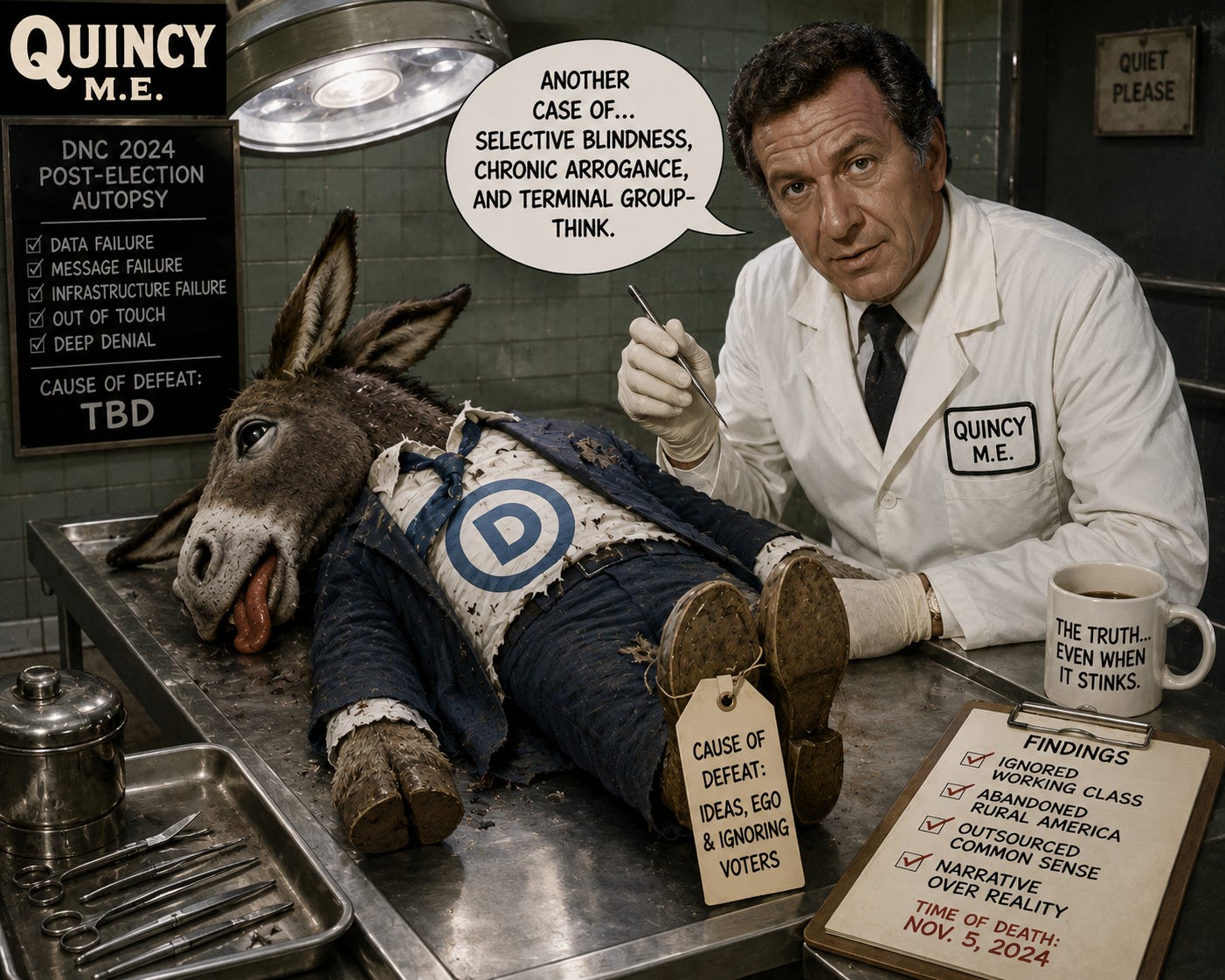
Bob Reads the Democrat Autopsy Report
Quincy finds advanced narrative decay
By Jim Reynolds | www.reynolds.com
May 22, 2026
The Democrats finally released their 2024 post-election autopsy report, and Bob read it so you don’t have to.
His first reaction:
“Interesting. The party that spent eight years calling half the country racist now wants to ‘reconnect with rural working-class voters.’ That’s a bold customer retention strategy.”
The report is titled Build to Win. Build to Last. And in fairness, parts of it are surprisingly honest. Not morally honest. Structurally honest. Like a casino finally admitting the slot machines are broken while carefully avoiding discussion of who emptied the vault.
Because the most revealing thing about the report isn’t what it says.
It’s what it absolutely refuses to say.
The document runs nearly 200 pages and reads like a boardroom presentation prepared after the Titanic hit the iceberg.
Slide 1:
“We may need a better communications strategy.”
Bob:
“You hit an iceberg.”
The central thesis is simple: Democrats have become geographically and culturally isolated. They concentrated too heavily on elite urban strongholds, abandoned vast sections of the country, lost touch with working-class voters, and now need a ten-year rebuilding plan to reconnect with normal Americans.
That part is true.
The report openly admits the party stopped organizing locally, stopped investing in state infrastructure, stopped building durable relationships, and became dependent on nationalized messaging bubbles. It warns that millions of rural voters no longer feel represented by Democrats even when suffering from economic decline, collapsing healthcare access, and disappearing industry.
In other words:
the people Democrats claimed to champion started voting Republican.
That’s not a messaging hiccup.
That’s an extinction-level warning.
And the report knows it.
One of the most important admissions comes early. The authors acknowledge that Democrats became too dependent on intellectualized, reason-heavy messaging in an era driven by economic anxiety, populist anger, and emotional distrust of institutions.
Translation:
Normal people stopped talking like NPR panels.
The report repeatedly hints at something Democrats still cannot fully admit aloud: modern politics is no longer a graduate seminar. Voters don’t want PowerPoints about “stakeholder equity frameworks.” They want gas prices lower than their blood pressure.
Bob again:
“Turns out people prefer groceries to pronouns.”
The autopsy also admits Democrats got badly outmaneuvered in the modern media environment. Conservatives built decentralized ecosystems: podcasts, YouTube channels, meme culture, alternative news networks, influencers, independent creators, and digital guerrilla warfare.
Meanwhile Democrats remained trapped inside a top-down legacy media model built for 1998.
This is one of the report’s clearest moments of accidental truth:
they no longer control the flow of information.
That realization terrifies them.
For decades, Democrats benefited from institutional synchronization:
legacy media,
academia,
Hollywood,
corporate HR,
late-night television,
bureaucracies,
and eventually social media moderation systems.
The old machine worked because narrative enforcement was centralized.
But decentralized communication shattered that monopoly.
Now a guy with a podcast microphone in his garage can outperform a network anchor with a $40 million studio budget.
That changes everything.
The report knows it.
It practically screams it between the lines.
And then we arrive at the funniest section of all:
the warning against excessive identity fragmentation.
You could almost hear the muffled fighting in the editing room.
Because after years of slicing Americans into microscopic grievance categories — race, gender, sexuality, privilege tiers, intersectional ranking systems, linguistic compliance tribes — the report suddenly discovers that voters may prefer being treated like citizens instead of demographic Lego pieces.
Bob:
“You mean people didn’t enjoy being sorted into oppression spreadsheets?”
The report cautiously suggests Democrats should return to broader economic unity messaging instead of hyper-segmented identity politics.
Which is remarkable.
That’s like a vegan quietly recommending hamburgers after losing Wisconsin by 300,000 votes.
But here’s where the entire document becomes unintentionally hilarious.
For all its structural analysis, all its charts, all its strategy language, all its consultant jargon about “resiliency” and “organizing architecture,” the report completely avoids the three radioactive subjects sitting in the middle of the room:
Joe Biden’s condition.
Kamala Harris’s installation.
And Gaza.
Not a word of substance.
Imagine writing a 200-page autopsy of the Hindenburg while refusing to discuss fire.
The report discusses messaging failures, but not the fact that millions of Americans watched a sitting president visibly deteriorate in real time while the media insisted everything was fine.
It discusses voter distrust, but not the catastrophic credibility collapse caused by years of coordinated denial.
It discusses infrastructure, but not the unprecedented mid-cycle candidate swap that bypassed a competitive primary process.
And it discusses coalition fractures while completely sidestepping one of the most explosive internal Democratic rebellions in decades: the Gaza divide.
That omission matters.
Because the report accidentally reveals the real crisis facing Democrats:
they can diagnose operational failure,
but they still cannot diagnose ideological failure.
They understand they lost voters.
They still don’t fully understand why those voters left.
The deeper issue isn’t technology.
It isn’t organizing.
It isn’t media spending ratios.
It’s trust.
Millions of Americans increasingly believe the Democratic Party speaks in managed narratives rather than observable reality.
That’s the real autopsy.
Not field offices.
Not vendor accountability.
Not digital ecosystems.
Reality itself became negotiable.
And once voters conclude that a political movement will distort obvious truths in service of the narrative, every future statement becomes suspect.
That’s the danger zone.
Bob put it more simply:
“If you tell people not to believe their own eyes long enough, eventually they stop believing you instead.”
The report ends with a call for a permanent 50-state infrastructure rebuild and a return to year-round local organizing. Strategically, that’s probably smart. Ron Brown’s 1989 recovery model worked because Democrats once knew how to sound culturally normal while speaking to economic frustration.
But rebuilding infrastructure is easier than rebuilding credibility.
Especially after years of telling working-class Americans:
inflation wasn’t real,
crime wasn’t real,
the border wasn’t open,
Biden was sharp as a tack,
and men can become women by declaration.
At some point the consultant class always reaches the same conclusion:
“The messaging failed.”
No.
Sometimes the public simply rejected the product.
And that possibility still appears almost psychologically unavailable inside large parts of the Democratic ecosystem.
Which is why this report feels less like a completed autopsy…
and more like the opening scene of the next one.
Bob folded up the report, looked at the cover, and shrugged.
Build to Win.
Build to Last.
“Feels more like:
Build to Rationalize.”
Bob appreciates your comment.
Great review, Bob (and Jim). Fully agree. Reality is something everyone understands it but sometimes it becomes obscured by outside descriptions. Thanks for setting the record straight.
Bill Schoettleer