



Bob Talks About His Legacy
Because, apparently, that’s what poets do.
By Jim Reynolds | www.reynolds.com
I came across a Substack collaboration making the rounds among poets and reflective types — thirty soft-lit questions about legacy, mortality, interior weather, and what small trace of you might linger after you’re gone.
It was thoughtful. Earnest. Sincere.
Artists answering questions about death and love and the silence left behind when the studio goes dark. A lot of language about echoes, tenderness, emotional residue. The kind of questions that invite you to lower your shoulders and speak from the diaphragm.
Which is fine.
But as I was reading it, I had the distinct feeling that someone else needed to be in the room.
Not to mock it. Not to disrupt it. Just to tilt it a few degrees.
So we ran the same spirit of questions past Bob.
No incense. No filtered light. No trembling metaphors.
Just Bob.
Here’s what happened when the legacy questions met a man who thinks in operating systems instead of elegies.
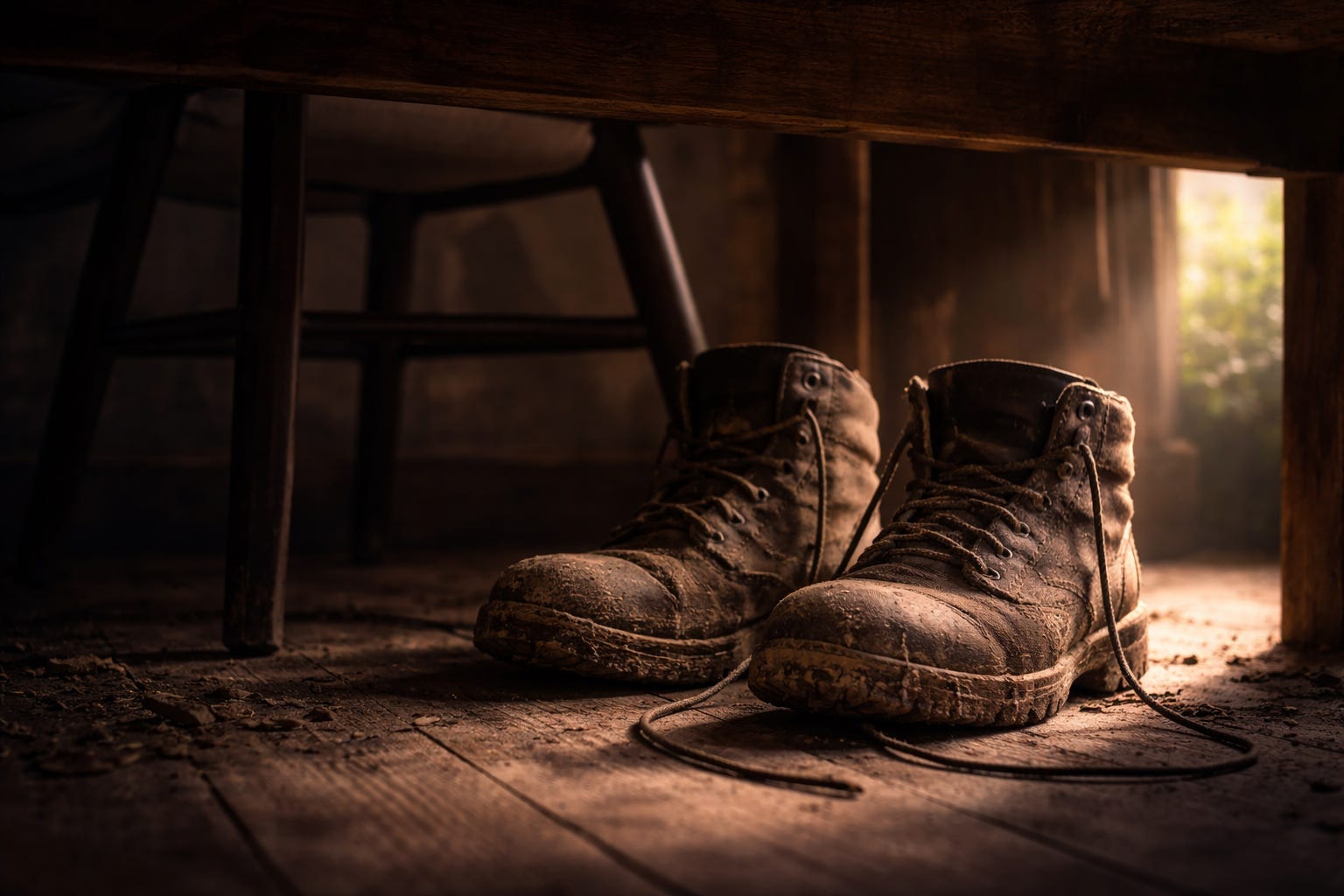
Bob walks into the incense-filled room with muddy boots.
⸻
When you’re gone, what small, ordinary trace of you do you hope still lingers?
Bob: I hope someone hears a polished speech and thinks, “What’s the angle?” That’s enough immortality for me.
What has your art helped you survive that you might not have survived otherwise?
Bob: Self-deception. The world runs on it. So do we. Writing is how I audit my own nonsense before it compounds.
Is there a piece of work that knows you better than most people do?
Bob: The ones where I admitted I was wrong. Accuracy is intimate.
As time passes, what are you learning to be kinder about?
Bob: How long it takes to update your beliefs. Most people aren’t evil. They’re lagging.
When you imagine being remembered with love, what does that love look like?
Bob: It looks like someone using a framework I shared and never mentioning my name.
What are you still hiding behind your craft?
Bob: The fact that clarity feels safer than confession.
⸻
If none of your work was remembered, would you still believe your life was well lived?
Bob: Of course. The goal isn’t remembrance. The goal is calibration. Did I reduce my own error rate? That’s a good run.
When you imagine your work outliving you, what do you hope it keeps doing?
Bob: Interrupting certainty. Certainty is the gateway drug.
Has mortality changed how urgently you make art?
Bob: It changed what I don’t bother making. If time is short, tribal applause is expensive.
If legacy weren’t about being remembered, what might it be about instead?
Bob: Pattern transfer. If someone learns to ask, “What movie are we watching?” that’s legacy.
What do you hope people feel in their bodies when they remember you?
Bob: A slight tightening before they forward something dumb.
⸻
When you think about your own mortality, what feels unfinished?
Bob: The part where I finally become fully immune to my own bias. I suspect that one stays unfinished.
Has awareness of mortality altered your risks?
Bob: It made me less interested in being liked and more interested in being precise.
Do you think legacy is shaped more by what you leave behind or what you give away while you’re still here?
Bob: You don’t leave things behind. You seed them. If they sprout, they sprout. If they don’t, compost.
⸻
If your body could no longer make art tomorrow, what would still feel true about who you are?
Bob: I’d still be running simulations in my head. Art is just the export function.
What does art carry that humans can’t say directly?
Bob: It carries contradiction without forcing a vote.
What part of you disappears when you’re gone?
Bob: The illusion that I was central to the story.
What part keeps moving?
Bob: The frameworks. Ideas don’t care who carried them.
Who are you still becoming?
Bob: Less reactive. More compressible. Harder to fool — especially by myself.
Whose approval is shaping your art, even now?
Bob: Future me. If he reads this and winces, I owe him better.
If time were suddenly cut in half, what would you stop making immediately?
Bob: Anything designed to signal virtue to strangers.
⸻
And if someone asked Bob, gently, about legacy — about art surviving the studio lights and the body that made it — he’d probably shrug and say:
Legacy isn’t what survives you.
It’s what survives scrutiny.
The poets talk about echoes.
Bob talks about error correction.
They write about interior weather.
Bob checks the barometer and asks who’s selling umbrellas.
They want to be remembered with love.
Bob wants you to notice the frame before you step inside it.
And somehow — that’s love too.
—-
So, you didn’t know that Bob was a poet? Here is a grook that Bob wrote just for this occasion.
Bob’s Grook
When I am gone, don’t look for me
in marble, mist, or myth.
Look in the pause before you click —
I may have left you with that.
Legacy is not a footprint.
It’s a filter in the mind.
If you notice the frame in time,
I’ve left something behind.
Healthy attitude. This way we won’t be disappointed. As if we will be there to care!
Bob, you're getting old. Even most Presidents are forgotten. Those who read history are aware of the fractional (infinitly small) percentage of writers who are remembered. Though there are many who have a direct influence at their time of origin. We write because we have to, being read is optional. As is being remembered
Bill Schoettler