


California Reinvents the Laws of Traction
Sacramento discovers that tires should roll easier, grip harder, cost less, and obey physics only when convenient.
By Jim Reynolds | www.reynolds.com
August 20, 2026
I read a Substack article about California’s new tire regulations.
I was hoping to learn what the regulations actually do, what provisions they contain, how tire manufacturers will have to change their products, and how any of this might affect me.
Instead I got Barack Obama, National Lampoon, gasoline taxes, bullets, prostitution, pedophilia, Christianity, and “rotate your tires.”
What I did not get was the one thing I wanted to know:
What does the damn law say?
So here is my substitute for the no-information article.
California is imposing new efficiency standards on replacement tires—the tires you buy after the originals wear out.
Not spare tires.
Replacement tires.
And the target is something called rolling resistance.
I think I have been exhibiting rolling resistance to CA unelected leaders for my entire adult life.
Rolling resistance is the energy your tire consumes simply by rolling down the road. Rubber flexes as it enters the contact patch, squishes under the weight of the car, heats up, and then reforms as it comes around again.
That deformation consumes energy.
California wants less of it.
🅱️ Bob: “Naturally. Sacramento has finally found a way to regulate squish.”
When you think about it in practical terms, rolling resistance and traction are often competing demands. Traction depends in part on the tire deforming and conforming to the surface beneath it. Anyone who has driven off-road knows the principle. When we need more grip from a Jeep, we air down the tires. The tread spreads, flexes, and conforms to rocks and terrain.
That is precisely the behavior California is trying to reduce in another context.
🅱️ Bob: “Apparently the tire should deform when I need traction, but not when Sacramento needs mileage.”
Beginning in stages, replacement tires sold in California will have to meet increasingly stringent rolling-resistance requirements. Tires that don’t meet the standard eventually cannot be sold there.
At first glance, this sounds wonderfully unobjectionable.
More efficient tires.
Better mileage.
Lower emissions.
Everybody wins.
Except tires don’t work that way.
A tire is not a single-purpose device.
It is an elaborate bundle of compromises.
Grip.
Wet braking.
Dry braking.
Cornering.
Ride quality.
Noise.
Tread life.
Heat resistance.
Load capacity.
Cost.
And rolling resistance.
Tire engineers spend their careers moving those variables around without wrecking something else.
And there is an especially obvious tension between rolling resistance and traction.
Rubber grips the road partly because it deforms against it. That deformation creates friction, hysteresis, heat—and rolling resistance.
Reduce one aggressively enough and eventually you start affecting the other.
The easiest way to understand the idea is to take it to the ridiculous extreme.
Want really low rolling resistance?

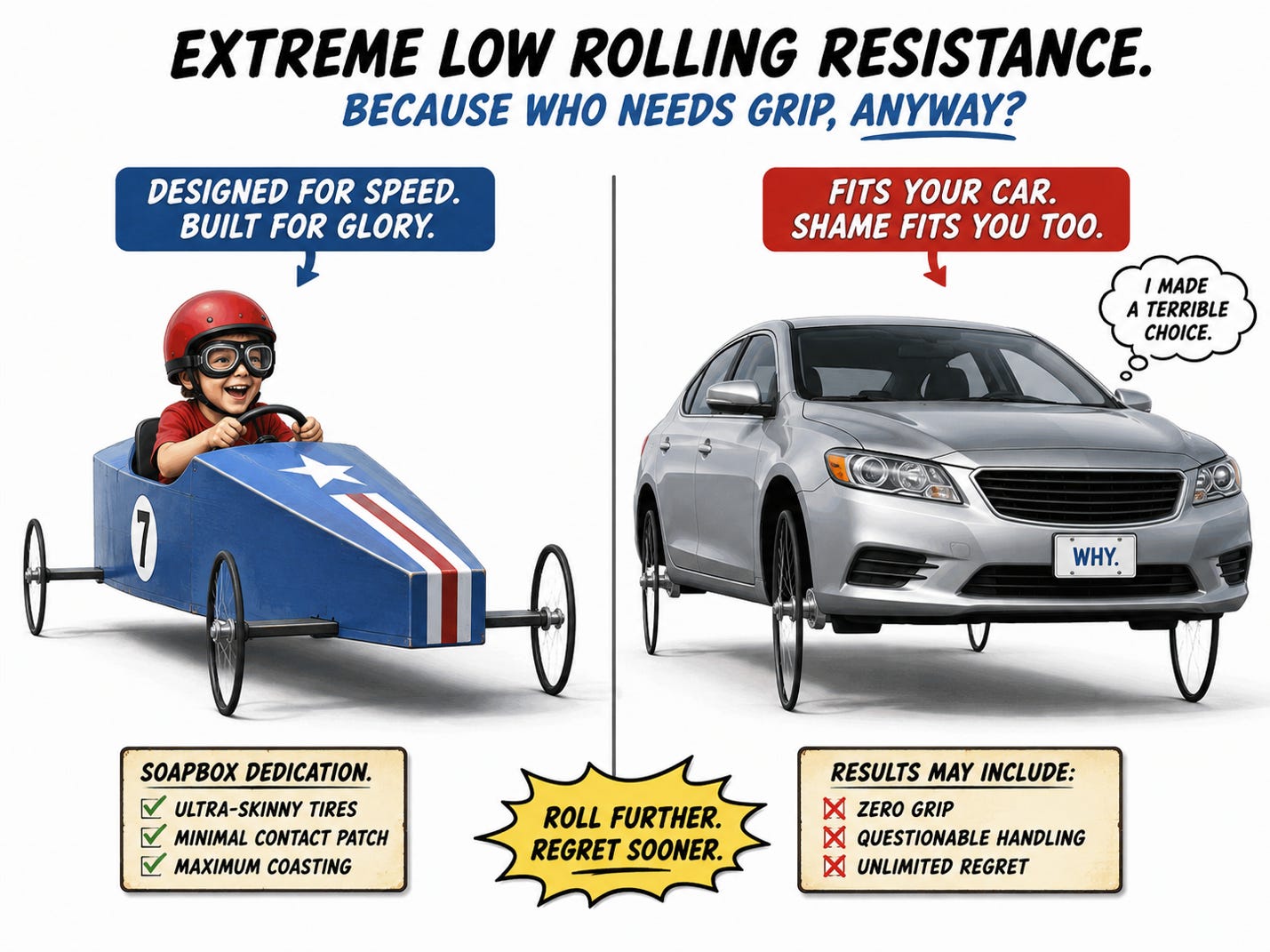
Put soapbox-derby tires on your Buick.
Skinny little wheels.
Hard rubber.
Tiny contact patch.
It will roll beautifully.
🅱️ Bob: “Excellent mileage. Braking sold separately.”
Take the idea farther and you eventually arrive at something approaching a steel wheel.
Very little rubber deformation.
Very little energy lost.
Terrific rolling efficiency.
Not quite as terrific when somebody pulls out in front of you on a wet freeway.
Of course, real tire engineering is more sophisticated than that. Modern manufacturers use silica, polymers, tread design, carcass construction and other technologies to reduce rolling resistance without surrendering traction one-for-one.
But physics does not disappear because Sacramento passed a regulation.
There is still a tradeoff.
And California knows it.
That is why the regulation doesn’t merely establish a rolling-resistance standard.
It also includes a wet-grip requirement.
Think about that for a moment.
The state is effectively saying:
Reduce friction here.
But don’t reduce friction too much over there.
🅱️ Bob: “Nothing inspires confidence like the phrase ‘minimum wet grip.’”
That wet-grip requirement is important. It prevents manufacturers from simply building rock-hard tires that roll forever and stop sometime next Thursday in the middle of a busy intersection.
But it does not answer the real question.
“Minimum wet grip” is not the same thing as maximum grip.
It is not even necessarily the same grip provided by the tire I would otherwise choose.
Suppose I am willing to give up one or two percent in fuel economy because I want considerably better braking, cornering or wet-weather traction.
Why shouldn’t I?
Maybe I live in the mountains.
Maybe I drive a performance car.
Maybe I tow.
Maybe I simply care more about stopping distance than squeezing another fraction of a mile out of a gallon of gasoline.
That is one of the reasons an aftermarket tire business exists in the first place.
Original-equipment tires are selected by automakers while balancing fuel economy, EV range, noise, ride, price, handling and government efficiency targets.
Owners frequently replace them because they want a different compromise.
More grip. Better snow performance. Longer tread life. Stronger construction. Better handling. Lower price.
California has now decided that one characteristic—rolling efficiency—deserves government priority over some portion of those individual choices.
🅱️ Bob: “I don’t think I need a California bureaucrat telling me how to spend my money at Pep Boys.”

That brings us to the question almost nobody seems interested in answering:
What tires disappear?
How many perfectly safe tires currently sold in California will fail the new rolling-resistance requirements?
What characteristics do those tires have that consumers currently value?
Are some of them stickier?
Do some have better dry braking?
Better cornering?
Longer tread life?
Lower prices?
What happens to those characteristics when engineers have to redesign the tire around a government efficiency target?
And here is the big one:
What is the counterfactual?
California can calculate projected gasoline savings down to the gallon.
It can estimate carbon dioxide reductions.
It can calculate the theoretical dollars motorists will save.
Fine.
Now calculate the other side.
If the tires required under the new standard provide even slightly less traction under some conditions, what happens to accident rates?
What happens to stopping distances?
What happens when a driver loses control in the rain?
What is the economic value of one prevented crash?
One prevented serious injury?
One prevented death?
Maybe the answer is zero.
Maybe modern tire technology allows manufacturers to meet California’s standards without sacrificing any meaningful safety, performance or durability whatsoever.
Wonderful.
Show us.
That is what regulation is supposed to demonstrate before eliminating consumer choices.
Instead we usually get the benefits calculated to three decimal places and the tradeoffs waved away with assurances that everything will be fine.
Then there is the money.
Whenever government changes the specifications for an entire industry, somebody wins and somebody loses.
Large premium tire manufacturers have spent decades and enormous sums developing sophisticated low-rolling-resistance technology.
Companies already capable of meeting California’s future standards have a substantial advantage over manufacturers selling cheaper products that may require redesign, retooling or abandonment.
That does not prove corruption.
It does not prove anybody paid anybody off.
It does mean we should ask the obvious question:
Who benefits when government raises the technological minimum required to sell a tire?
The companies already above that minimum certainly won’t complain.
And there are newer companies whose entire commercial pitch is built around highly efficient, low-rolling-resistance tires.
Again, nothing sinister is required.
This is how regulation frequently works.
Environmental groups demand a higher standard.
Government adopts it.
Sophisticated manufacturers demonstrate that it can be achieved.
Smaller or cheaper competitors absorb the cost.
Consumers lose some choices.
The surviving companies call it progress.
🅱️ Bob: “Amazing how often mandatory innovation already has somebody ready to sell it to you.”

There is another wrinkle worth knowing.
This did not begin with one California bureaucrat waking up last Tuesday and deciding tires needed fixing.
The underlying effort goes back more than two decades, with environmental organizations pushing California toward replacement-tire efficiency standards for years.
That makes the story more interesting, not less.
Because the issue isn’t one politician.
It is an entire governing philosophy.
Find an efficiency metric.
Declare it socially desirable.
Turn it into a standard.
Require every manufacturer to optimize around it.
Calculate the theoretical savings.
Then treat the lost choices as somebody else’s problem.
Maybe California is right.
Maybe there really is a vast pool of inefficient replacement tires wasting gasoline for no useful reason.
Maybe tire manufacturers can eliminate that waste while preserving traction, durability, performance and price.
If so, demonstrate it.
But that isn’t the same question as whether lower rolling resistance is desirable.
Of course lower rolling resistance is desirable.
So is more traction.
So is shorter stopping distance.
So is longer tread life.
So is lower cost.
The entire art of tire engineering lies in deciding how much of each you want.
California has decided it should participate in that decision.
That is the story.
Not Obama.
Not pedophilia.
Not National Lampoon.
Not “rotate your tires.”
The story is that California is changing the engineering requirements for the tires you will be allowed to buy—and doing so in the name of a tradeoff that most drivers have never even been told exists.
Which brings us back to my soapbox-derby car.
Those skinny little tires roll wonderfully.
Put four of them on a family sedan and the absurdity becomes obvious.
Efficiency is not the only thing a tire is supposed to do.
🅱️ Bob: “Maybe just let ME buy the damn tire.”

One more reason to leave CA. They spend so much time on silly things. There is a payoff here, somewhere. Maybe indirect, but laws like this don’t appear out of the goodness of some politician’s heart. It doesn’t work that way. California increasingly behaves like a self-perpetuating political enterprise in which every “solution” creates another constituency, bureaucracy, expenditure, or mandate—and almost nobody inside the system has an incentive to make government smaller. California has so much legislative machinery that seemingly trivial measures can conceal an incentive structure: a favored industry gets a mandate, an advocacy group gets funding or relevance, consultants get contracts, regulators get a larger domain, unions get additional work, or politicians get a constituency they can claim to have served. The payoff doesn’t necessarily arrive as an envelope of cash. Often it’s institutional—money, jobs, influence, campaign support, regulatory power, or another permanent constituency dependent on Sacramento. There is no Goody Two-Shoes in this arrangement. Somebody wanted the law. Somebody benefits from the law. Somebody gets money, power, relevance, protection, or political credit from the law. The trick is finding out who.
Bob: 🅱️ “Sacramento doesn’t manufacture legislation. It manufactures customers.”
I cross the state line going into California to visit relatives on a regular basis. Just before the California state line there are a slew of gas stations doing a very brisk business in Arizona. It seems Californians would rather gas up out of state when it’s economically feasible. That’s a no-brainer.
Now California is going to be sending tire replacement customers to Arizona to purchase replacement tires, really?
Momma always said; stupid is as stupid does. 🤣