


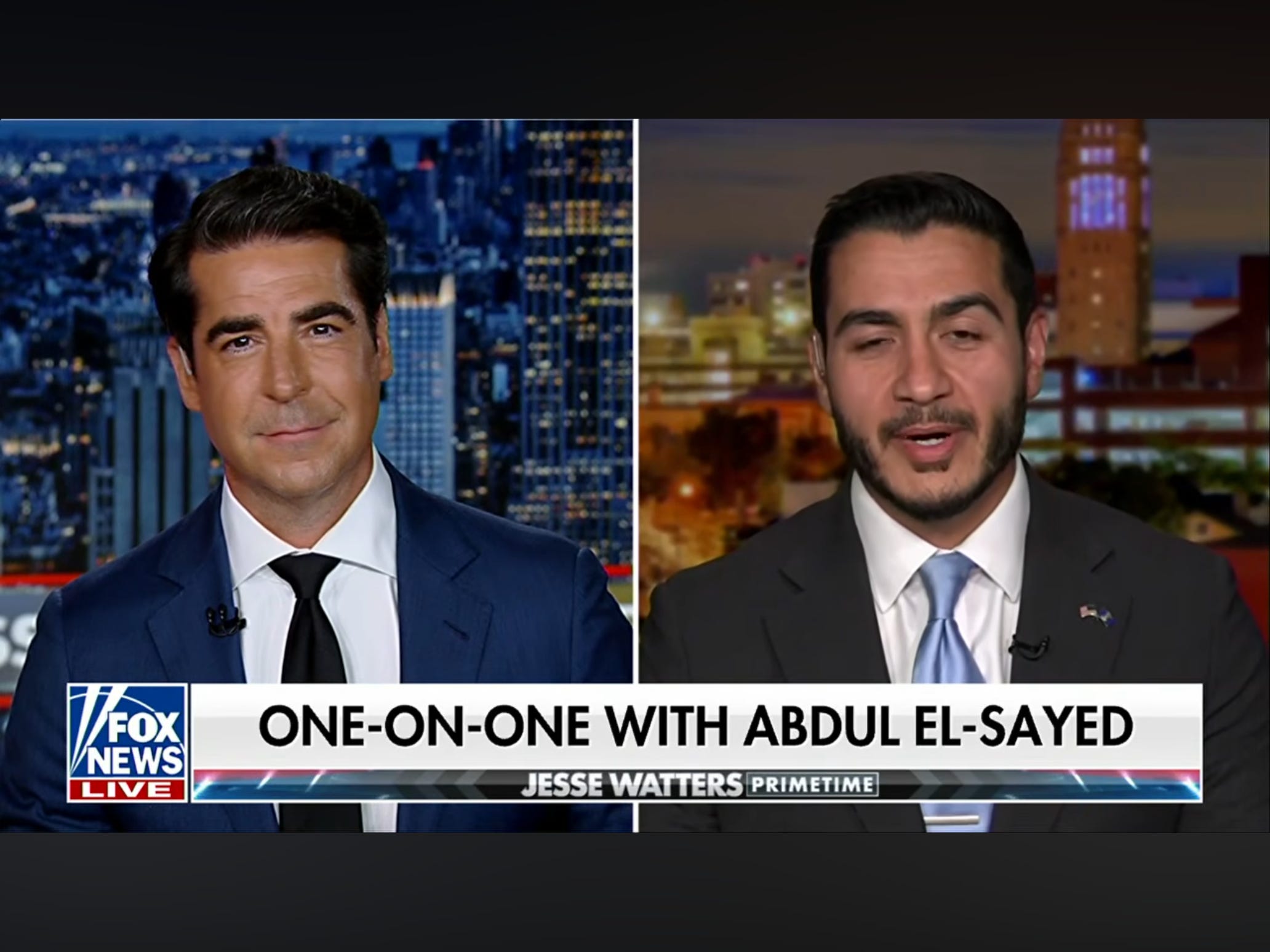
Damage Control in Real Time
Did El-Sayed just lose Michigan on national television? I think so.
By Jim Reynolds | www.reynolds.com
August 25, 2026
Abdul El-Sayed’s appearance on Jesse Watters was not a debate. It was a prolonged, transparent evasion.
El-Sayed said he was there to answer serious questions and have a serious debate.
Then he did almost exactly the opposite.
The overall impression was hard to miss: he appeared evasive, unserious, and unwilling to give direct answers to direct questions.
Watters asked direct questions. El-Sayed answered almost none of them. He talked over the host repeatedly, redirected every difficult subject, repeated the same talking points, and kept trying to seize control of the interview.
After a while, it stopped sounding like argument and started sounding like a filibuster.
The pattern was the story.
On immigration, Watters pressed him about past calls to abolish ICE. El-Sayed claimed ICE “isn’t working” because there are more undocumented immigrants now than under the old INS, then immediately pivoted: Michigan voters, he insisted, are asking him about gas prices and groceries, not immigration.
🅱️ Bob: “Biden lets in 12 million illegals and suddenly it is ICE’s fault?”
Watters called the dodge.
El-Sayed kept talking. He did a lot of that. Talking over, under, around and through everything that Watters, the host, was trying to say.
On the Iran conflict, Watters asked if he was glad the ayatollah was dead. El-Sayed said he would never defend the Iranian regime, then pivoted to the war, the JCPOA, and rising gas prices.
Watters asked three times whether the strikes themselves were justified.
El-Sayed never answered.
The closest he came was complaining about the cost of filling a tank.
🅱️ Bob: “Evidently, he did not want to answer the question. Why didn’t he just say that?”
The most revealing moment came on sex-change surgeries for minors.
Watters asked if El-Sayed supported them.
El-Sayed answered that the government should not tell people what healthcare they can have.
Watters pressed harder: “So you think it’s okay for a parent to slash his kid’s ding-a-ling off?”
El-Sayed responded by asking Watters if he was circumcised.
🅱️ Bob: “Sounds like a roundabout way of avoiding the question.”
When Watters said yes and pointed out that circumcision is different from castration, El-Sayed doubled down on equating the two.
At one point, El-Sayed appeared to invoke the authority of being a doctor to corner Watters on a medical question. There was an obvious response sitting on the table.
El-Sayed has an M.D. But he never completed a residency and has never been licensed to practice medicine.
🅱️ Bob: “I bow out on this one. Too easy.”
Watters missed it. Or perhaps he decided El-Sayed was doing a perfectly good job of losing votes without any additional help.
That was low-hanging fruit, particularly in an interview where El-Sayed seemed determined to use credentials and technical language as another way of controlling the exchange.
He still never answered the question.
Unable to answer a question about sex-change surgery for minors, he changed the subject to Jesse Watters’ penis.
🅱️ Bob: “A first in TV debate tactics: when you run out of answers, ask the host if he’s circumcised. Perfect.”
On biological males in women’s sports, the same pattern held.
Watters asked directly.
El-Sayed said the decision should be left to “the people who govern sports.”
Watters asked again.
El-Sayed complained that Watters was not asking about the issues Michigan voters supposedly care about.
Watters seemed to think that Michigan voters probably cared about men in women’s sports.
Again, no answer.
On taxes, at least, El-Sayed answered the question.
He defended a wealth tax on fortunes above $100 million with the remarkable argument, “What are you even going to do with more money?”
Watters had an immediate answer.
Whatever he wants. It’s America.
El-Sayed then accused him of defending billionaires.
But the most important problem for El-Sayed was not any particular policy position.
It was El-Sayed.
He said he wanted a serious conversation, but he did not behave like someone interested in having one.
He interrupted. He filibustered. He obfuscated. He repeated himself. He tried to put Watters on the defensive on Watters’ own show.
And when a question became politically dangerous, he simply refused to answer it.
That might work in a campaign room where everyone already agrees with you.
On television, it looks very different.
It looks evasive.
Worse, it looks insincere.
That was the impression that became harder to shake as the interview continued.
El-Sayed did not come across as a man candidly explaining what he believes. He came across as an operator managing exposure.
Every answer seemed calculated to get him safely to the next subject.
Nothing seemed spontaneous. Nothing seemed particularly gracious. Nothing suggested that he was actually listening to the question being asked.
🅱️ Bob: “I guess he forgot that he was part of a live interview.”
He was performing damage control.
And everybody could see it.
That matters because voters make judgments about more than policy.
They decide whether they believe you.
They decide whether they like you.
They decide whether they think you are leveling with them.
A candidate who will not give plain answers to simple culture and enforcement questions is advertising something important: he does not trust his own positions with a broader electorate.
Michigan is not merely a progressive primary electorate. It is a general-election state with a large political middle.
Those voters may disagree about ICE, Iran, transgender policy, taxes, or almost anything else.
But they understand when somebody is ducking a question.
And they understand when somebody is talking at them rather than talking to them.
That may have been the real damage El-Sayed did to himself tonight.
Not that Jesse Watters landed some devastating ideological blow.
El-Sayed damaged himself.
He arrived announcing that he wanted serious questions and a serious debate.
Then, for nearly the entire interview, he refused to participate in one.
That is not political skill.
It is damage control conducted in real time.
And the problem for El-Sayed is that the interview created exactly the clips he was trying to avoid.
Michigan voters do not have to wonder what happens when he is asked directly about ICE, Iran, sex changes for minors, or biological males in women’s sports.
They can watch him refuse to answer.
Maybe one television interview does not lose a Senate race.
But if Michigan was looking for reassurance that Abdul El-Sayed is a sincere, reasonable man who will tell voters plainly what he believes, tonight did the opposite.
He looked evasive.
He looked combative.
And most damaging of all, he looked insincere.
The questions were not the trap.
The answers were.
🅱️ Bob: “And sometimes, the non-answers.”
Watters handled a difficult situation fairly well. He let the guy hang himself. His non-answers told Michigan voters exactly where this disagreeable and argumentative fellow stands. And somehow, we know more about Jesse’s anatomy than anybody really wanted to know.
It was interesting to watch. Watters took the high road when E-S continually talked over him. He recognized that E-S was burying himself with his own oafish attitude. O’Reilly would have been much more aggressive in that situation. That is not Watters’ wheelhouse. He is the fun guy. We will see if E-S goes on with Hannity. That could be interesting. Nonstop blabbering from both sides. It is hard to win when you come off as unlikeable.