



Davos, Interrupted
How Howard Lutnick Walked Into the World Economic Forum and Declared Globalization a Failure
By Jim Reynolds | www.reynolds.com
For decades, Davos has functioned less as a conference than as a confirmation ritual.
Globalization was inevitable.
Borders were obsolete.
Manufacturing was a relic.
Energy independence was parochial.
National loyalty was passé.
These were not debated assumptions. They were axioms—recited annually by people who flew in on private jets to explain why ordinary citizens needed fewer choices, fewer industries, and fewer objections.
This year, that spell was broken.
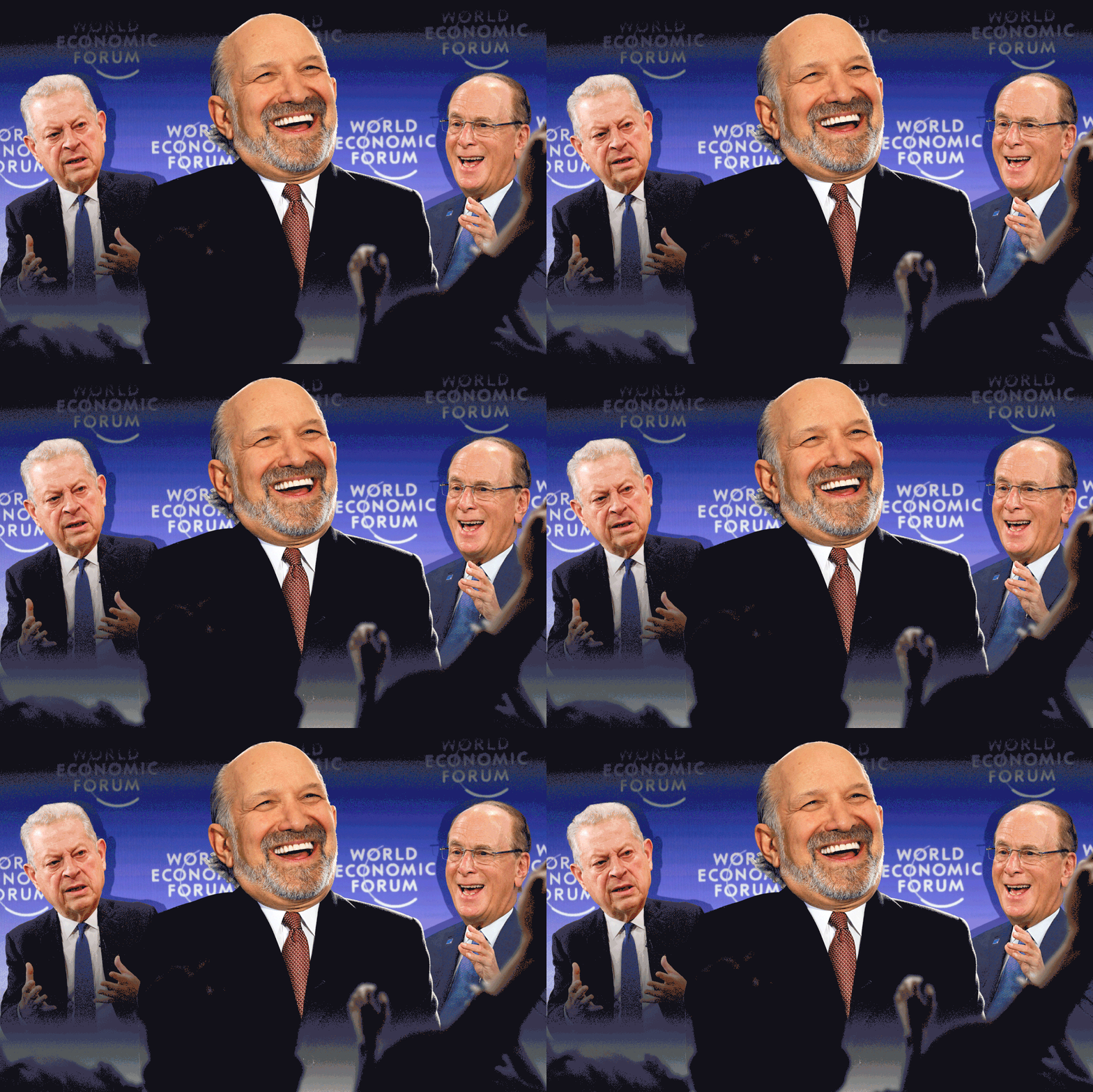
U.S. Commerce Secretary Howard Lutnick walked onto the World Economic Forum’s own stage and said the thing Davos was built to deny:
“Globalization has failed the West and the United States of America.
It’s a failed policy.”
Not whispered.
Not hedged.
Declared.
Why Lutnick Matters
This wasn’t a protester yelling from outside the barricades.
Howard Lutnick is not an academic theorist or a cable-news contrarian. He is a longtime Wall Street executive, the former CEO of Cantor Fitzgerald, a firm that lost hundreds of employees—including Lutnick’s brother—on September 11, 2001. He rebuilt the company from near-annihilation, understands capital flows at scale, and now serves as Secretary of Commerce under President Trump.
In other words: this was not a populist rant.
It was an audit.
What He Actually Said — and Why It Landed
Lutnick’s critique was precise and devastating because it targeted outcomes, not intentions.
He argued that decades of offshoring and cheap-labor chasing:
• hollowed out domestic industry
• destroyed innovation ecosystems
• created fragile, brittle supply chains
• and left Western nations dependent on adversaries for critical goods
Then he went straight for the sanctum sanctorum.
Speaking about Europe’s Net Zero commitments, Lutnick asked—plainly:
“Why would Europe agree to be net zero by 2030 when they don’t make a battery?”
The implication was lethal.
Climate policy without industrial capacity is not virtue.
It is geopolitical submission.
You cannot moralize your way out of supply chains.
You cannot regulate your way into sovereignty.
Net Zero, absent manufacturing, simply transfers leverage to China—who does make the batteries.
This is the part Davos hates most: when moral language collapses under engineering reality.

The Reaction: When the Script Breaks
The response was not polite nodding.
Lutnick faced boos and heckling—most notably from Al Gore, whose decades of failed predictions have aged like a doomsday cult calendar. Gore, who once warned of ice-free poles and submerged cities by now, sat in judgment of someone pointing out that energy, industry, and reality still matter.
The irony was thick enough to mine.
European officials pushed back defensively, insisting globalization still works—while implicitly acknowledging that something fundamental had shifted. Financial press described the speech as a “challenge” to the Davos consensus.
That undersells it.
It wasn’t a challenge.
It was a funeral oration, delivered in the cathedral.

⸻
A Bob Aside (Unattributed, as God Intended)
Our friend Bob is sitting in the back row at Davos, wearing a badge that says:
Stakeholder (Provisional)
He leans over and whispers:
“So let me get this straight.
Globalization was inevitable.
Borders were obsolete.
Manufacturing didn’t matter.
Energy independence was immoral.
And now—pure coincidence—we’re shocked that everyone depends on China for batteries, Russia for energy, and Taiwan for chips.
I guess nobody could have seen that coming.
Except, you know… anyone who can count.”
Bob watches the room tighten.
“Here’s the problem.
If globalization failed because of bad execution, we need better experts.
But if it failed because the incentives were wrong from the start…
then the experts were the problem.”
Bob smiles.
“That’s not a policy disagreement.
That’s an HR issue.”
⸻
What Davos Won’t Admit
Davos will tell you—quietly, later—that globalization didn’t really fail.
They’ll say it was:
• misapplied
• under-regulated
• insufficiently inclusive
• corrupted by politics
What they will not say is the truth Lutnick forced into daylight:
The model worked exactly as designed — for capital, not for countries.
Globalization optimized for:
• labor arbitrage
• regulatory escape
• cost minimization
• profit without responsibility
It was never designed to preserve:
• national resilience
• domestic innovation
• industrial depth
• worker stability
Those were not bugs.
They were tradeoffs.
And here is the admission Davos cannot make without collapsing its authority:
If governments have a moral obligation to prioritize their own citizens,
then global technocracy loses its claim to moral supremacy.
If borders matter, sovereignty matters.
If sovereignty matters, accountability matters.
And if accountability matters, then Davos is just a conference — not a compass.
⸻
Where This Leaves Us
Globalism didn’t collapse in Davos.
It was audited.
And the numbers didn’t add up.
The age of inevitability is over.
The age of tradeoffs has returned.
And the people who spent decades insisting there were no tradeoffs
are now asking—very politely—to be exempt from the bill.
"moral language collapses under engineering reality "
Brilliant, thank you Jim.