


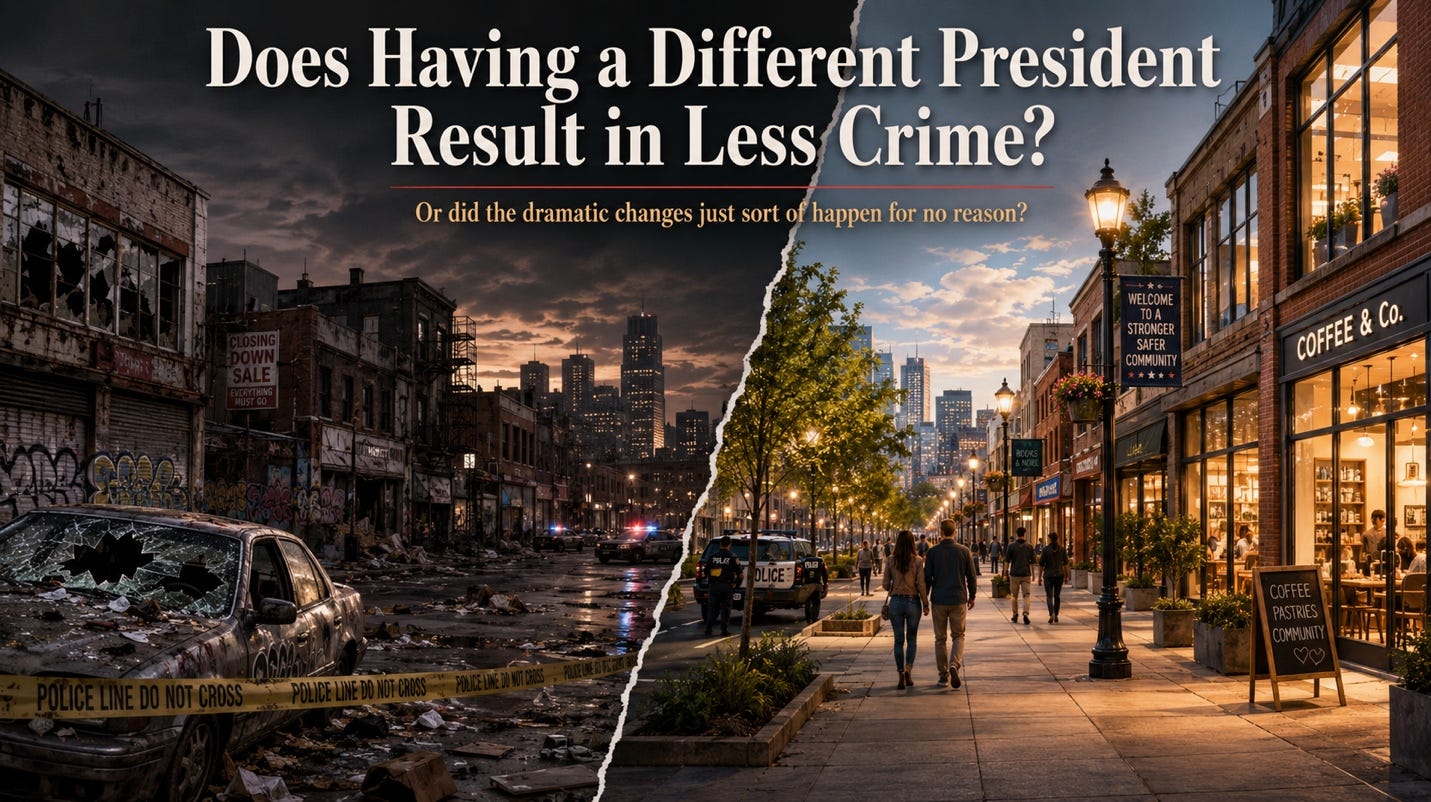
Does Having a Different President Result In Less Crime?
Or Did the Dramatic Changes Just Sort of Happen for No Reason?
By Jim Reynolds | www.reynolds.com
August 16, 2026
There is a particular sound an old engine makes when something isn’t quite right.
A tick. A clatter. Maybe a lifter complaining under the hood.
You can take the car apart, consult three mechanics, study oil pressure charts and debate the molecular properties of petroleum additives.
Or you can pour in a little Sea Foam and see if the noise stops.
Keep that thought.
Because something remarkable is happening in America.
The country is getting quieter.
Not politically, of course. That would require divine intervention.
But criminally.
Murders are plunging. Robberies are plunging. Carjackings are plunging. Auto theft is falling. Violent crime across America’s major cities has dropped at rates we have not seen in decades.
2025 national murder rate down 18.1%
homicide down another roughly 17–18% in major-city samples in early 2026
carjackings down sharply
robbery down sharply
And this creates a delicate problem for the people who spent years explaining why Donald Trump’s approach to crime was simplistic, cruel, authoritarian, xenophobic, racist, counterproductive, or—on especially productive afternoons—all six.
Trump campaigned on crime.
He said the border would close.
He said violent criminals would be prosecuted.
He said police would be supported.
He said cartels would be attacked.
He said illegal guns would be seized.
He said repeat offenders would stop revolving through courthouse doors.
He said disorder would no longer be treated as an unfortunate side effect of social injustice.
Then he became president.
And crime went down.
A lot.
Now, correlation is not causation.
We know this because people who ignored that rule whenever crime rose under Republican politicians have suddenly rediscovered it.
So let’s be careful.
Crime had already begun falling from its horrific post-2020 peak before Trump returned to office. That is true. Some cities were improving during the final Biden years.
But that story comes with complications of its own.
There were serious questions about crime reporting during that period. FBI reporting systems had undergone major changes. Some early statistics were incomplete. And in Washington, D.C., allegations eventually surfaced that serious offenses had been downgraded or classified in ways that made crime numbers look better than they otherwise would have.
Perhaps some of the skepticism was justified.
Fine.
But now we have a problem.
The numbers keep going down.
And Joe Biden is no longer president.
If Democratic-run cities were somehow massaging crime statistics to make Democratic crime policies look successful, why would they continue doing it now?
For Donald Trump?
What exactly would be the incentive?
Does the mayor of Chicago wake up every morning wondering how he can make Trump look more effective?
Does New York City Hall have a secret MAGA statistics department?
Is Oakland cooking the books because somebody wants Jeanine Pirro to look good on television?
At some point, the simpler explanation deserves a hearing.
Crime really is going down.
And while it is going down, something else has happened.
Consequences have started coming back.
That may be the most important word in this entire story.
Consequences.
For years, some of America’s largest cities conducted a remarkable social experiment.
Prosecutors announced that entire categories of crime would be treated more leniently.
Cash bail was attacked without always replacing it with meaningful detention for dangerous defendants.
Repeat offenders accumulated arrest records that began to resemble frequent-flyer statements.
Police were told simultaneously to prevent crime and to avoid doing many of the things traditionally associated with preventing crime.
Retail theft became a business model.
Open-air drug use became urban scenery
And during the riots of 2020, America watched government officials explain with straight faces why burning police cars, shattered storefronts and autonomous zones required nuance.
The criminal justice system gradually became less about crime and punishment and more about crime and explanation.
Then voters began changing their minds.
Chesa Boudin was recalled in San Francisco.
Pamela Price was recalled in Alameda County.
George Gascón was thrown out in Los Angeles.
Mike Schmidt lost in Portland.
Different cities. Different elections. Same message.
Enough.
And something else happened.
Prosecutors started prosecuting again.
This is where Washington, D.C., becomes particularly interesting.
Jeanine Pirro—yes, Judge Jeanine—became U.S. Attorney for the District of Columbia.
Whatever one thinks of her television career, the numbers coming out of her office are not television numbers.
Federal prosecution increased sharply.
The percentage of arrests declined for prosecution collapsed.
Illegal firearms were seized by the thousands.
Federal agents began concentrating on repeat offenders, armed criminals, carjackers and violent crews.
Meanwhile, homicides dropped.
Carjackings dropped.
Robberies dropped.
Vehicle theft dropped.
Was every one of those crimes prevented by Jeanine Pirro?
Of course not.
But here is a proposition apparently considered radical in some academic circles:
A criminal sitting in jail cannot carjack you tonight.
Bob looked puzzled.
🅱️ “So incapacitation works?”
Apparently we may need another federally funded study.
Washington isn’t the only place.
Federal enforcement increased in Memphis.
Trump’s administration intensified its campaign against cartels and trafficking organizations.
The southern border—the greatest uncontrolled human conveyor belt in modern American history—was effectively shut down.
That doesn’t mean every illegal immigrant was a criminal. That would be absurd.
It means that one giant uncontrolled avenue through which gang members, traffickers, fugitives, drugs and cartel operatives could enter the United States was dramatically constricted.
Does that matter?
Maybe.
Should we at least be allowed to ask?
Apparently that question requires considerably more scholarly caution than asking whether climate change caused a thunderstorm.
Then there are the riots.
Or rather, there largely aren’t.
We have had demonstrations, ugly confrontations and isolated political violence.
What we have not had is anything resembling the sustained national insanity of 2020—cities burning, police precincts abandoned, businesses looted, prosecutors declining cases and politicians competing to explain why the people setting fires were actually engaged in an important conversation about social justice.
That atmosphere matters too.
Crime does not occur in a laboratory.
Criminals watch.
They notice whether police are afraid to arrest them.
They notice whether prosecutors prosecute.
They notice whether judges detain them.
They notice whether politicians excuse them.
They notice whether mobs are allowed to occupy streets.
And they notice when the rules change.
This doesn’t require a Ph.D.
It requires eyesight.
So can we assign all the credit for America’s remarkable crime decline to Donald Trump?
I don’t know.
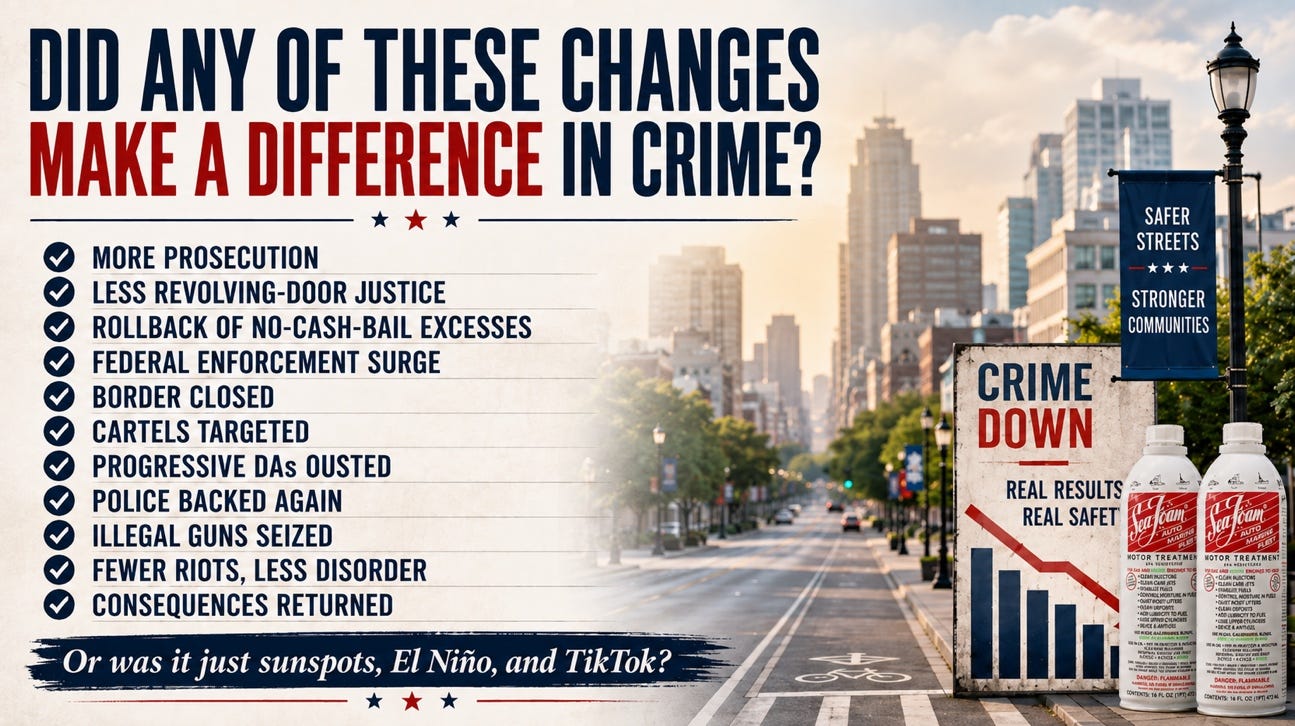
Is there a clean statistical correlation between the closed border, increased federal enforcement, tougher prosecution, the defeat of progressive prosecutors, pressure on the cartels, reduced urban disorder and declining violent crime?
There certainly appears to be enough of one to ask the question.
But perhaps we’re wrong.
Maybe it’s sunspots.
El Niño.
The mesmerizing effect of TikTok.
Perhaps violent criminals all discovered pickleball simultaneously.
Researchers are welcome to investigate.
They can build models, run regressions, adjust for demographics, weather, COVID recovery, incarceration rates, police staffing, economic conditions and whatever else makes the computer happy.
I’m serious. They should. And they will. And do you think any of these university-built models will be allowed to give the Trump administration credit?
I am also old enough to appreciate a practical result.
Which brings me back to the engine.
Every now and then the lifters in my engine start making noise.
I add some Sea Foam to the oil.
The noise goes away.
Now perhaps some master mechanic can explain exactly what happened. Maybe the additive cleaned a deposit. Maybe it improved lubrication somewhere. Maybe the engine was going to quiet down anyway.
I cannot prove the causal chain.
I know this:
Before Sea Foam, noise.
After Sea Foam, less noise.
So the next time the engine starts rattling, I am not convening a symposium.
I’m adding Sea Foam.
America just spent several years listening to an increasingly noisy engine.
Murders. Carjackings. Looting. Fentanyl. Street takeovers. Repeat offenders. Riots. Open borders. Prosecutors who seemed more suspicious of punishment than of criminals.
Then the country put Donald Trump back in charge.
The border closed.
Federal enforcement increased.
Prosecution increased.
Cartels got hammered.
Police got backed.
Consequences returned.
And the engine got quieter.
People are free to argue about why.
Bob already has his answer.
He picked up the can of Sea Foam.
🅱️ “Put another bottle in.”

It turns out that criminal respond to "incentives" just like everyone else!
Love this!