


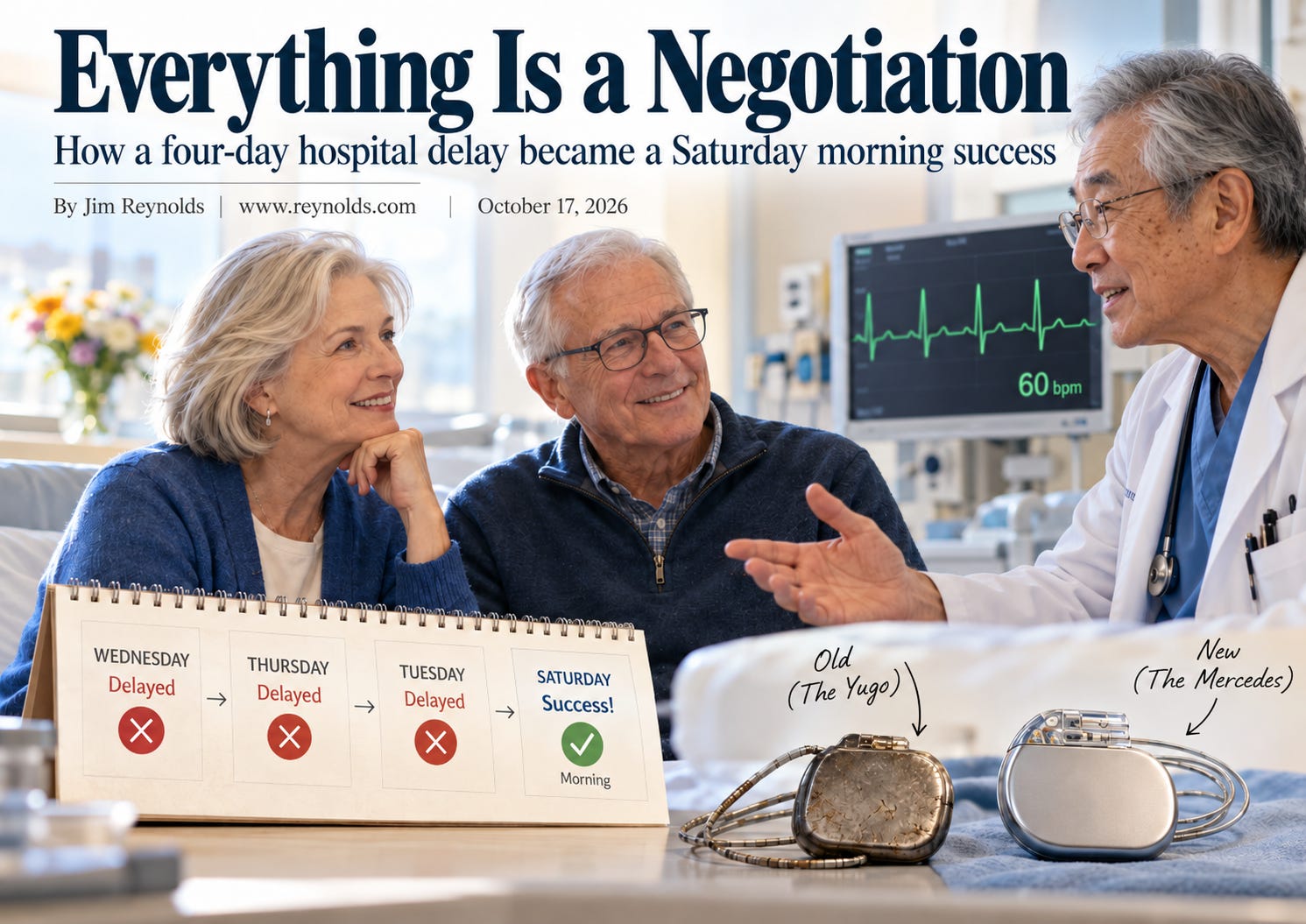
Everything Is a Negotiation
How a four-day hospital delay became a Saturday morning success
By Jim Reynolds | www.reynolds.com
October 17, 2026
My wife, Vicki, entered the emergency room at Henry Mayo Newhall Hospital on Sunday morning. Five days later, she was still there, waiting for a pacemaker.
The original schedule called for Wednesday. Then Thursday. Then the following Tuesday.
Meanwhile, Vicki was walking around the hospital several times a day, unassisted. She felt reasonably well. But the cardiac monitor told another story. Her heart was occasionally pausing for several seconds, sometimes as long as five.
Vicki has experienced fainting episodes since she was a teenager. Now we had documented evidence that her heart occasionally stopped beating for several seconds.
I had received a pacemaker myself just two weeks earlier. Mine corrected a different electrical problem, but the experience had given both of us a crash course in cardiac plumbing and wiring.
We understood the machinery. And we knew enough to ask questions.
By Friday morning, I had one particularly important question.
Why was my wife spending more than a week in a hospital bed waiting for a procedure that had originally been scheduled for Wednesday?
The Squeaky Wheel
Friday morning, I returned to the hospital.
I explained to the nurse that I had recently received a pacemaker through our cardiologist in Orange County, where we live. The experience had been excellent. Vicki also had her own cardiologist there.
Then I introduced an alternative.
What would it take to have Vicki released so our Orange County specialists could do the job?
I wasn’t angry. I wasn’t making accusations. I simply explained that waiting more than a week seemed excessive, particularly when her cardiac pauses were continuing.
We were told that leaving would require signing a release.
Fair enough.
There was no ultimatum. But the implication was clear.
We had options.
A Hurry-up-and-Waite Experience
Enter Dr. Ichiro.
He was an older physician, perhaps in his seventies, with an informal manner and a ready sense of humor.
I told him that Vicki and I had spoken with his colleague, Dr. Waite, the previous day. We’d learned that the procedure would be postponed until the following Tuesday.
I told Ichiro that we’d spent enough time with Dr. Waite.
He laughed loudly.
Then he asked whether we watched Jimmy Failla on Fox.
Of course we did.
We were off to a good start.
Ichiro mentioned, with a smile, that Waite was taking a short vacation.
Vicki and I looked at each other.
No comment required.
The Yugo and the Mercedes
The original plan called for a leadless pacemaker, a small device inserted through a vein in the groin and positioned inside the heart.
This was incredible technology, but it required a specialized procedure room unavailable over the weekend.
Vicki already had an older pacemaker, installed when she was only in her mid-forties. Its battery had run down years ago, and the device had been deactivated. It hadn’t seemed particularly helpful when it was operating, but the wires connecting it to her heart were still there.
Ichiro suggested another approach.
Why not open the existing pacemaker pocket, remove the old generator, test the leads, and connect a new generator if the leads were still serviceable?
No new wires. No specialized procedure room. Potentially a much simpler operation.
“Easy-peasy,” he said.
Now we were getting somewhere.
We discussed manufacturers. Vicki’s old pacemaker was a Biotronik. Mine was a new Boston Scientific.
Ichiro compared pacemaker manufacturers to automobile manufacturers.
“Do you remember the Yugo?” he asked.
He suggested that some people might prefer a Chevrolet, Ford, or Chrysler.
I interrupted politely.
“Vicki would like a Mercedes.”
He suppressed a smile.
We moved on to Boston Scientific.
Throughout the conversation, Ichiro treated us as people capable of understanding the technical details. He didn’t waste time explaining things we already knew.
At one point, I realized I hadn’t established something rather fundamental.
“So, doctor, are you a surgeon?”
“Yes.”
“And you’ll be doing the procedure?”
Yes again.
Excellent. We were talking to the man who could actually do the job.
Eventually, Ichiro excused himself. He had some things to organize.
About ten minutes later, he returned.
“Nothing to eat or drink after midnight.”
Vicki was scheduled for surgery Saturday morning.
Just like that.
The procedure that had slipped from Wednesday to Thursday to the following Tuesday was now scheduled for the next morning.
Saturday Morning
Vicki went into surgical preparation at 6:30 Saturday morning. I settled into the hospital coffee room, passing the time with emails and the news while waiting for word.
It took a while.
By 10:30, she was out. The operation was a success.
She remembers nothing about the procedure itself.
I spoke on the phone with Dr. Ichiro. He was able to reuse the leads from her ancient pacemaker—the Yugo. That made this the least invasive of the options we had considered.
The only difficulty was cleaning up the area around the old device. Ichiro reported considerable oxidation that needed attention.
I suspect they don’t remove many pacemakers this old. Most people receive them when they’re already ancient themselves—like me and my brother Jeff.
Vicki was only 44 when hers was installed back in the 1990s. She had an unusual condition, and the original device never seemed to do much good.
Now she has a Boston Scientific pacemaker, just like mine.
Her resting heart rate is set at 60 beats per minute, with an upper pacing rate of 130.
Within a span of 15 days, both of us received pacemakers.
Some coincidence.
Perhaps what we learned from my experience helped bring about this convergence of destinies.
Ichiro believes Vicki will likely never experience another cardiac pause.
We’re greatly encouraged, although we’ll reserve final judgment until she’s had an opportunity to field-test the machinery.
On my way out of the building, I checked the monitor at the nurses’ station.
Of course I did. Would you expect anything different?
A steady 60 beats per minute.
Everything Is a Negotiation
Looking back, Dr. Ichiro deserves considerable credit.
He reconsidered the original plan and chose the least invasive procedure that would accomplish the medical objective.
That’s good engineering as well as good medicine.
And it illustrates something I’ve come to appreciate during our recent adventures with cardiac medicine.
Patient agency and medical expertise aren’t competing interests. They work best together.
Vicki and I challenged the timetable. Ichiro supplied the medical judgment. Together, we arrived at a better solution.
We never threatened anybody. We didn’t raise our voices. We didn’t accuse the doctors of indifference.
In fact, we spent much of the conversation laughing.
But the central question remained: If Vicki needed a pacemaker, why were we waiting another four days?
By the end of the conversation, we weren’t.
Vicki is scheduled for release Sunday (today). On Monday, we expect to resume our trip home to Nevada City, which we started eight days ago.
We’re looking forward to many healthy years ahead.
In hindsight, that frightening encounter with the kitchen floor at John and Krys’ house may have been a fortunate event.
Without it, Vicki’s heart problem might have remained undiagnosed, and none of this would have happened.
Sometimes the squeaky wheel gets the grease.
And sometimes it gets a brand-new Mercedes.
Thanks for staying tuned.
Regards,
Jim Reynolds
www.reynolds.com

Bill, thanks for the kind note. I’ve seen enough hospital rooms lately.
Sounds about normal...unfortunately. Question, question, question. Especially in hospitals. Vicki is lucky, to have not only a conscientious husband but to find a reliable doctor. Best wishes for complete success for both of you. And thanks for sharing an interesting story. Be well and prosper.