


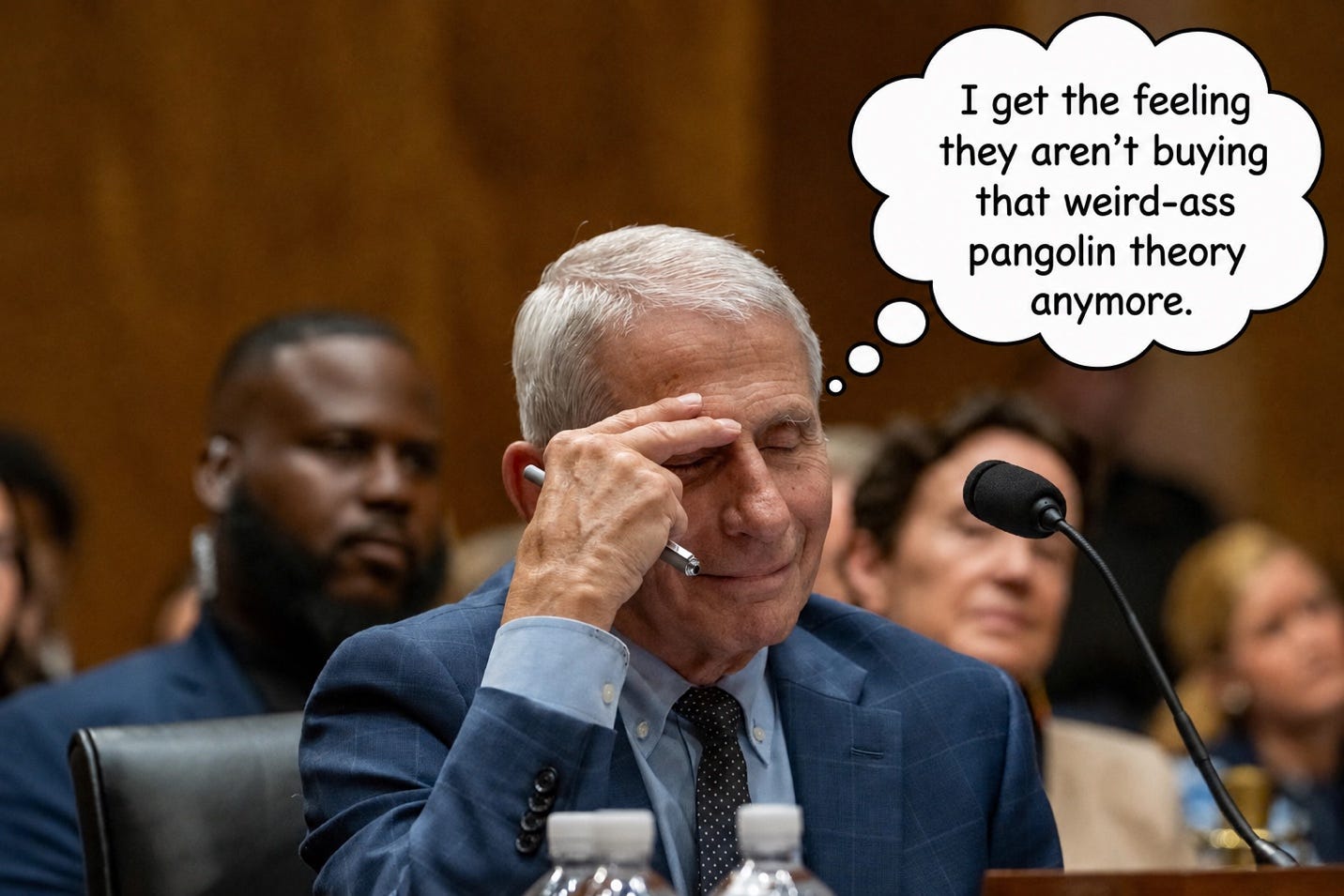
Fauci Takes the Fifth
The Man Who Had an Answer for Everything Suddenly Had Nothing to Say
By Jim Reynolds | Reynolds.com
July 29, 2026
Anthony Fauci returned to Capitol Hill Wednesday under subpoena.
This time, the man who spent the pandemic explaining nearly everything to the American people explained almost nothing.
Fauci appeared before the Senate Homeland Security and Governmental Affairs Committee, now chaired by Sen. Rand Paul, for a hearing examining the origins of COVID-19, federally funded research in Wuhan and the government’s pandemic response.
The confrontation followed Paul’s release of more than 1,000 pages from Fauci’s pandemic-era journals and records. Paul maintains that Fauci’s private writings reveal uncertainties and concerns that were often missing from his confident public pronouncements.
Fauci began with a résumé.
He reminded the committee of his 54 years in government, his 38 years as director of the National Institute of Allergy and Infectious Diseases and his many previous appearances before Congress.
Then he attacked the chairman.
Fauci accused Paul of conducting a prolonged campaign of slander and of being obsessed with putting him “behind bars.” He argued that the hearing had been designed not to discover the truth, but to lure him into a statement that could later be prosecuted as perjury.
Then, on the advice of counsel, he invoked the Fifth Amendment.
And kept invoking it.
For roughly three hours, Fauci refused to answer more than 100 questions. He would not discuss the laboratory-leak theory, gain-of-function research, NIH funding connected to Wuhan, deleted emails, federal records, social distancing, asymptomatic transmission or the reasoning behind some of the most consequential public-health directives in modern American history.
🅱️ Bob: “The man who told 330 million Americans what to do suddenly needed a lawyer to tell him what to say.”
Republican senators eventually began asking questions so simple that no reasonable person could imagine an incriminating answer: the color of his tie, a folder or the carpet.
Fauci still took the Fifth.
His legal strategy was understandable. Once a witness invokes the privilege, answering harmless questions while refusing difficult ones can allow opponents to argue that the privilege has been selectively waived.
But what makes sense in a lawyer’s office can look very different on television.
🅱️ Bob: “When the color of the carpet becomes legally dangerous, you may have wandered into the wrong hearing.”
For years, Fauci spoke with immense authority. He corrected presidents, lectured senators, instructed citizens and wrapped disputed policies in the mantle of science.
His recommendations helped shape school closures, business restrictions, masking rules and vaccination mandates that disrupted millions of lives.
Americans were repeatedly told to trust him.
On Wednesday, Congress asked him to explain himself.
He declined.
The hearing became even more combustible when Fauci’s attorney repeatedly attempted to intervene. Paul warned him, then ordered security to escort him from the room. Paul also announced that the committee would consider contempt proceedings.
Democrats called the hearing partisan theater and a wasteful relitigation of the pandemic. Fauci’s defenders noted that invoking the Fifth Amendment is a constitutional right, not an admission of guilt.
More than 150 scientists signed a letter defending him and arguing that Republicans had produced no credible evidence of wrongdoing.
🅱️ Bob: “We already know that 51 former intelligence officials got the laptop wrong. Why not try 150 scientists?”
All of that is legally relevant.
None of it repairs the optics.
The Fifth Amendment exists for good reason. Innocent people may invoke it when facing a hostile prosecutor, ambiguous questions or the possibility that an inaccurate recollection will be characterized as a lie.
But Fauci was not an obscure citizen caught in an unfamiliar proceeding.
He was one of the most powerful and publicly visible officials of the pandemic. He helped determine what Americans could do, where they could go, whether their children attended school and whether they could keep their jobs.
That level of power carries an obligation to account for its use.
🅱️ Bob: “Apparently, accountability is one of those things that works better from six feet away.”
Wednesday’s hearing produced no confession.
It produced no new substantive testimony at all.
It produced something politically more damaging: three hours of silence from a man who once seemed incapable of it.
Fauci may believe he protected himself legally.
He did not protect his legacy.

It was a bad time.
The worst.
Everyone on the Left seemed to believe he had been deputized to enforce the rules, shame the doubters and glare at anyone who refused to participate in the foolishness.
Hey, I can accept a side-eye.
But a full-up glare?
I don’t think so.
I did not participate.
No mask. No vaccine. No six-foot ritual.
Our family continued to gather, eat, visit and live like a family. We did not wear masks around one another. We did not sit at opposite ends of the room. We did not treat grandchildren like biohazards.
We all survived just fine.
I did not wear a mask in the grocery store. I did not wear one while dining. I did not wear one at the wine bar, where there was naturally an abundant supply of Lefties.
They would lower the mask, take a sip of wine, then carefully pull it back over their faces.
I tried not to laugh.
I really did.
But the Bob factor was strong, and resistance was not always possible.
The comedy, however, was never the real story.
The real story was the wreckage.
I watched small businesses close. I watched owners lose what they had spent years building. Restaurants, shops and family enterprises disappeared because government officials treated livelihoods as abstractions and obedience as a moral virtue.
That is the tragedy.
And that is Fauci’s legacy.
He is not a figure to be honored. He is despised by reasonable people who remember what was done, what was demanded and how confidently it was all imposed.
Then came the final twist.
The man who had spent years explaining himself to the country had kept a private diary. And in those pages, Fauci appears to have supplied much of the evidence against Fauci.
The old bureaucrat did not merely step on a rake.
He kept a written record of where he had placed it.
There you are Sandy: a little mini story just for you. Jim
The hearings prompted an interesting conversation while floating in a resort pool with a new friend. We lamented the many unforgivable restrictions that Fauci and Newsom imposed on us in that terrible first year. My mother died attended only by the angels locked up in a nursing home. The emotional chaos inflicted on my teenaged granddaughter will probably never leave her. The terror every time someone coughed. We all have those stories. There are still folks in my neighborhood walking their dogs at 7am wearing full plastic face shields. Fauci may never face justice in this world but hopefully in the next.