


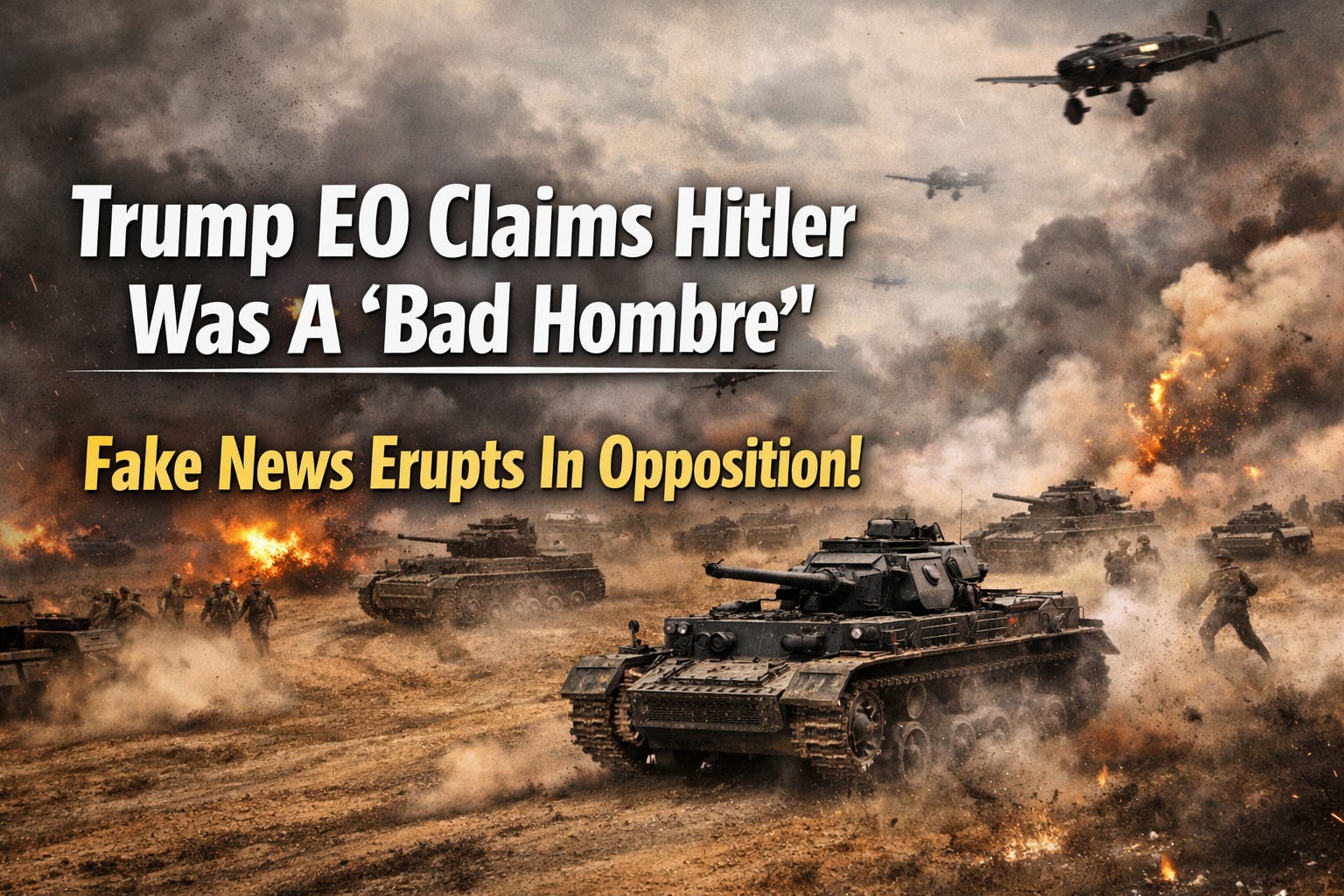
SATIRE
Final: Trump Condemns Hitler; Media Demands Nuance
By Jim Reynolds | www.reynolds.com
WASHINGTON — In a move that stunned commentators, historians, and several cable-news producers mid-segment, President Trump on Monday signed a new executive order stating, without ambiguity, that Adolf Hitler was “a horrible person.”
The order, titled Affirmation of Basic Historical Reality, ran several pages and detailed the administration’s objections to Hitler’s record, citing genocide, mass murder, authoritarianism, aggressive war, and “generally being a bad hombre — full stop.”
According to senior officials, the executive order was deemed necessary after “a growing sense that some historical facts now require constant clarification.”
White House Press Secretary Karoline Leavitt followed the signing with a press briefing that quickly became tense. For nearly an hour, Leavitt reiterated the administration’s position that Hitler was bad — a stance reporters appeared increasingly uncomfortable with as the briefing wore on.
“Isn’t this kind of divisive?” one reporter asked.
“Why single out Hitler when other leaders have also committed atrocities?” asked another.
A third wondered whether condemning Hitler outright risked “flattening history” and “alienating viewers who prefer context.”
As Leavitt continued listing Hitler’s crimes, the tone of the questions shifted.
“Can you acknowledge he was a product of his time?”
“Isn’t it dangerous to apply modern moral standards retroactively?”
“Are you saying infrastructure investments don’t matter?”
Within hours, legacy outlets began recalibrating.
The Guardian urged readers to “resist simplistic moral binaries,” noting that while Hitler’s later years were “deeply problematic,” his early period featured “ambitious mobilization efforts” and “a sense of national cohesion many Germans reportedly found meaningful.”
CNN aired a prime-time special titled Hitler: A Tainted Figure, But Also a Pioneer, in which panelists stressed that although atrocities occurred, they should not “dominate the conversation” or “crowd out legitimate discussion of logistical achievements.”
One analyst referred to Hitler as “the father of rapid mobilization,” praising his ability to move large numbers of people and equipment quickly, while describing his invasions as “blitz-style operations that escalated in unforeseen ways.” Mentions of genocide were brief and accompanied by reminders that “history is complicated.”
Producers explained that focusing too heavily on outcomes risked “oversimplifying intent.”
By day two, several outlets had adopted the phrase complex legacy as standard practice. Editors encouraged writers to use both-sides framing when referencing World War II and warned against “binary thinking.”
Fact-checkers entered the discussion, publishing lengthy analyses disputing Trump’s claim that Hitler was “simply evil.” One piece argued that the statement lacked nuance, while another suggested Trump’s fixation on condemning Hitler raised “questions about motive.”
When Trump returned to the podium and reiterated his position — again stating that Hitler was bad — the backlash intensified.
“This obsession is unhealthy,” one commentator said.
“Why won’t he acknowledge nuance?” asked another.
A third warned that Trump was “weaponizing history.”
Trump abruptly cut off the next reporter mid-sentence, waved dismissively, and said he does not take questions from “fake news” outlets. He then paused, scanned the room, turned without another word, and walked out — leaving the press corps to debate whether silence itself was a form of extremism.
In a particularly inventive segment, panelists explored whether Hitler’s personal identity “complicated the moral picture,” cautioning viewers against “rigid historical interpretations.”
Former presidential hopeful Kamala Harris was asked about the growing controversy and responded unequivocally: “Well, I haven’t been to Europe, either.”
When pressed on whether she believed Hitler was a bad person, Harris explained that history was “a lived experience” and that it would be “premature” to draw firm conclusions about events she had not personally witnessed.
“I think we all need to be very careful about absolutes,” she added. “Especially when we’re talking about geography.”
Several outlets praised the response as “deeply contextual” and “emotionally intelligent,” noting that Harris had successfully avoided “binary moral traps.” One analyst described her answer as “a master class in epistemic humility.”
Harris’s remarks immediately reset the debate, with commentators applauding her for bravely refusing to take a position on Hitler. Many agreed the moment demonstrated that, in today’s political climate, certainty itself has become the real extremism.
Meanwhile, White House insiders indicated that additional historical figures were under internal review. The name Genghis Khan reportedly emerged as a front-runner, though officials stressed this could neither be confirmed nor denied “out of respect for the process.”
In anticipation of a possible executive order, legacy outlets began assembling panels of Khan defenders to ensure balance. Proposed segments included Genghis Khan: Monster or Misunderstood?, Empire Builders We’re Still Judging Too Harshly, and When Does Mass Slaughter Become Context-Dependent?
One producer said preparations were necessary “so we’re not caught flat-footed if Trump oversimplifies again.”
By the end of the week, the controversy had little to do with Hitler at all. It had become a case study in reflex — how opposition, once unmoored from judgment, turns into inversion. What began as an uncontroversial statement of historical fact metastasized into a full-blown exercise in narrative contortion, complete with panels, disclaimers, nuance-wrangling, and moral hedging.
No one seriously disputed the atrocities. They just became inconvenient. Context did the work denial used to do. Balance replaced clarity. And certainty — the kind that once anchored civilization — was recast as dangerous.
In the end, the episode revealed less about history than about the present. A culture that cannot say obvious things plainly, once a disfavored figure says them first, is not engaged in debate. It is engaged in avoidance. And avoidance, dressed up as sophistication, has a way of eating everything it touches.
Some things, it turns out, really are simple.
Bad hombre — full stop.
Bill, thanks. I appreciate your edit ideas. Always good to take a final look at brevity — of which I am a strong proponent. But Kahn gave a little more context/breadth and Kammie was just funny. I have a hard time cutting stuff that makes me laugh. Jim
Well done! My only regret is that too many who should see this won't, or at least won't acknowledge it.
Keep 'em coming. Love this stuff.
Bill Schoettler