


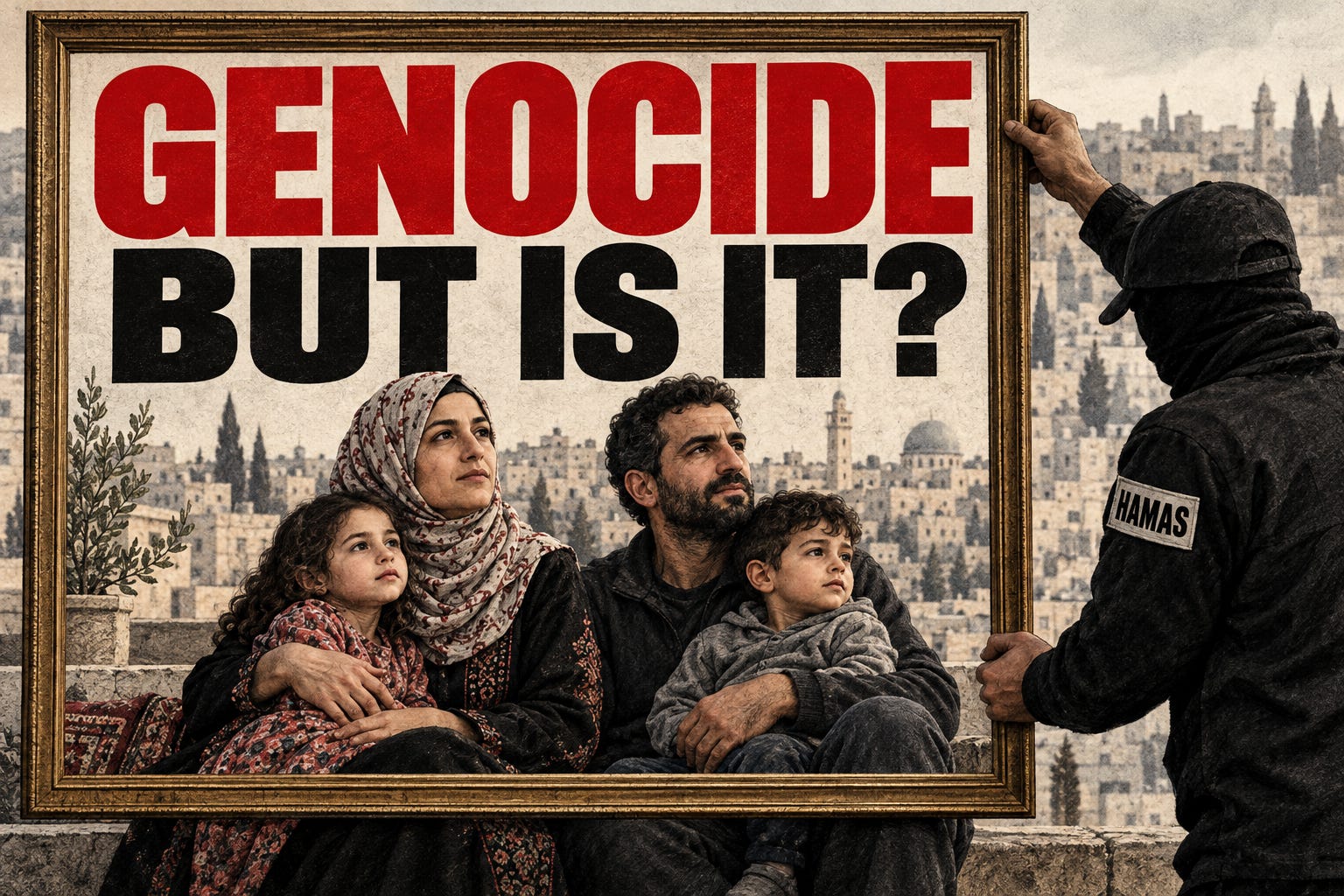
Gaza and the Meaning of Genocide
The accusation that turns a war against Hamas into a war against a people
By Jim Reynolds | www.reynolds.com
October 8, 2026
On October 7, 2023, Hamas-led attackers crossed into Israel and hunted civilians in their homes, on the roads, and at a music festival.
Gunmen threw grenades into a roadside shelter where people had crowded together to escape. They opened fire inside. In Israeli communities, attackers set homes ablaze with civilians inside. Verified videos show captives being beaten and kicked, and an injured woman dragged by her hair from the trunk of a vehicle and forced into its back seat. These were deliberate attacks on people who could not defend themselves.
The assault killed about 1,200 people, most of them civilians. The attackers carried 251 hostages back to Gaza, including children and elderly people. A UN mission later found reasonable grounds to believe that rape and gang rape had occurred during the attacks.
That is what Israel was responding to. Its people had been slaughtered, and its hostages were in the hands of the organization that had organized the slaughter. Israel went to war to bring them home and break Hamas’s military power so that it could not carry out another October 7.
The story that assigns guilt in advance
The political framework is familiar. In The Communist Manifesto, Marx and Engels described history through conflict between “oppressor and oppressed.” Applied mechanically to a modern war, that framework can assign the stronger side guilt and the weaker side innocence before examining what either has done.
Saul Alinsky described a related tactic in Rules for Radicals: “The enemy properly goaded and guided in his reaction will be your major strength.” Provoke the opponent, then turn his response into a weapon against him.
Hamas’s reported statements give that tactical comparison substance. In November 2023, senior Hamas official Khalil al-Hayya acknowledged that the attack was expected to produce a large reaction and revive attention to the Palestinian cause. The following June, The Wall Street Journal reported messages in which Yahya Sinwar calculated that continued fighting and Palestinian civilian deaths would work to Hamas’s advantage.
Those statements reveal a calculation worth confronting: Israeli retaliation and Palestinian suffering could become political assets for the organization that initiated the attack. Hamas did not need to defeat Israel on the battlefield to benefit from pressure on Israel to stop fighting.
My objection to the oppressor and oppressed story is that it blurs Hamas into the population it claims to represent. Palestinian suffering is real. Hamas’s exploitation of that suffering does not make it imaginary. It makes the distinction between civilians and the organization conducting the war indispensable.
Used as a slogan, genocide supplies the verdict that this framing invites: Israel’s response becomes a plan to exterminate the Palestinian people. The accusation is repeated as though repetition had settled the case. Question it and you are told you are defending genocide.
I reject that accusation. I regard its promotion as an established fact as a harmful lie. It substitutes the destruction of a people for the defeat of the organization that attacked Israel, then uses that substitution to condemn the entire war.
The slogan must face two tests: whether its political framing preserves responsibility for the attack, and whether its allegation of genocide is supported by evidence. Start with the historical scale. Examine the warnings and supplies. Then return to the purpose of the fighting, and to the people Hamas placed between itself and the Israeli forces.
Start with the scale
Consider the populations destroyed in some of history’s clearest genocides. These percentages refer to the people targeted, not the populations of the continents or countries surrounding them.
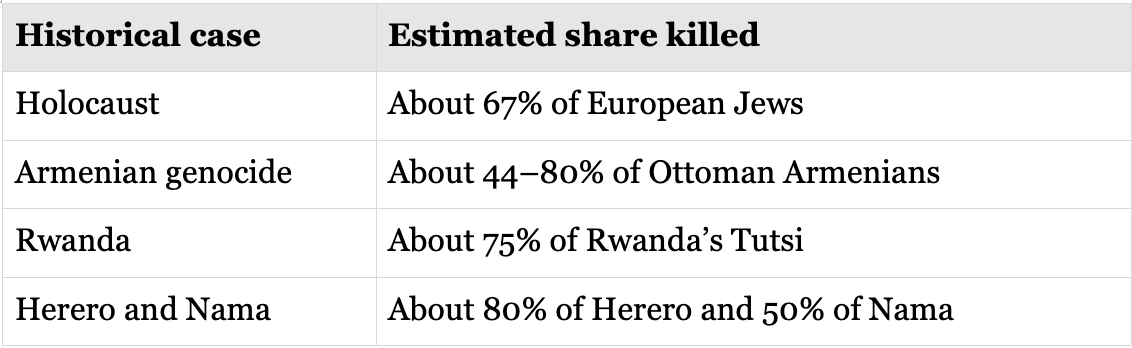
For an illustrative calculation, use a rounded Gaza death toll of 75,000 against a prewar population of 2.2 million. That is about 3.4%, including combatants. Subtract Israel’s disputed estimate of 22,000 combatants killed and the remainder is about 2.4%. That subtraction is an illustration, not a verified civilian count or a tally of all indirect deaths.
About three quarters of Rwanda’s Tutsi. A few percent of Gaza’s population in this calculation. Even without subtracting a single Hamas fighter, the difference is enormous.
Genocide has no minimum death percentage. The numbers lead us to the question of purpose; they do not replace it. But anyone invoking Rwanda or the Holocaust to describe Gaza should have to confront the comparison rather than borrow the horror and discard the scale.
Then examine the warnings
Before major operations in northern Gaza, Israel told civilians to leave the areas where it intended to fight. It issued public evacuation instructions and called residents directly.
Those warnings belong in the argument. A military telling civilians to move away from an impending battle is taking an action directed toward their survival. That action can also alert the enemy and complicate the attack. It is evidence about purpose, even when the warning fails to protect everyone.
Compare that with the German extermination order against the Herero. General Lothar von Trotha demanded that they leave the country and threatened to shoot any Herero remaining, armed or unarmed. The people themselves were the target.
Israel’s evacuation message warned civilians about the fighting ahead. Treating that as equivalent to an order to kill people because of their ancestry strips the distinction out of the history.
The distinction does not end with the warning. Israel told civilians to leave the combat areas. It did not pursue the departing population in a campaign of extermination. The objective was to fight Hamas, not to hunt down Palestinians who escaped the fighting.
The Herero were ordered out because of who they were. Gazans were ordered out because of where they were.
Follow the supplies
Food, water, medicine, and shelter supplies entered Gaza through arrangements involving Israel, foreign donors, and aid organizations. Israel facilitated substantial deliveries. That record cannot simply disappear from an accusation that its purpose was to destroy the population.
Israel halted incoming supplies from March 2 to May 19, 2025, after the first phase of the ceasefire expired. It said it was pressing Hamas to release more hostages and cutting off supplies Hamas was seizing and using to finance itself. The halt hurt civilians. Deliveries later resumed. Coercing Hamas over hostages is not the same purpose as exterminating Palestinians. Criticize the tactic. An allegation of genocide still has to prove the intent it alleges. The stoppage alone does not supply that proof.
End with intent
In the Holocaust, Jews were the target because they were Jews. Rwanda’s killers hunted Tutsi because they were Tutsi. Von Trotha’s extermination order made Herero identity sufficient grounds for death. The people themselves were the enemy.
Hamas was Israel’s enemy. The Palestinian people were not.
Palestinian civilians bear no collective guilt for October 7. The invasion and its massacres were organized by Hamas and carried out by Hamas-led armed groups. A Palestinian child did not commit those crimes. An ordinary family in Gaza did not become a legitimate military target because Hamas ruled the territory.
Hamas nevertheless embedded its war within civilian life. US intelligence assessed that Hamas and Palestinian Islamic Jihad used the Al-Shifa hospital complex and sites beneath it for command infrastructure, weapons storage, and holding some hostages. In October 2023, Hamas urged residents to ignore Israel’s evacuation instructions and remain in the north. Israel also reported efforts by Hamas to prevent civilians from leaving.
Those choices put Palestinian civilians between Hamas and the forces pursuing it. Using civilians to shield military operations is a crime against the people being used. Families exposed to the fighting should not be presumed to have volunteered for that role. They did not control Hamas’s military decisions, and many faced terrifying limits on where they could go.
That is a profound part of Gaza’s tragedy: civilians caught in a war they could not control, with armed men conducting military operations among them. Their suffering belongs in the account. So does Hamas’s responsibility for exposing them to danger. Israel’s obligation to protect civilians survives every violation Hamas commits.
Amnesty International and a UN commission of inquiry have concluded that Israel committed genocide. They cite official statements, destruction, displacement, and restrictions on necessities.
I reject their conclusion. In my judgment, those findings do not establish that the purpose of Israel’s campaign was the destruction of Palestinians as a people. That specific purpose must be proved, rather than supplied by the label.
Warnings and aid deliveries do not settle every allegation about how Israel fought. But they are actions that an allegation of extermination must confront. Unlawful attacks should be investigated and punished. Accountability for particular acts does not require accepting the claim that Israel went to war to destroy the Palestinian people.
Israel wanted its hostages back. It wanted to deliver a decisive blow to Hamas so that its citizens would never again face the wanton bloodshed of October 7. Those objectives explain the war. The genocide accusation replaces them with a different purpose, then demands that we treat the replacement as fact.
I will not accept that substitution. It obscures Hamas’s responsibility for the invasion and its conduct in Gaza, while turning Palestinian suffering into a verdict that the suffering alone cannot establish.
Return to Alinsky: the opponent’s reaction becomes your strength. Hamas commits the atrocity, then Palestinian suffering becomes a weapon against Israel’s response. Within the oppressor and oppressed frame, the roles remain fixed: Israel is condemned for its power, while Hamas disappears into the population it has endangered.
Destroying Hamas is not the same thing as destroying the Palestinian people.
The lie begins when we are told to forget the difference.

Note on Sources
Historical references draw on the U.S. Holocaust Memorial Museum and the German Historical Institute’s reproduction of von Trotha’s extermination order. Other important sources include the UN’s March 2024 findings on October 7 sexual violence; The Times of Israel’s reporting on Hamas’s stated objectives, casualty estimates, and Israel’s reasons for halting supplies; The Wall Street Journal’sreporting on Sinwar’s messages; and COGAT’s humanitarian aid records. The political references are Marx and Engels’s The Communist Manifesto and Saul Alinsky’s Rules for Radicals. The genocide conclusions challenged here appear in Amnesty International’s December 2024 report and the UN commission of inquiry’s September 2025 report.