


How the Heart Works
By Jim Reynolds | www.reynolds.com
October 2, 2026
Note: This is part of a new series I am exploring:
Reynolds Explains How It Works
Clear explanations of complicated things.
I thought I would start with a machine every one of us carries around all day, every day.
The heart.
In the words of the old show tune: “Ya’ Gotta Have Heart.”

The heart sounds complicated because medicine gives names to every chamber, valve, vessel, electrical node, and pressure change.
But the basic machine is simple.
The heart is a pump that keeps blood moving through two connected loops: one through the lungs and one through the rest of the body.
That is the whole system.
Everything else explains how the pump stays synchronized, how blood moves in the correct direction, and how the body changes output when you stand up, climb a hill, or start running.
Start With the Job
Your cells need oxygen and nutrients.
They also produce waste products, including carbon dioxide.
Blood is the transportation system.
The heart keeps that blood moving.
One side sends oxygen-poor blood to the lungs.
The other side sends oxygen-rich blood to the body.
So the complete path is:
Body → right side of heart → lungs → left side of heart → body
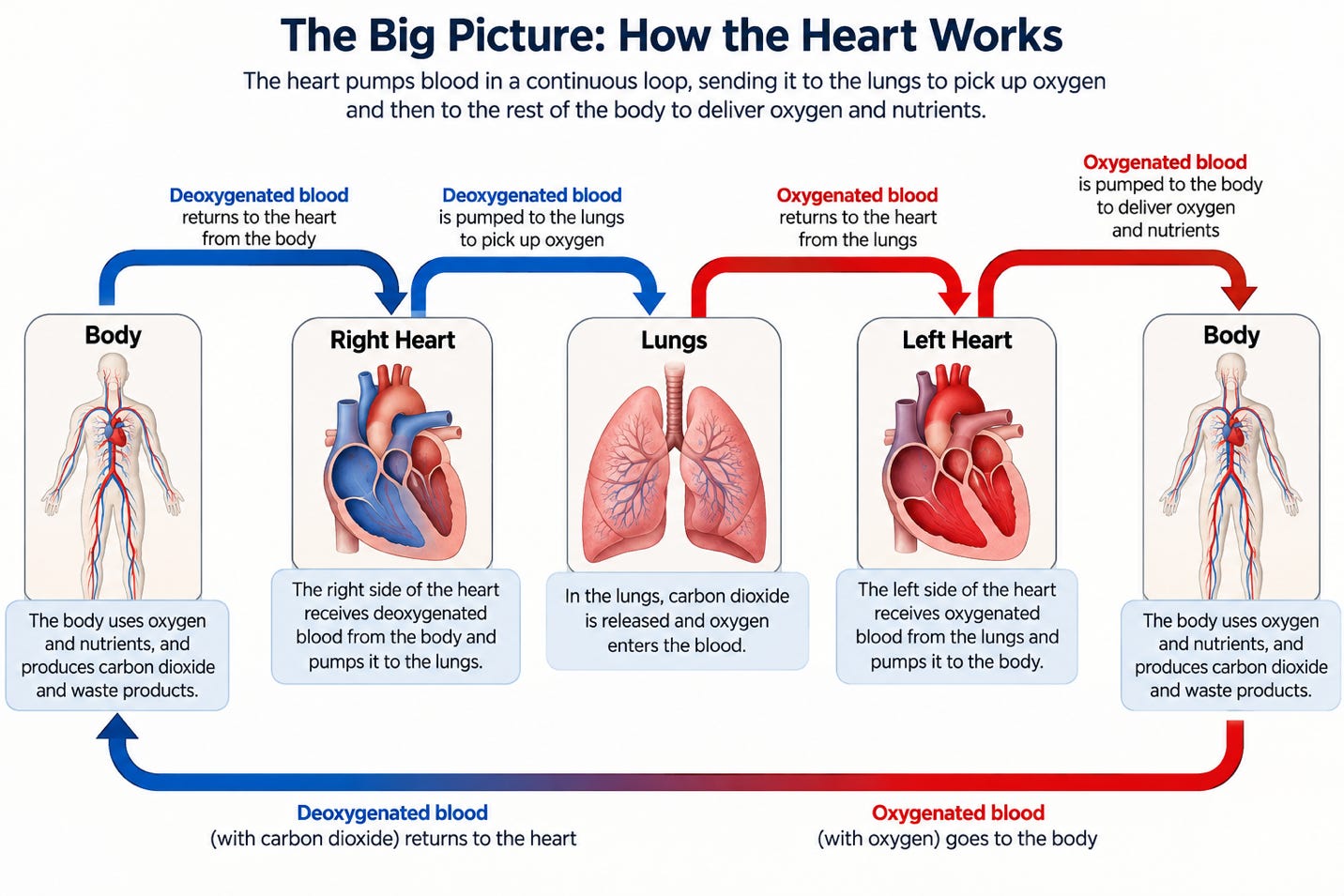
Once you understand that loop, most of the heart becomes much easier to understand.
The Heart Is Really Two Pumps
The heart has four chambers.
Two are on top.
Two are on the bottom.
The upper chambers are called atria.
The lower chambers are called ventricles.
The right atrium and right ventricle work together as one pump.
The left atrium and left ventricle work together as another.
The right side pumps blood to the lungs.
The left side pumps blood to the entire body.
That is why the left ventricle has a thicker muscular wall.
It has the harder job.
The right ventricle only has to push blood through the lungs.
The left ventricle has to push it from your chest to your brain, kidneys, legs, fingers, and everything in between.
Blood Only Moves One Way
A pump is not very useful if the fluid keeps flowing backward.
The heart solves that problem with valves.
There are four major valves.
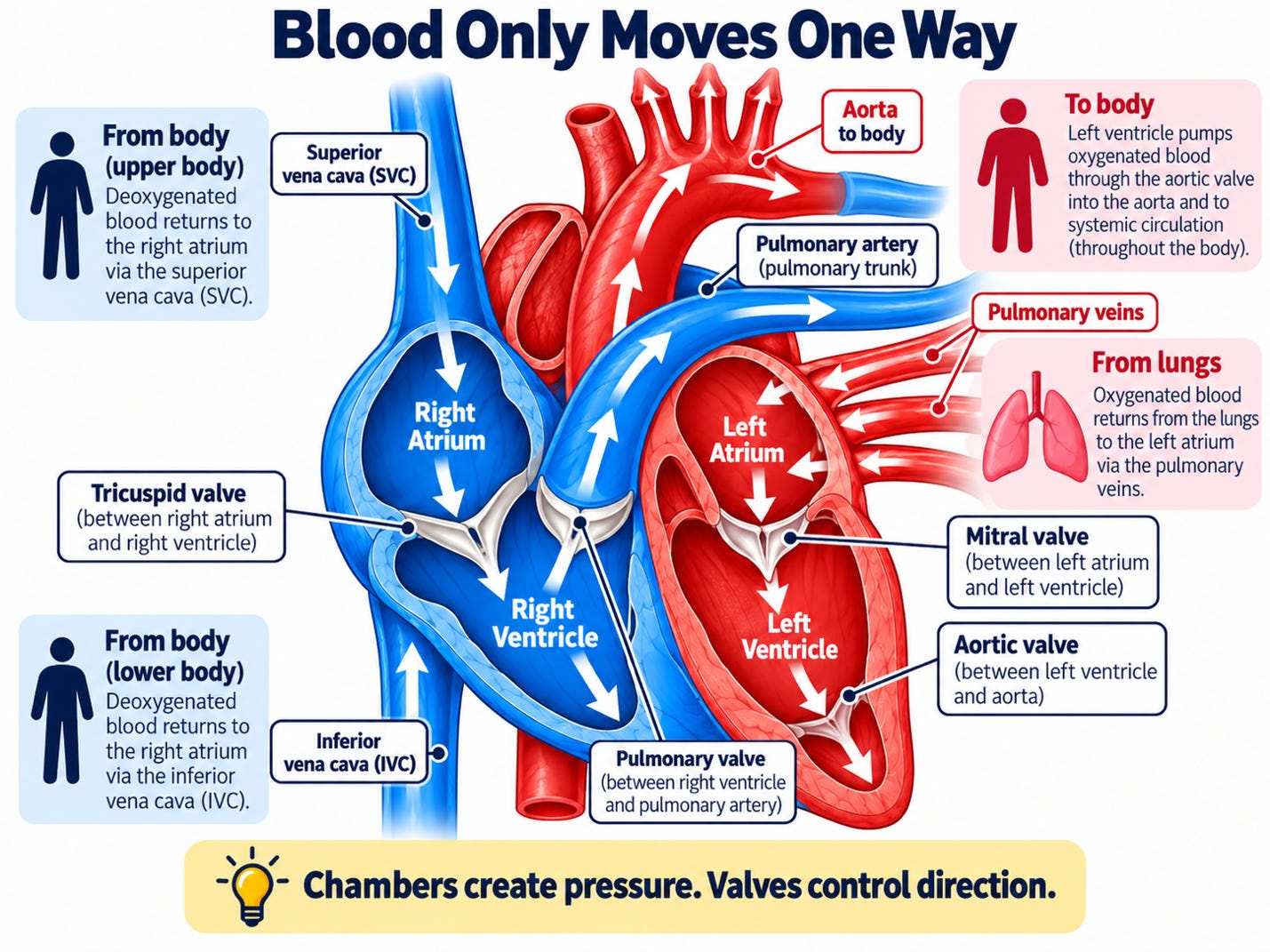
They act like one-way doors.
They open when blood is supposed to move forward.
They close when pressure tries to push blood backward.
You do not have to memorize their names to understand the machine.
The important idea is:
Chambers create pressure. Valves control direction.
When the valves are working properly, each heartbeat moves blood forward through the system.
What a Heartbeat Actually Is
A heartbeat is not one single squeeze.
It is a sequence.
First, the atria contract and help fill the ventricles.
Then the ventricles contract.
The right ventricle sends blood to the lungs.
The left ventricle sends blood to the body.
Then the heart relaxes and begins filling again.
Squeeze.
Relax.
Fill.
Squeeze again.
That cycle repeats roughly once every second when a person is resting, though the exact rate varies widely.
The Electrical System Comes First
The heart does not wait for your brain to command every beat.
It has its own electrical system.
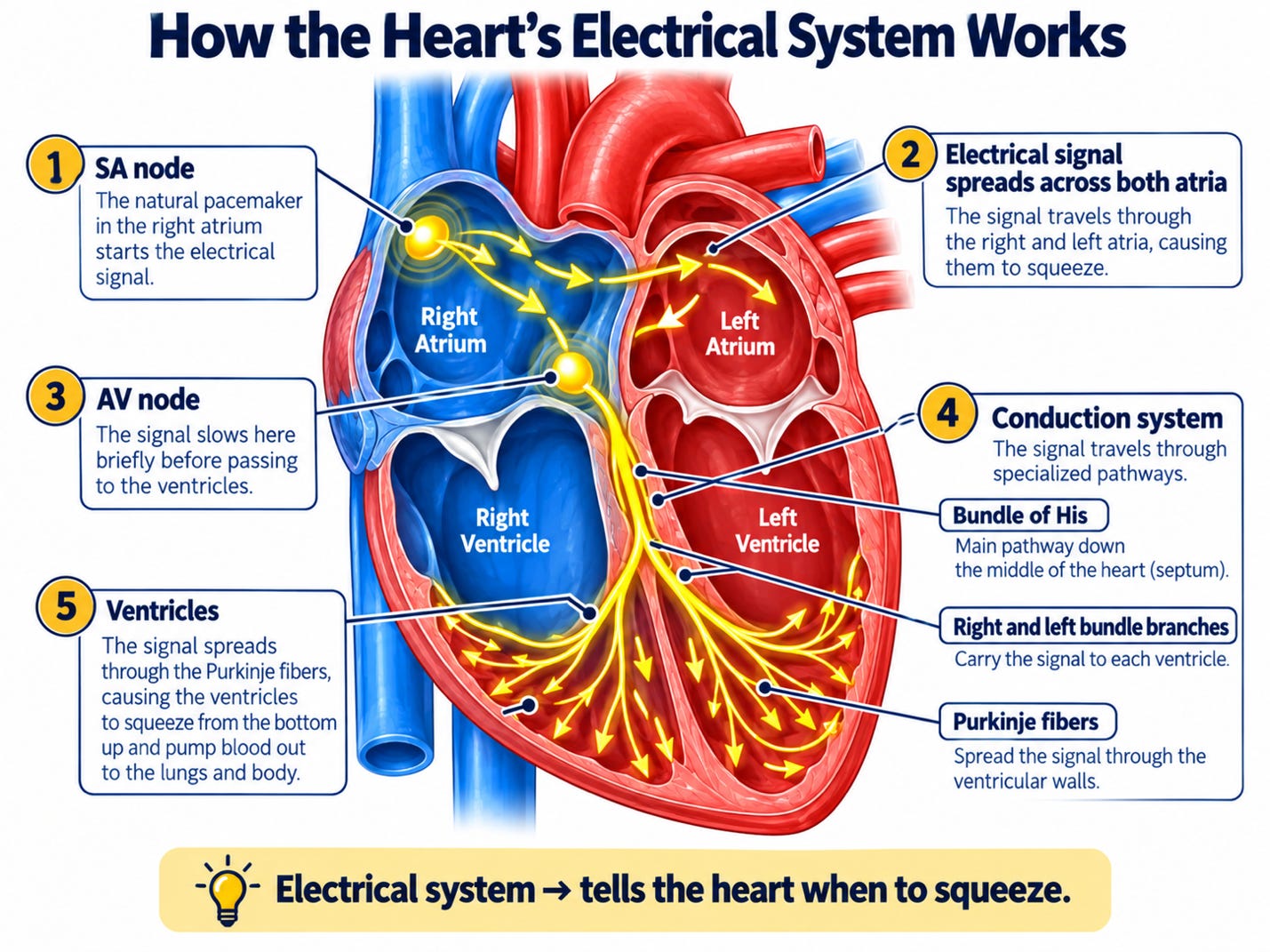
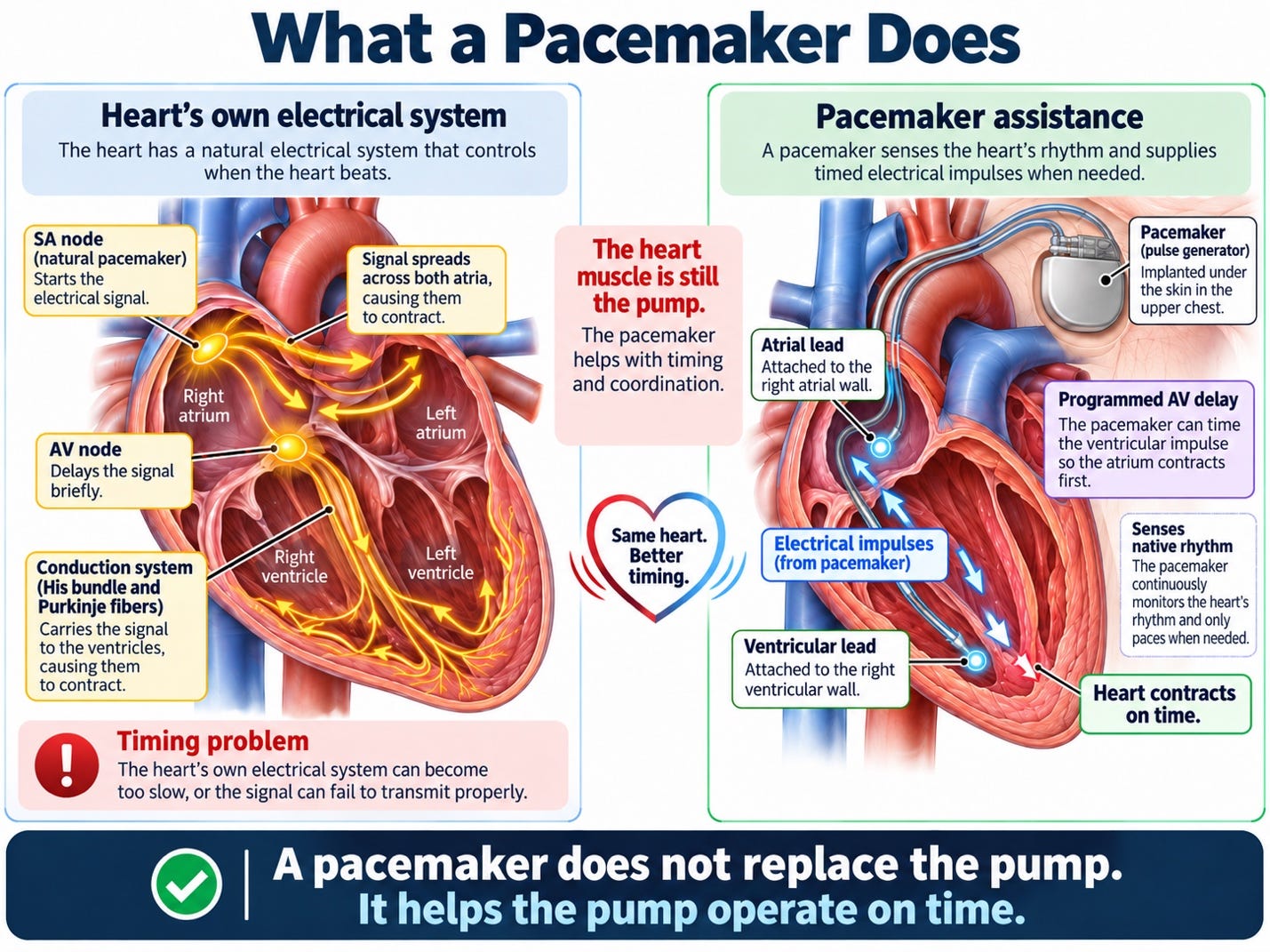
A small group of specialized cells in the right atrium, called the sinoatrial node, or SA node, normally starts each heartbeat.
It is often called the heart’s natural pacemaker.
The SA node generates an electrical signal.
That signal spreads across the atria.
The atria contract.
Then the electrical signal reaches another important structure called the atrioventricular node, or AV node.
The AV node briefly delays the signal.
That delay matters.
It gives the ventricles time to fill before they contract.
Then the electrical signal travels rapidly through specialized conducting tissue into the ventricles.
The ventricles contract.
So the heart has two systems working together:
Electrical system → tells the heart when to squeeze
Mechanical system → actually pumps the blood
If the electrical timing fails, the muscle itself may still be perfectly strong.
The problem is that the pump is no longer being told when to work properly.
Bob’s Question
🅱️ “So the electricity doesn’t power the heart muscle like electricity powers a motor?”
Correct.
The electrical signal is more like a timing command.
The muscle cells already contain the machinery needed to contract.
The electrical signal tells them when to do it.
Think ignition timing rather than an electric motor.
Why the Heart Speeds Up
Suppose you start walking uphill.
Your leg muscles suddenly need more oxygen.
They also need waste products removed faster.
The body responds in several ways.
Your breathing increases.
Blood vessels adjust.
And your heart beats faster and usually more forcefully.
The heart does not independently decide that you are climbing a hill.
Your nervous system and circulating hormones respond to what the body is doing.
They influence the SA node and the heart muscle.
The result is increased cardiac output.
Cardiac output simply means how much blood the heart pumps each minute.
It depends mainly on two things:
Heart rate × amount pumped per beat
That second number is called stroke volume.
If the heart beats 60 times per minute and pumps 70 milliliters each time, it moves about 4.2 liters of blood per minute.
During strenuous exercise, that number can rise dramatically.
Why Blood Pressure Exists
Blood does not move because it feels like moving.
It moves because pressure pushes it.
When the ventricles contract, they create pressure.
That pressure drives blood into the arteries.
The familiar blood-pressure reading reflects two points in the cardiac cycle.
The higher number, called systolic pressure, is measured while the ventricles are contracting.
The lower number, called diastolic pressure, is measured while the heart is relaxing between beats.
So a blood pressure of 120/80 does not mean the pressure is constantly 120 or constantly 80.
It rises and falls with every heartbeat.
What the Arteries Do
People often think arteries carry oxygen-rich blood and veins carry oxygen-poor blood.
Usually they do.
But that is not what defines them.
An artery is simply a vessel that carries blood away from the heart.
A vein carries blood toward the heart.
That explains the apparent exception in the lungs.
The pulmonary artery carries oxygen-poor blood away from the heart to the lungs.
The pulmonary veins carry oxygen-rich blood from the lungs back to the heart.
Direction defines the vessel.
Not oxygen content.
What Happens in the Lungs
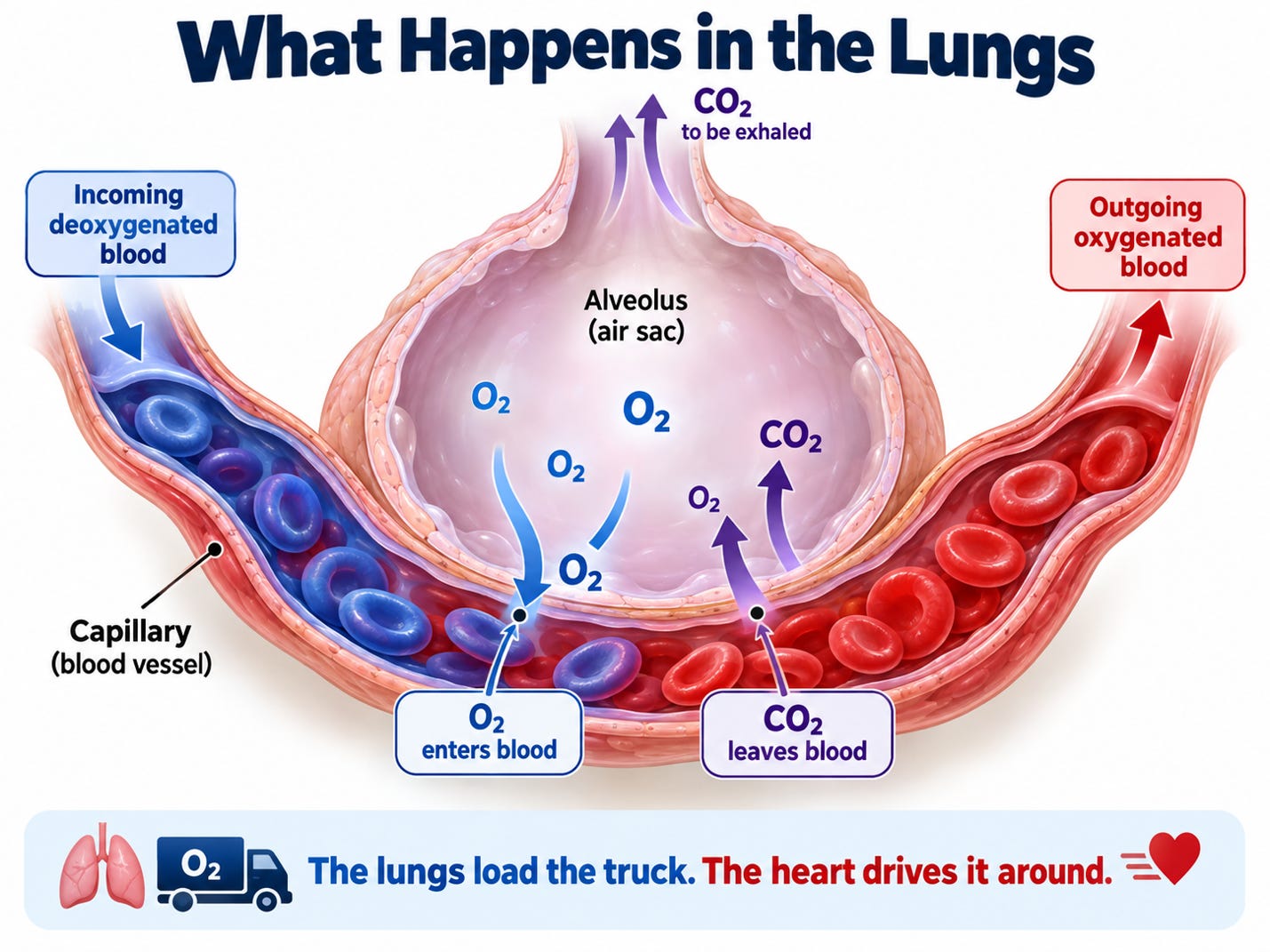
The right side of the heart sends blood into the lungs.
There, blood passes through tiny vessels surrounding millions of microscopic air sacs.
Oxygen moves from the air in the lungs into the blood.
Carbon dioxide moves from the blood into the lungs.
You breathe the carbon dioxide out.
The freshly oxygenated blood then returns to the left side of the heart.
The left ventricle sends it back into the body.
This is why breathing and circulation are inseparable.
The lungs load the truck.
The heart drives it around.
What the Blood Does in the Muscles
Oxygen-rich blood reaches tiny vessels called capillaries.
That is where oxygen leaves the blood and enters the tissues.
Inside cells, oxygen helps release usable energy from nutrients.
Much of that work happens inside structures called mitochondria.
You can think of mitochondria as microscopic energy plants.
They take fuel derived from food and, with oxygen, produce a molecule called ATP.
ATP is the immediately usable energy that allows muscle fibers to contract.
So during exercise, the chain looks roughly like this:
Food provides fuel.
Lungs provide oxygen.
Blood carries both.
Heart provides circulation.
Mitochondria turn the available fuel and oxygen into usable cellular energy.
A failure anywhere along that chain limits performance.
Why You Get Tired
If your muscles demand energy faster than the cardiovascular system can supply oxygen and fuel, the body begins reaching its limits.
Breathing becomes harder.
Heart rate rises.
Metabolism changes.
Muscles accumulate chemical byproducts.
Your brain receives signals telling you that continued effort is becoming expensive.
The sensation is fatigue.
Fatigue is not one single mechanism.
It is the body saying, in effect:
We are approaching the limits of what this system can currently sustain.
The Coronary Arteries
The heart pumps blood to the entire body.
But the heart muscle also needs its own blood supply.
It gets that through the coronary arteries.
These vessels run across the surface of the heart and feed the heart muscle itself.
That creates an important distinction:
A person can have a heart whose pumping muscle is strong but whose blood supply is threatened.
If a coronary artery becomes severely narrowed or blocked, part of the heart muscle may stop receiving enough oxygen.
That is the basic mechanism behind many heart attacks.
The plumbing supplying the pump has failed.
Heart Attack Is Not the Same as Cardiac Arrest
These terms are often confused.
A heart attack usually means blood flow through a coronary artery has been blocked enough to injure heart muscle.
A cardiac arrest means the heart has stopped providing effective circulation.
One is primarily a blood-supply problem.
The other is primarily a pumping or electrical catastrophe.
A heart attack can cause cardiac arrest.
But they are not the same event.
What a Pacemaker Does
A pacemaker does not make a weak heart muscle strong.
It solves a different problem.
It helps control timing.
The heart normally generates its own electrical signal. A pacemaker monitors that rhythm. If the heart beats too slowly, or if the electrical signal fails to travel properly from the atria to the ventricles, the pacemaker can supply precisely timed electrical impulses.
In a dual-chamber pacemaker, one lead can sense or stimulate the right atrium and another can stimulate the right ventricle. The pacemaker can then preserve the proper delay between the upper and lower chambers so they contract in the correct sequence.
The key distinction is simple:
A pacemaker does not replace the pump.
It helps the pump operate on time.
If the heart muscle is strong but the electrical command system is unreliable, restoring the timing can make an enormous difference.
Bob’s Bottom Line
🅱️ “So the heart is basically two pumps with four one-way doors and an ignition system.”
That is surprisingly close.
Two pumps.
Four main valves.
An electrical timing system.
A network of pipes.
And blood circulating through two connected loops.
The Part Worth Remembering
Forget the Latin names.
Remember the machine.
The right side sends blood to the lungs.
The lungs load it with oxygen.
The left side sends it to the body.
Valves keep it moving forward.
Electrical signals keep the chambers squeezing in the correct sequence.
Blood carries oxygen and fuel to the cells.
And then the entire process starts again.
About once every second.
Every minute.
Every day.
For decades.
That is how the heart works.
And mine is pumping a steady 60 beats a minute and I feel great.
However it came to be, the system is remarkable. Each part contributes to the same practical job: keeping billions of living cells supplied, every minute of every day. Evolutionists and creationists will interpret its origins differently. Both can appreciate how beautifully the machinery works.
Al,
We share the basic machinery with every other vertebrate: a heart, blood, and a network of vessels carrying oxygen and nutrients to the tissues and carrying wastes away. The plumbing varies. A fish uses gills; we use lungs. But the central job is the same—keep the cells supplied.
There is something there for everybody.
Jim