


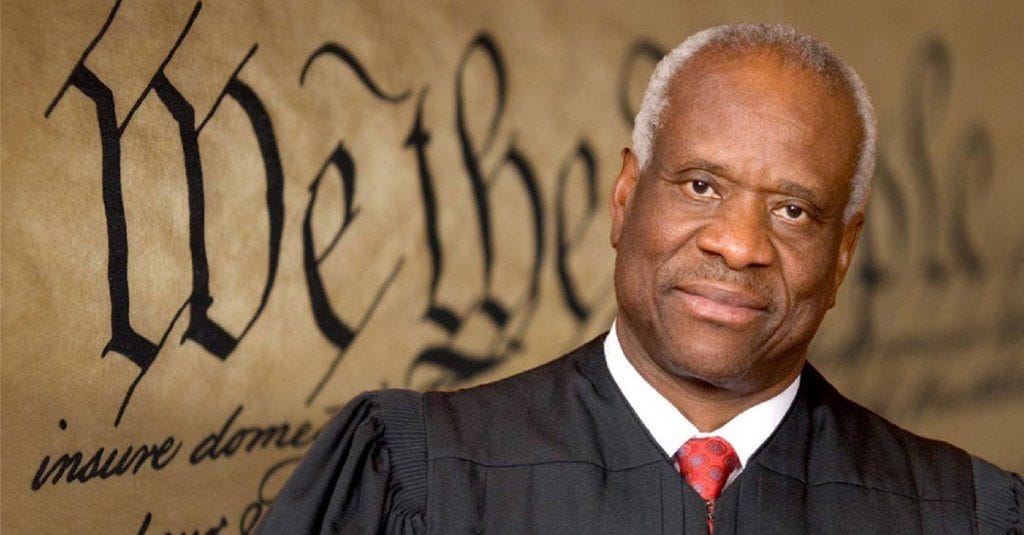
Justice Clarence Thomas Address at the University of Texas at Austin
April 16, 2026
Summary
In this address at the University of Texas at Austin on April 16, 2026, Justice Clarence Thomas reflects on the 250th anniversary of the Declaration of Independence and argues that America’s founding principles remain the only secure basis for liberty, dignity, and self-government. Drawing from his own upbringing in segregated Georgia, he says the truths of the Declaration were never abstract to him. They were lived convictions: that all men are created equal, that rights come from God rather than government, and that human dignity cannot be erased by unjust laws or hostile rulers.
Thomas argues that the real force of the Declaration lies not only in its words, but in the courage of the men who signed it and pledged “their lives, their fortunes, and their sacred honor.” He says America’s crisis today is not mainly intellectual confusion, but a lack of moral courage and devotion to principle. He contrasts the founding vision with progressivism, which he portrays as hostile to natural rights and too willing to place human freedom at the mercy of the state. Throughout, he insists that liberty cannot survive without sacrifice, citizenship requires responsibility, and the next generation must be willing to stand publicly and personally for what is true, even at a cost.
Key Takeaways
Justice Thomas frames the Declaration of Independence as the moral foundation of the American republic.
He argues that human equality and unalienable rights come from God, not from government.
He recalls learning these truths not from abstraction, but from family, church, and lived experience under segregation.
He says the Declaration gave Frederick Douglass, Abraham Lincoln, and Martin Luther King Jr. the moral ground to challenge slavery and segregation.
He emphasizes that the most important part of the Declaration may be its closing pledge: “our lives, our fortunes, and our sacred honor.”
He argues that principles without courage and sacrifice are only words on paper.
He praises the devotion of the Founders, soldiers, families, and ordinary Americans who sustained the country through hardship and war.
He warns that many in public life speak nobly but lack the devotion required to do what is right when it becomes costly.
He points to cowardice, conformity, and love of approval as recurring threats to moral leadership.
He reflects on Plessy v. Ferguson as an example of how obvious injustice can endure when those in authority lack courage.
He argues that rights are prior to government, and that government exists to secure them, not create them.
He presents the Constitution as the means of government, and the Declaration as the statement of government’s ends.
He stresses that limited government, separation of powers, and federalism exist to restrain abuses of power.
He argues that progressivism rejects the founding’s view of natural rights and substitutes state power for transcendent moral truth.
He portrays Woodrow Wilson-style progressivism as foreign to the American tradition and dangerous in its consequences.
He links modern statism to the broader 20th-century disasters produced by ideologies that denied permanent human rights.
He says America’s future depends less on clever debate than on the willingness of citizens to stand for truth in daily life.
He calls on students and citizens to show courage in classrooms, workplaces, communities, school boards, and public life.
He argues that courage, like cowardice, becomes a habit.
He closes by urging Americans not merely to celebrate the Declaration, but to defend it, live by it, and recommit themselves to its ideals.
================= Thomas Address (emphasis added) =================
Thank you all very much. President Davis, Provost Inboden, Dean Dyer, faculty, students, and honored guests, I thank each of you for being here. And I thank the school and the officials here for the invitation to visit the University of Texas at Austin.
My wife, Virginia, and I are pleased to be here to celebrate the 250th anniversary of the Declaration of Independence. If my memory serves me, this is only my second visit to the University of Texas, and this is the first visit at the invitation of the university.
But I have hired and worked with a number of outstanding young people associated with this university. My first was now-Chief Judge Greg Maggs of the U.S. Court of Appeals for the Armed Forces, who was a fairly new faculty member at the law school when I became a member of the Court. He took a leave of absence to help me as a law clerk during the second half of my first term.
My first UT graduate to serve as a law clerk was Greg Coleman three decades ago. Greg went on to become the first Solicitor General of the State of Texas. He was simply outstanding, as was his son Reed, who also was a graduate of the law school here and who was equally outstanding.
Greg’s widow and our very dear friend Stephanie are with us today. Stephanie, thank you, and thanks for being such a good friend.
Both Greg and his son Reed clerked for my dear friend Judge Edith Jones, also a graduate of UT Law School. I greatly admire Judge Jones. She is one of my heroes, and I admire her as a person and as a jurist. I am grateful that she can be here today.
A number of my former clerks are also here. I cannot tell you which ones, so let me ask them to stand to be recognized.
So in my chambers, UT and UT Law School are very well represented. I hope that my talk today will help in some small way to inaugurate another great initiative, the State of Texas’s plan to restore the teaching of civics and Western civilization to a central place in its flagship university.
I am grateful and honored to have been invited by Justin Dyer, the dean of the new School of Civic Leadership. I am also grateful for the assistance of my former law clerk, Professor John Yoo, who has spent the last three decades at Berkeley Law School but is now joining Justin and his team here at the University of Texas.
The school’s stated mission is to help students encounter the distinct inheritance of Western civilization and the American constitutional tradition as part of a larger quest for wisdom about how to live and how to lead. Your plans could not come at a more important moment for our nation, when, as we celebrate the 250th anniversary of the Declaration of Independence, the very values announced in it have fallen out of favor.
It is my sincere hope that your work to revitalize the teaching and research of Western civilization and the American constitutional tradition will lead the way in the reform of our nation’s colleges and universities. And I hope that your example will help rejuvenate our fellow citizens’ commitment to the principles of the Declaration of Independence.
I always seem to enjoy my travels to this amazing state. My wife, Virginia, and I have many wonderful friends and acquaintances here. And it is so special to have our dear friends Harlan and Kathy Crow join us today.
One of the features of the state that stands out is the way Texans talk about it. What comes through is the sustained and sustaining affection they have for their home state. That reverential feeling for and attachment to Texas is to be respected and admired, and, if possible, emulated.
This affection is similar to the attachment that I grew to have for my home state of Georgia, and certainly for our country, despite the indelible mark of segregation and its companion evils. I was proud to say that I was American by birth and Georgian by the grace of God. It was not uncommon to hear others openly proclaim their allegiance to God and country.
At our grammar school, St. Benedict’s, we started each school day by lining up two by two and class by class in the schoolyard to watch the raising of our flag and to say the Pledge of Allegiance before silently marching to our respective classrooms.
Even as so much of our God-given and constitutional rights were denied us, we still faithfully said the Pledge of Allegiance, memorized the Preamble to the Constitution, and yearned for the fulfillment of its promised ideals.
Sadly, these sentiments are not as widely shared among our fellow citizens today, and they certainly do not seem to have the sustaining strength that they had back then. In fact, all too often, the sentiments tend toward cynicism, rejection, hostility, and animus toward our country and its ideals.
With the foregoing in mind, I would like to begin by addressing my first encounter with the principles of the Declaration of Independence. It is perhaps not what you would immediately think.
The second paragraph of the Declaration proclaims, “We hold these truths to be self-evident, that all men are created equal, that they are endowed by their Creator with certain unalienable rights.” Throughout my youth, these truths were articles of faith that were impervious to bigotry and discrimination.
The American Heritage Dictionary of the English Language defines self-evident as “obviously true and requiring no proof, argument, or explanation.” Whether they had a divine source or a worldly one, they were never questioned. They were the Holy Grail, the North Star, the rock, immovable and unquestioned.
Despite the multiplicity of laws and customs that reeked of bigotry, it was universally believed among those Blacks with whom I lived, and who had very little or no formal education, that in God’s eyes and under our Constitution, we were equal. This was also the case with my nuns, most of whom were Irish immigrants.
At home, at school, and at church, we were taught that we are inherently equal, that equality came from God, and that it could not be diminished by man. We were made in the image and likeness of God. That proposition was not debatable and was beyond the power of man to alter.
Others with power and animus could treat us as unequal, but they lacked the divine power to make us so. Somehow, without formal education, the older people knew that these God-given or natural rights preceded and transcended governmental power or authority.
When you lived in a segregated world with palpable discrimination, and the governments nearest to you enforced laws and customs that promoted unequal treatment, it was obvious that your rights or your dignity did not come from those governments, but rather from God.
Though not a literate man, my grandfather often spoke of our rights and obligations coming from God, not from the architects of segregation and discrimination. Men were not angels. They were subject to the constraints of antecedent rights, and we were not subject to those men, even as we were subjected to their whims.
We knew that life, liberty, and property were sacrosanct. Those truths were self-evident to the adults in our lives and were taught to us as indelible, undeniable truths. Those around us could endure the insults of segregation with dignity because they knew that in God’s eyes, they were equal.
All too often, there is an unfortunate tendency when discussing the Declaration to make these self-evident truths and first principles of government obscure. Intellectuals want you to believe that our founding principles are matters of esoteric philosophy or sophisticated debate. Even those who support them too often talk about them as if they were academic playthings.
They overcomplicate them, take the spirit out of them, and discuss them in a way that puts us to sleep. But the principles of the Declaration of Independence, as I encountered them, are a way of life. They are not an abstract theory that you only learn in college or law school, but the basic premises of our Constitution and government that you can learn from the people all around you.
When Alexis de Tocqueville visited early America from France, he was struck that there was no country in the civilized world where people were less occupied with philosophy than the United States. But there was likewise no country where the principles of the Declaration were more deeply ingrained or more fiercely defended than those same United States.
That is the sense in which I knew the principles of the Declaration in my childhood. That is the only sense in which those principles can sustain our country. And that is the sense in which I will speak to you about those principles today.
I believe now, as I did then, that the Declaration of 1776 provides us with the principles to guide us as citizens of our republic. Even in this time of questioning and criticism of our founding, we should not forget that the Declaration established the principles that produced, despite all of our imperfections, our miscues, and our tragic mistakes, the freest, wealthiest, and most powerful nation in the history of the world.
It provided the moral principles by which Frederick Douglass, Abraham Lincoln, and Martin Luther King Jr. would criticize the institutions of slavery and segregation. The Declaration, in fact, along with the Gospels, is one of the greatest anti-slavery documents in the history of Western civilization.
It did not establish a form of government. That was the work of the Constitution that followed. But it stated the purpose of government. The Declaration made it clear in prose that the purpose of government is to protect our God-given unalienable rights, rights that all individuals equally possess.
As Abraham Lincoln declared in 1858, in the midst of his great debates with Stephen Douglas, “Drop every paltry, insignificant thought for any man’s success. It is nothing. I am nothing. Judge Douglas is nothing. But do not destroy that immortal emblem of humanity, the Declaration of American Independence.”
The ideas of the Declaration are so powerful that our nation could not coexist with the contradiction created by the great evil of slavery. Those principles were so powerful that hundreds of thousands of Americans fought and died in the Civil War to make men free. Those ideas have been so powerful that they convinced our nation to finally end segregation.
They continue to be so powerful today that they have inspired people throughout the world to throw off the shackles of their own oppressors. And it all began with our founders declaring in 1776 that “we hold these truths to be self-evident, that all men are created equal, and that they are endowed by their Creator with certain unalienable rights, that among these are life, liberty, and the pursuit of happiness.”
We should also not forget the important sentence that follows: “That to secure these rights, governments are instituted among men, deriving their just powers from the consent of the governed.” The principle of consent follows from the principle of equality. We the people can never legitimately consent to the violation of our God-given equality.
However, when I encounter the Declaration of Independence anew today, I am most struck by the final sentence. It can be easy to forget, 250 years later, the courage it took for those 56 men to sign the Declaration. Arguably, those men committed treason against the king, risking death at the hands of an empire far mightier than the newborn United States.
They thus concluded with the memorable final sentence: “And for the support of this Declaration, with a firm reliance on the protection of divine Providence, we mutually pledge to each other our lives, our fortunes, and our sacred honor.”
I will say it again: we mutually pledge to each other our lives, our fortunes, and our sacred honor.
Recently, I came across a definition of courage that is attributed to President Franklin Delano Roosevelt: “Courage is not the absence of fear, but rather the assessment that something else is more important than fear.” In essence, the signers of the Declaration were saying that they were willing to die for the principles they were asserting, the supreme act of courage. Those principles were more important than their fear.
Nothing in the Declaration of Independence, I now realize, matters without that final sentence. Without that sentence, the rest of the Declaration is but mere words on parchment paper. Nice words, but nonetheless just words. What changed the world was not the words, but the commitment and spirit of the people who were willing to labor, sacrifice, and even give their lives, what Lincoln at Gettysburg called “the last full measure of devotion,” for the Declaration’s principles.
It is that devotion to which we owe our rich inheritance. It was that devotion that sustained the Founders and the Continental Army as they fought and won the Revolutionary War, braved the winter at Valley Forge, crossed the Delaware, and defeated an army many times their number and firepower to win their freedom.
It was that devotion that Nathan Hale expressed when, before being executed by the British, he reportedly said, “I only regret that I have but one life to give for this country.”
It was that devotion that Patrick Henry invoked when he stood before the Virginia Convention and asked, “Is life so dear, or peace so sweet, as to be purchased at the price of chains and slavery? Forbid it, Almighty God. I know not what course others may take, but for me, give me liberty or give me death.”
That devotion has driven the great achievements and heroism of Americans in the 250 years since. Think of the frontiersmen who settled the West. Think of the families who built their little towns on the prairies. Think of the women who raised their children to love God and country and sent them off to fight wars.
Think of the soldiers on the battlefields of the Civil War who sang, “As He died to make men holy, let us die to make men free.” Think of the innovators and laborers and engineers who, Tocqueville observed, were so infused with patriotism that they felt every triumph for their country as a triumph in their personal lives.
Think of how that devotion carried us from Independence Hall to Flanders Field and to the beaches of Normandy. Think of the memorable scene in Band of Brothers when the American soldiers arrived at a concentration camp, saw the suffering, emaciated, desperate prisoners, unlocked the gates, and gave them food and blankets and warm embraces. The soldiers looked around and knew in their hearts that this is why we fight.
Think of the passengers of Flight 93 that crashed in Shanksville, Pennsylvania, on 9/11, or the young men and women whom we send in harm’s way even as we sit here today.
Think of my grandparents who heroically, quietly, without fanfare, sat my brother and me down at the kitchen table in August 1955 and committed the rest of their lives to us so that we could have a chance. They told us, “We don’t have no education and no chance, but you boys are going to have a chance. But we’re going to devote the rest of our lives to you boys.”
It was their devotion, their love, their dedication to raising us right, that made the difference, not the words, though the words expressed as best they could what they intended to do. Their devotion is what mattered.
Similarly, it is the devotion expressed in the final sentence of the Declaration, the willingness to do anything for our principles, that has throughout American history been most indispensable. It is that devotion that we are missing today, and that we must find in our hearts if this nation is to endure.
I arrived in Washington, D.C., 47 years ago. It is hard to believe. I arrived as a staffer for Senator Jack Danforth of Missouri in 1979, telling myself that the job on Capitol Hill would be a short stop on my way home to Savannah, Georgia.
I then joined the executive branch during the Reagan administration, served in two federal agencies for nearly a decade, served as a judge on the federal Court of Appeals, and have for the past 34 years served on the Supreme Court.
Since the day I arrived in Washington, there was never a shortage of people espousing noble purposes, saying all the right things. All around me there have been people full of promises, claiming a commitment to some righteous cause, to traditional morality, to national defense, to free enterprise, to religious piety, or to the original meaning of the Constitution.
These people can be just as high-minded as the men who signed the Declaration. They can mouth the words of the Declaration and parrot its principles. They can write essays and talk at conferences about the Declaration with the best of them.
All too often, however, this was but lip service, camouflaged by grand theories in the tall grass of big words and eloquent phrases. What seemed to be lacking, however, was that devotion.
People gain positions of authority, and you learn who they really are. To paraphrase something I recently read, combat strips us down to our essentials. Once in the spotlight, in that combat, many people fall prey to the lures that are set up to turn them away from their previously untested principles.
They become petrified by criticism, so fearful of negative attention that they find ways to avoid doing the right thing. Or they fall prey to the enchanting siren songs of flattery and become so bewitched by praise that they will desperately seek to conform accordingly.
They are enticed by access to things that were previously unavailable to them. They get so swept up in the euphoria of acclamation and acceptance that they put aside their convictions. They water down their message, negotiate against themselves, vote against their principles, and hide in the tall grass.
They recast themselves as institutionalists, pragmatists, or thoughtful moderates, all as a way of justifying their failures to themselves, their consciences, and their country.
It did not take me long in Washington to stop wondering why the Supreme Court took 60 years to overrule Plessy v. Ferguson, the 1896 decision that endorsed government-enforced racial segregation and validated the Jim Crow South that I grew up in.
It could not possibly have taken my Court 60 years to know that Plessy was a hideous wrong and that racial discrimination was grossly incompatible with our colorblind Constitution. The justices must have known it all along. The right thing to do, as Justice Harlan spelled out in his lone dissent, was obvious, as it so often is.
Perhaps what stood in the way was cowardice. The justices may have been afraid of the societal consequences. They may have been afraid of coming under political fire. They may have been afraid of losing their social standing. They may have been afraid of bad press. They could have been concerned that if they began to enforce a colorblind Constitution, they would have to address interracial marriage next.
But in any case, for 60 disgraceful years, they made American children like me grow up in a racial caste system because it was easier to do nothing than to do the right thing.
When Americans look to Washington and wonder why it so often disappoints, it is not because there are too few people who know what is right. It is not because we lack the intellect or the capacity or the talent. It is instead because there are too few people who are willing to do what it takes to do the right thing, to sacrifice the popularity, flattery, comfort, and security that are the purchase price for principle.
It is because too few of us reflect, and reflect deeply, the courage and commitment of that final sentence of the Declaration. And so many seem to have forgotten how much others have sacrificed so that this nation could exist and endure.
I will state this more poignantly: Do any of us have what it took for our young soldiers to storm Normandy Beach, to fight at Guadalcanal, to later fight at Chosin Reservoir? If we cannot say that we have the courage required of these young soldiers in battle to defend our founding principles, then how do we preserve these principles and this republic?
Until we have a devotion that matches the courage of those who made this country possible, I seriously doubt any amount of study or development of insights about our Constitution will make much difference. There is a world of difference between what it takes to score academic points and what it takes to protect and defend the Constitution as we are sworn to do.
I have faced this struggle myself. About 43 years ago, in the early spring of 1983, I was at the lowest point in my life. I had just buried both of my grandparents, the man and woman who raised me, and the two greatest people I have ever known.
I was broke. I was living in, and nearly evicted from, a cockroach-infested apartment. I could not pay my credit card bills on time. I would soon sell my car to pay my son’s tuition. I was being constantly attacked by the media and Congress because, as chairman of the Equal Employment Opportunity Commission, I did not bow to the then-prevailing orthodoxy on race.
At that point, I asked myself a simple question: What are the principles worth? What are your principles worth to you?
My answer then was the same I would give today. They are worth life itself.
What are those principles? They are the same principles in the Declaration. They were bequeathed to me by my grandparents and reinforced by my nuns and my faith.
In God’s eyes, we are equal. We are all equally created in the image and likeness of God. We are all endowed with the natural rights to life, liberty, and happiness. Our rights and our dignity are inherent. They do not come from others, and they do not come from the government.
And our government derives its legitimacy and its authority from our consent. We do not derive our rights from our government.
The primacy of our rights in relation to our government is crucial in reconciling the moral words of the Declaration with our Constitution and our history. None of our rights come from the government. All of the government’s authority comes from our consent.
And the structure and limited role of government is to ensure that it does not exceed the authority to which we have consented or intrude on our natural rights.
The Constitution is the means of government. It is the Declaration that announces the ends of government.
The Constitution achieves this purpose by protecting our natural rights and our liberties from concentrated power and excessive democracy. Our Constitution creates a separation of powers and federalism, truly for the first time in modern history, to prevent the government from becoming so strong that it threatens our natural rights.
Federalist No. 10 proposed the idea that the great threat to our rights comes from the majority faction. Human history teaches us, alas, that numerical majorities frequently seek to control government and use the state to violate the rights of the minority.
Because man is fallen, and the desire for power was, as James Madison described it, “sown in the nature of man,” government had to be limited. For, as Madison also said, “If men were angels, no government would be necessary. If angels were to govern men, neither external nor internal controls on government would be necessary.” But alas, men are not angels.
The slaveholders used the power of government to deny the fundamental natural rights of the slaves. The segregationists used the state to oppress freed men and women, including my ancestors.
As we meet today, it is unclear whether these principles will endure. At the beginning of the 20th century, a new set of first principles of government was introduced into the American mainstream. The proponents of this new set of first principles, most prominent among them the 28th president of our country, Woodrow Wilson, called it progressivism.
Since Wilson’s presidency, progressivism has made many inroads into our system of government and our way of life. It has coexisted uneasily with the principles of the Declaration. Because it is opposed to those principles, it is not possible for the two to coexist forever.
Progressivism was not native to America. Wilson and the progressives candidly admitted that they took it from Otto von Bismarck’s Germany, whose state-centric society they admired. Progressives like Wilson argued that America needed to leave behind the principles of the founding and catch up with the more advanced and sophisticated system of relatively unimpeded state power.
He acknowledged that it was a foreign science, speaking very little of the language of English or American principle, and offering none but what were, to our minds, alien ideas. He thus described America, still stuck with its original system of government, as “slow to see the superiority of the European system.”
Progressivism was the first mainstream American political movement, with the possible exception of the pro-slavery reactionaries on the eve of the Civil War, to openly oppose the principles of the Declaration. Progressives strove to undo the Declaration’s commitment to equality and natural rights, both of which they denied were self-evident.
To Wilson, the unalienable rights of the individual were “a lot of nonsense.” Wilson redefined liberty not as a natural right antecedent to government, but as “the right of those who are governed to adjust government to their own needs and interests.” In other words, liberty no longer preceded government as a gift from God, but was to be enjoyed at the grace of government. The government, as Wilson reconceived it, would be “beneficent and indispensable.”
Progressives such as John Dewey attacked the Framers for believing that their ideas were immutable truth, good for all times and places, when instead they were, according to him, historically conditioned and relevant only in their own time.
Progressivism seeks to replace the basic premises of the Declaration of Independence and hence our form of government. It holds that our rights and our dignities come not from God, but from government. It requires of the people a subservience and weakness incompatible with a Constitution premised on the transcendent origin of our rights.
You will not be surprised to learn that the progressives had a great deal of contempt for us, the American people. Before he entered politics, Wilson described the American people as “selfish, ignorant, timid, stubborn, and foolish.” He lamented that we do too much by vote and too little by expert rule.
He proposed that the people be ruled by administrators who use them as tools. He once again aspired to be like Germany, where the people, he said admiringly, were docile and acquiescent.
The century of progressivism did not go well. The European system that Wilson and the progressives scolded Americans for not adopting, which he called nearly perfect, led to the governments that caused the most awful century the world has ever seen: Stalin, Hitler, Mussolini, and Mao.
All were intertwined with the rise of progressivism, and all were opposed to the natural rights on which our Declaration is based. Many progressives expressed admiration for each of them shortly before their governments killed tens of millions of people.
It was a terrible mistake to adopt progressivism’s rejection of the Declaration’s vision of universal, unalienable natural rights. Wilson’s claim that natural rights must give way to historical progress could justify the greatest mistakes in our history.
In Plessy v. Ferguson, my Court upheld Louisiana’s system of racial segregation because “separate but equal,” it observed, was reasonable in light of the established usages, customs, and traditions of the people, and with a view to the promotion of their comfort and the preservation of the public peace and good order.
It comes as no surprise that the progressives embraced eugenics. Progressives believed that Darwinian science, the idea of ever-advancing progress written into biology itself, had proven the inherent superiority and inferiority of the races.
It was only a small step for Wilson to re-segregate the federal workforce. It was only another step for the government to launch sterilization programs on those deemed by the experts of the day to be unfit to reproduce, upheld by my Court in Buck v. Bell in an opinion written by no less a figure than Justice Oliver Wendell Holmes.
We can argue over whether you believe in immutable, absolute natural rights or the Wilsonian idea of ever-progressing history. Indeed, your School of Civic Leadership was created to host just such arguments. But let me ask you to consider the consequences.
European thinkers have long criticized America for remaining trapped in a Lockean world with its weak decentralized government and strong individual rights. They say our 18th-century Declaration has prevented us from progressing to higher forms of government.
But we were fortunate not to trade our Lockean bonds for the supposedly enlightened world of Hegel, Marx, and their followers. Fascism, which after all was National Socialism, triggered wars in Europe and Asia that killed tens of millions. The socialism of the Soviet Union and the People’s Republic of China proceeded to kill more tens of millions of their own people.
This is what happens when natural rights give way to the higher good of notions of history, progress, or, as Thomas Sowell has written, “the visions of the anointed.”
None of this, of course, was an improvement on the principles of the Declaration. Tocqueville’s Democracy in America is largely about how America owed its superiority over Europe to its conscious decision to reject central planning and administrative rule, root and branch.
Progressivism, in other words, is retrogressive. As Calvin Coolidge said on the 150th anniversary of the Declaration: “If all men are created equal, that is final. If they are endowed with inalienable rights, that is final. If governments derive their just powers from the consent of the governed, that is final. No advance, no progress, can be made beyond these propositions.”
“If anyone wishes to deny their truth or their soundness, the only direction in which they can proceed historically is not forward, but backward toward the time when there was no equality, no rights of the individual, no rule of the people.”
When Abraham Lincoln addressed the assembled crowd at Gettysburg, they had gathered to memorialize the past, but Lincoln’s address urged them not to do so with complacency. Instead, Lincoln said they should look to the past as inspiration to take them to greater heights in the future:
“It is rather for us to be here dedicated to the great task remaining before us, that from these honored dead we take increased devotion to that cause for which they gave the last full measure of devotion, that we here highly resolve that these dead shall not have died in vain, that this nation shall have a new birth of freedom, and that government of the people, by the people, for the people shall not perish from the earth.”
As we gather to celebrate the 250th anniversary of the Declaration, it may be tempting to do so as passive spectators. It may be tempting to enjoy our tea and crumpets, treat the Declaration like a shiny object or a keepsake, and listen to the sound of our own voices.
We could get into debates over whose conception of the founding is better, over how we are so much better than our founders were, over what we would do differently. We could be careful not to do anything that exposes us to criticism, costs us friends, or hurts our career prospects.
But in my view, we must find in ourselves that same level of courage that the signers of the Declaration had, so that we can do for our future what they did for theirs.
Each of you will have opportunities to be courageous every day, whether your calling in life is as a day laborer, a stay-at-home mom, a small business owner, an educator, an office worker, a judge, or in some other endeavor.
It may mean speaking up in class tomorrow when someone around you expects you to live by lies. It may mean confronting today’s fashionable bigotries, such as anti-Semitism. It may mean standing up for your religion when it is mocked and disparaged by a professor. It may mean not budging on your principles when it will entail losing friends or being ostracized.
It may mean running for your school board when you see that they are teaching your children to hate your values and our country. It may mean turning down a job offer that requires you to make moral or ethical compromises.
One thing I do know to be true: it will mean waking up every day with the resolve to withstand unfair criticism and attacks. These are the choices that will confront you, and you must decide whether to respond with timidity or with courage, as the signers of the Declaration did.
It will, of course, not be easy. It never is. But if, like me, you need a greater source of strength than yourselves, you will need to rely on your faith to guide and sustain you through it all.
You will disappoint people you thought were friends and endure personal attacks, as well as attacks on those you care about. But if you stand, you will find that courage, like cowardice, can be habit-forming, and it will become a part of your life and a part of who you are. And I may dare say, it is liberating.
You will also be a living example for others to emulate.
So by all means, celebrate the Declaration of Independence. It is the most important act of American history, the foundation of our Constitution, and, as Lincoln said, the sheet anchor of our republic.
But I implore you to celebrate it by standing up for it, by defending it, and by recommitting yourselves to living up to its ideals. Channel the courage of the men who faced down a king and signed it, or a president who led the nation in a civil war rather than permit this house to be divided by the great contradiction of slavery.
Take increased devotion to that cause for which they gave the last full measure. And with a firm reliance on the protection of divine Providence, let us mutually pledge to each other our lives, our fortunes, and our sacred honor.
Thank you, and may God continue to bless our country.