


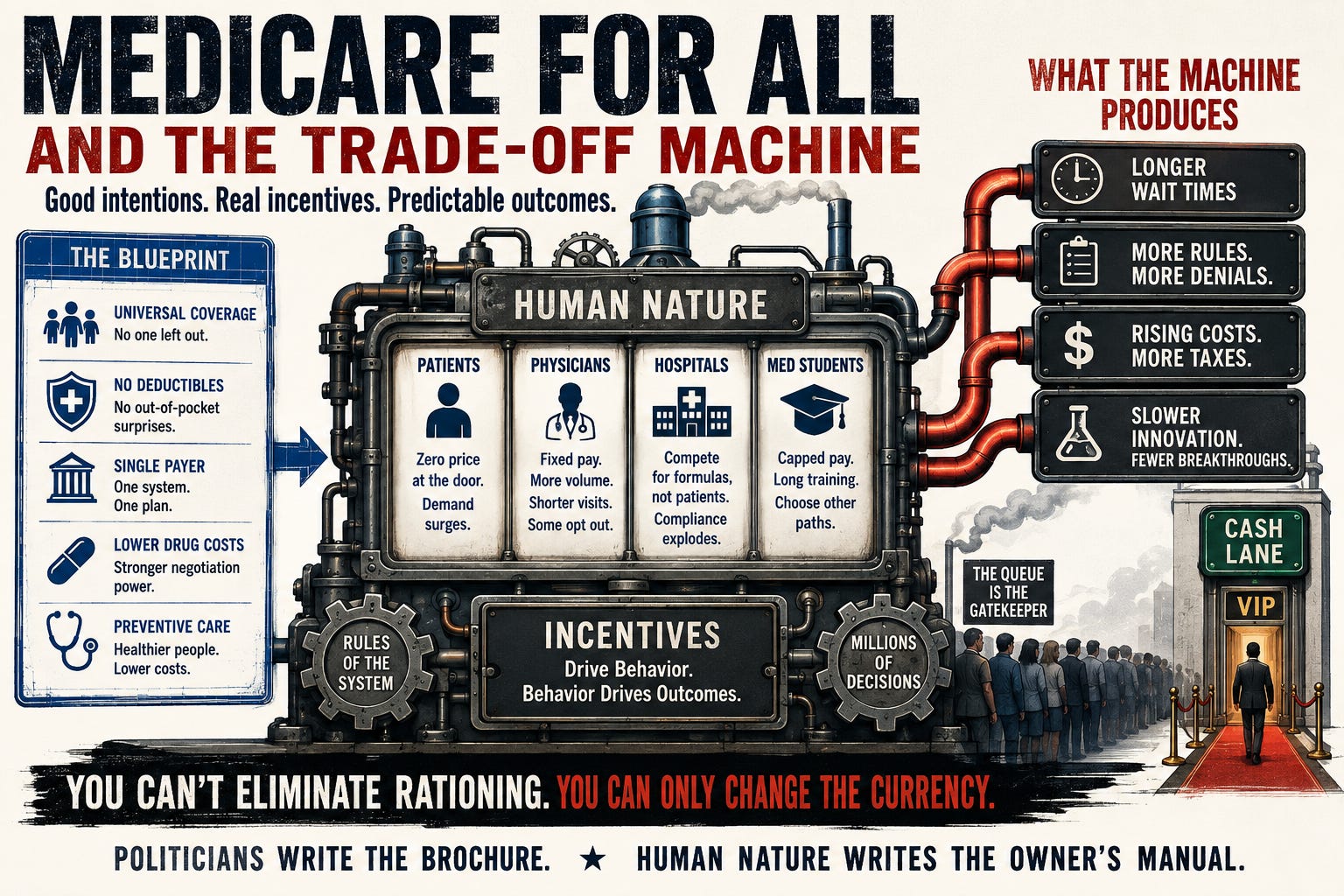
Medicare For All and the Trade-Off Machine
By Jim Reynolds | www.reynolds.com
August 5, 2026
I. Two Ways to Debate
There are two ways to debate public policy.
The first is the way we usually do it. Slogans, values, promises. Health care is a right. Health care is a privilege. Government is the solution. Government is the problem. Within minutes, everyone is talking past one another, nobody learns anything, and everyone walks away slightly more convinced they were right all along.
The second way begins with a blueprint. Before we build a machine, we ask how it is likely to behave once we turn it on.
That’s what engineers do. That’s what architects do. That’s what good economists do. They understand something that politicians—and the rest of us—consistently forget: systems produce outcomes because of the incentives embedded within them, not because of the speeches made on opening day.
This essay follows the second path.
We are not going to argue for or against Medicare for All. We are going to build the system on paper before anyone pours the concrete. We’ll examine the architecture, introduce actual human beings into the mechanism, and watch what happens when millions of ordinary people begin responding to the rules they actually face—not the rules we wish they faced.
The purpose isn’t to prove Medicare for All will succeed or fail. The purpose is to understand what kinds of pressures the design itself will generate. Once you understand the incentive structure, the future controversies stop looking like isolated crises and start looking like what they actually are: interacting consequences of a single design, playing out exactly as the blueprint predicted.
Physician shortages. Waiting lists. Administrative bloat. Cost control battles. Access disparities. These aren’t separate problems that might happen. They’re the same problem wearing different clothes.
We are no longer arguing about promises. We are arguing about the machine.
II. The Ideal Machine
Every proposal deserves to be judged by its strongest case, not its weakest. So before we introduce political friction, budgetary constraints, or institutional self-interest, let’s grant the advocates every reasonable assumption.
Assume Congress writes a thoughtful law. Assume the transition is orderly. Assume funding is adequate, administration is competent, and oversight is rigorous. Assume physicians cooperate, hospitals adapt, medical schools expand, and patients act responsibly.
In this best-case architecture, every citizen carries the same health card.
+--------------------------------------------------------------+
THE PROPOSED MODEL
+--------------------------------------------------------------+
Universal financial coverage without job-lock
Elimination of deductibles, copays, and surprise billing
Single-payer administrative consolidation
Centralized prescription drug price negotiation
Equal financial access to preventive care
+--------------------------------------------------------------+
Families no longer fear medical bankruptcy. Businesses stop hemorrhaging operational energy on annual insurance negotiations. Doctors spend less time battling billing departments, and drug costs fall under centralized purchasing power.
This is the system as intended. It’s a machine designed for universal access, financial predictability, and administrative simplicity. On paper, it’s elegant.
Now comes the uncomfortable question: What happens when millions of ordinary human beings—not saints, not villains, just people responding to incentives—begin living inside it?
III. Human Nature Enters the Room
A system’s blueprint is static. Human behavior is not.
Once the machine opens, every participant begins responding to the internal rules rather than the opening day speeches. Here’s what that looks like, one group at a time:
Patients face zero point-of-service costs. The price signal that once made you think twice about that specialist visit for a mild rash? Gone. Seeking care for minor, self-limiting ailments becomes completely rational—the cost to you is zero, and the benefit might be peace of mind. Demand surges across the entire system, not because people became hypochondriacs, but because the architecture stopped asking them to weigh cost against benefit.
Physicians face fixed reimbursement rates and swelling patient volume. Some absorb the higher load. Others shorten appointment times to twelve minutes and call it a day. Others cap their panel sizes and close to new patients. The most entrepreneurial ones transition to cash-only concierge models. The ones near retirement? They retire. None of them are villains. They’re just responding to the math.
Hospitals stop competing for private-payer margins and start competing for government reimbursement formulas. Entire administrative departments retool to master statutory compliance and formula optimization. The game changes from “attract insured patients” to “maximize yield per claim code.” The billing department shrinks; the compliance department triples.
Medical students look at extended training timelines, six-figure debt loads, and capped provider compensation—and quietly shift their specialization preferences toward lower-stress fields or non-bargained specialties where the ceiling hasn’t been lowered. Dermatology over primary care. The pipeline adjusts, slowly but inexorably.
None of this requires bad actors. None of it requires corruption. It only requires ordinary people making rational decisions within the parameters established by the architecture. The machine doesn’t ask for your ideology. It just sets the incentives and waits.
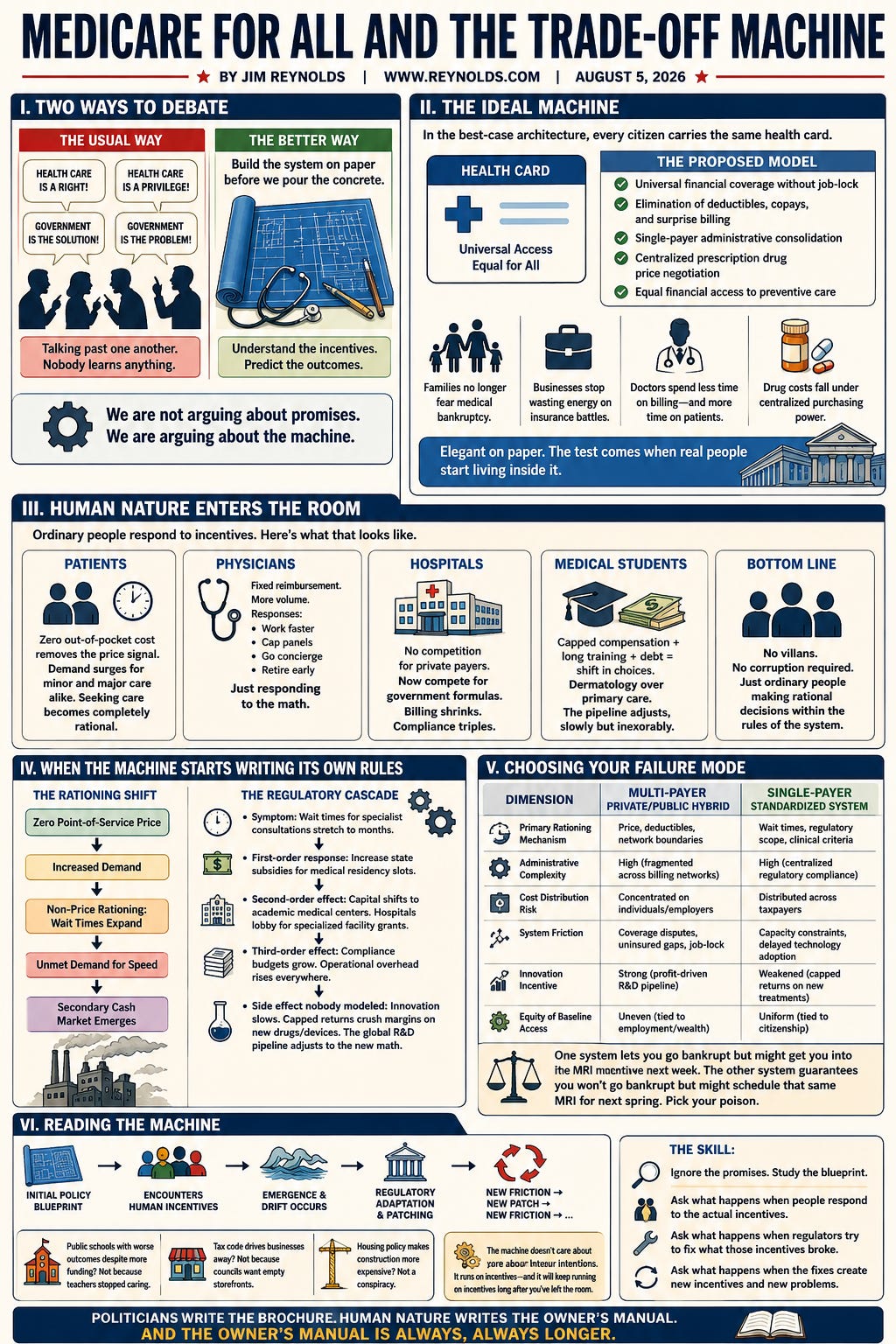
IV. When the Machine Starts Writing Its Own Rules
Here’s where it gets interesting.
When millions of individual choices interact inside fixed rules, emergent phenomena appear—outcomes no designer explicitly planned, no legislator voted for, and no advocate predicted in the brochure.
The most immediate one is straightforward: when price no longer rations service, time takes its place.
[ Zero Point-of-Service Price ]
⏬
[ Increased Demand ]
⏬
[ Non-Price Rationing: Wait Times Expand ]
⏬
[ Unmet Demand for Speed ] ⏩ [ Secondary Cash Market Emerges ]
You cannot eliminate rationing. You can only change the currency. In a multi-payer system, money rations access. In a single-payer system, waiting rations access. The queue becomes the gatekeeper. And as queues grow, something predictable happens at the margins: a private layer re-emerges for those willing to pay out-of-pocket for speed. The two-tier system the design was supposed to eliminate reconstructs itself—not as a policy choice, but as an emergent response to constraint.
Then the regulatory cascade begins.
To manage expanding queues and rising aggregate costs, central administrators implement utilization management protocols. The state now defines what counts as “medically necessary.” Private insurer pre-authorizations are replaced with standardized state oversight—different logo on the denial letter, same frustration in the doctor’s office.
Every adjustment triggers another:
Symptom: Wait times for specialist consultations stretch to months.
First-order response: Increase state subsidies for medical residency slots.
Second-order effect: Capital requirements shift toward academic medical centers, prompting hospital systems to lobby for specialized facility grants.
Third-order effect: Bureaucratic compliance budgets grow to track grant allocations, altering operational overhead across every institution.
Side effect nobody modeled: The innovation pipeline slows. When centralized price negotiation crushes margins on new drugs and devices, the incentive to develop them shrinks. The U.S. currently subsidizes global pharmaceutical R&D through high prices. Remove that subsidy and the world’s drug pipeline doesn’t politely maintain its current trajectory—it adjusts to the new math.
The system continuously adapts to the friction generated by its own rules. Each patch creates new friction. Each new friction demands another patch. The machine was supposed to be simple. It becomes anything but.
V. Choosing Your Failure Mode
No health-care system eliminates trade-offs. Each design simply chooses which pressures to accept and which to shift.
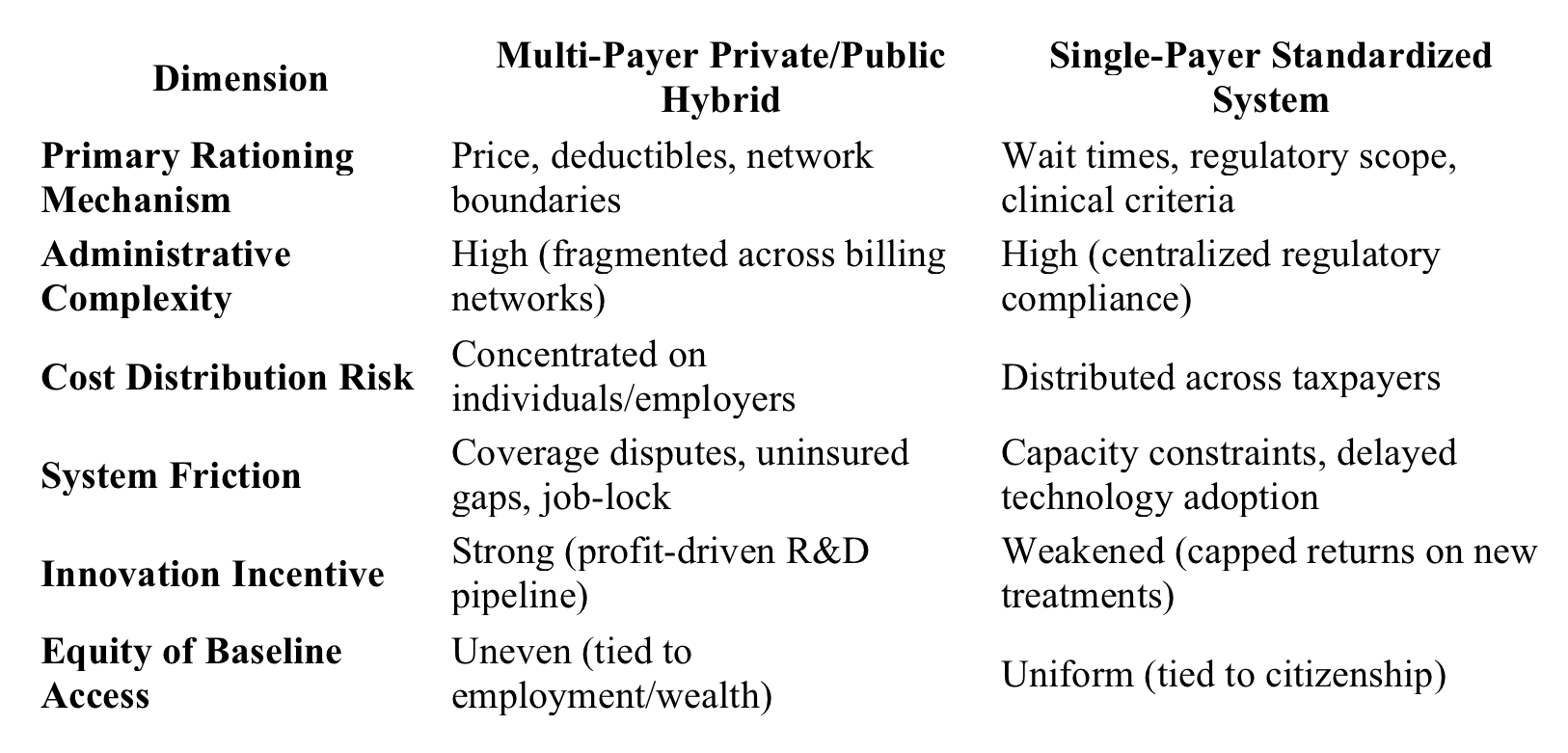
The choice is not between a flawed system and a friction-free alternative. It is a selection between two distinct sets of operational failure modes.
One system lets you go bankrupt but might get you into the MRI machine next week. The other system guarantees you won’t go bankrupt but might schedule that same MRI for next spring. Pick your poison.
This isn’t cynicism. It’s engineering. Every machine has a failure mode. The question is which one you prefer to live with—and whether the advocates are honest enough to tell you about it before you sign the contract.
VI. Reading the Machine
This dynamic is not unique to health care. It is the core lifecycle of every institutional design ever attempted.
[ Initial Policy Blueprint ]
⏬
[ Encounters Human Incentives ]
⏬
[ Emergence & Drift Occurs ] [ Regulatory Adaptation & Patching ]
⏬
[ New Friction ⏩ New Patch ⏩New Friction ⏩ ... ]
When a public school district produces worse outcomes despite increased funding, it’s not because the teachers stopped caring. When a municipal tax code drives businesses across county lines, it’s not because the city council wanted empty storefronts. When a housing policy meant to increase affordability instead makes construction more expensive, it’s not a conspiracy.
It’s the institutional machinery operating precisely according to its incentive structure. The machine doesn’t care about your intentions. It runs on incentives, and it will keep running on incentives long after you’ve left the room.
So here’s the skill this essay is trying to teach you: when you encounter a policy proposal, ignore the promises. Look at the blueprint. Ask what happens when ordinary people—lazy, clever, self-interested, short-sighted, occasionally noble, mostly just tired—start responding to the actual incentives the design creates.
Then ask what happens when the regulators try to fix what the first round of incentives broke.
Then ask what happens when the fixes create new incentives, and the new incentives create new problems, and the new problems require new fixes.
That’s not pessimism. That’s literacy.
Politicians write the brochure. Human nature writes the owner’s manual. And the owner’s manual is always, always longer.
Bill, all I can do is write them. If it changes one mind, maybe that is worth it.
Thank you for the article. Yes, it is common sense and lays out the problems. But it obviously presents other problems. First,I just know this won't apply to me. I won't see the doctor, try to see thee doctor for a hangnail. I'll wait until I show some blood, either literally or figuratively. But then I'll have to wait behind the hangnails before I can get treatment. Meanwhile, I bleed to death. The other obvious problem is that the wrong people won't read the article.