


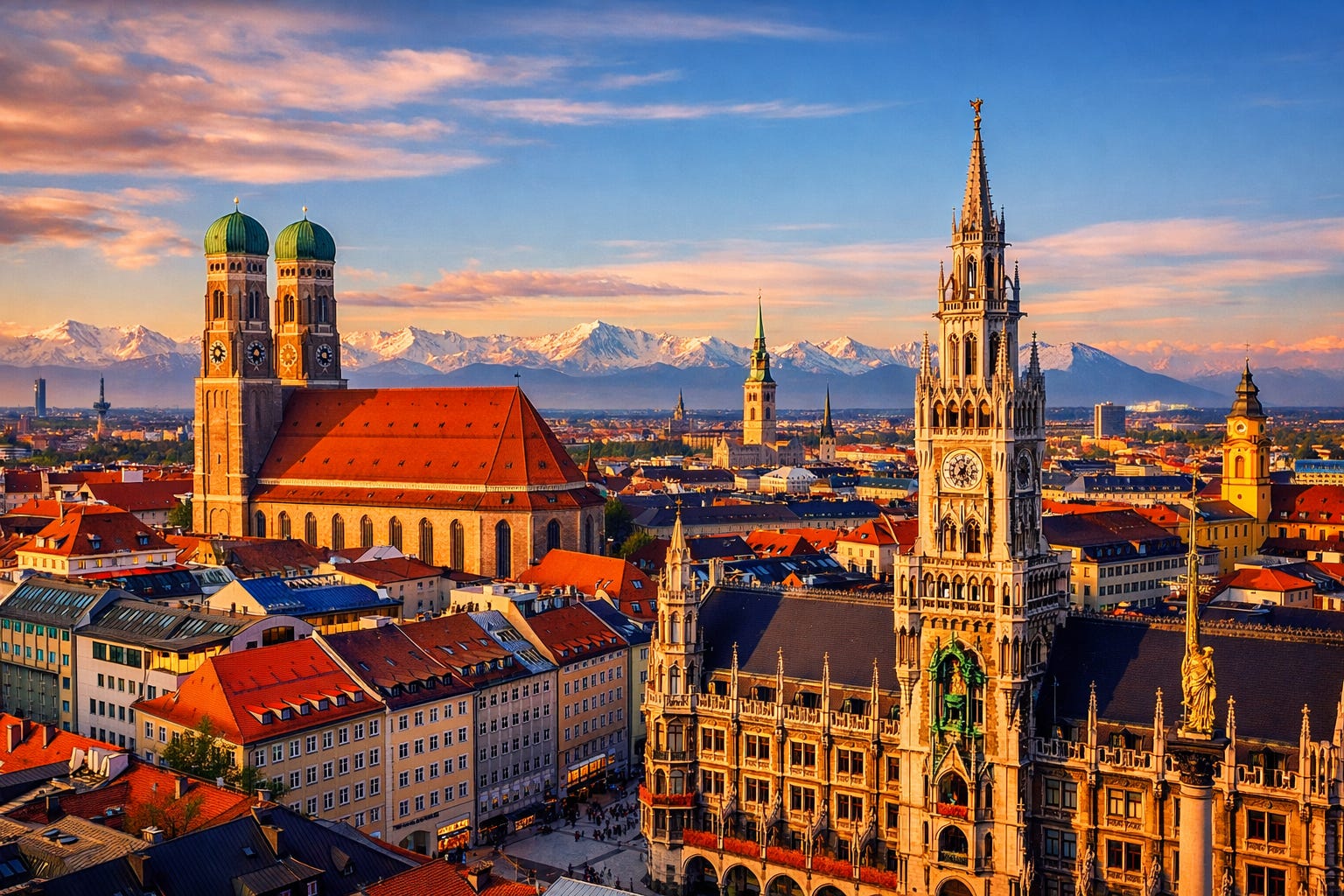
Munich: Readiness and the Presidency
By Jim Reynolds | www.reynolds.com
Munich is not a campaign stop.
It is not a podcast studio.
It is not a domestic policy panel.
It is not a protest stage.
It is a room where deterrence, alliance credibility, force posture, and geopolitical hierarchy are discussed as operational realities.
This year, Marco Rubio walked into Munich as Secretary of State and spoke in the language of statecraft:
Power.
Sovereignty.
Industrial capacity.
Alliance recalibration.
Enforcement.
Hierarchy.
He argued that institutions must serve capability.
He framed civilizational survival as the organizing principle of security.
He reassured Europe — but on revised terms.
Agree or disagree, he spoke in the grammar of power.
—-
Alexandria Ocasio-Cortez also appeared in Munich.
Her focus, as it has been throughout her career, centered on democratic norms, climate urgency, domestic legitimacy, and social justice concerns that intersect with global politics.
Those are real issues.
But Munich tests something different.
It tests whether a political figure can operate inside the architecture of international order — not simply critique it.
The presidency requires three forms of fluency:
Domestic legitimacy.
Economic stewardship.
Foreign policy command.
A candidate can rise on the first.
They cannot govern without the third.
In Munich, Rubio demonstrated comfort with:
Alliance mechanics.
Institutional reform.
Hard-power enforcement.
China management.
Conditional partnership.
He answered within the machinery.
AOC’s rhetoric, by contrast, remains rooted primarily in domestic moral framing. When transported into a geopolitical forum, that frame can feel adjacent rather than structural.
That does not make it unserious.
It makes it incomplete for that room.
If AOC intends to be a serious presidential contender — and many assume she does — she will eventually need to demonstrate mastery of that architecture:
Deterrence language.
Military-industrial coordination.
Alliance burden-sharing.
Energy-security tradeoffs.
Power balancing without abstraction.
That is not a criticism.
It is a requirement.
Munich exposes the difference between critique and command.
Between moral urgency and operational authority.
Between advocacy and executive readiness.
Rubio spoke as someone already embedded in the levers of state.
AOC spoke as someone still addressing the moral climate of those levers.
Both roles matter.
Only one is presidential in that setting.
And that is not about ideology.
It is about readiness.
The presidency is not won on domestic fluency alone. It is tested in rooms like Munich.
Rubio and his speech writers did a good job of distilling Trump’s agenda. Crystal clear.
Her deer-in-the-headlight freeze up may signal the end of her presidential aspirations. But probably not. Hey, speaking in public is no easy lift for anyone. But on this stage you must come prepared. She was not. I counted the seconds before she finally said something coherent: 11. That is an eternity in this venue.