


Munich: Two Visions of the West
By Jim Reynolds | www.reynolds.com
Munich is not just a conference. It is a symbol.
For decades, it has functioned as the cathedral of the post-war liberal order — the place where transatlantic unity is reaffirmed, where the “rules-based order” is invoked, where multilateralism is treated as both shield and scripture.
This year, two very different messages could be heard beneath the vaulted ceilings.
They were not shouting at each other.
They were not even directly debating.
But they were describing two different futures.
Marco Rubio stood in Munich and asked a foundational question:
“What exactly are we defending?”
His answer was not “the rules-based order.”
It was not “institutional stability.”
It was not “process.”
His answer was Western civilization.
Heritage.
Sovereignty.
Industrial strength.
Borders.
Capability.
He argued that the post-Cold War assumption — that trade would replace nationhood, that institutions could substitute for power, that global integration would dissolve rivalry — had proven naïve.
In his framing, decline did not begin with nationalism.
It began with abstraction.
We elevated procedure over sovereignty.
We elevated institutions over capability.
We allowed supply chains, energy policy, and borders to drift into ideological experiments.
The result, he suggested, was a thinner, more fragile West.
But Rubio did not threaten rupture.
He reassured.
“We want to do this together.”
The alliance remains.
But its hierarchy changes.
National interest before global abstraction.
Capability before legitimacy.
Strength as the guarantor of order.
—
The alternative vision — expressed in different language by leaders like Gavin Newsom — begins from a different diagnosis.
In that framing, the West’s strength comes from its norms.
Institutions are not tools to be subordinated; they are pillars to be protected.
The rules-based order is not an abstraction; it is the architecture that prevents great-power chaos.
Power constrained by process — whether through climate commitments, international courts, or supranational coordination.
Climate leadership is not self-impoverishment; it is strategic modernization.
Migration is not primarily a civilizational risk; it is a humanitarian and demographic reality to be managed within liberal norms.
In this worldview, decline does not begin with abstraction.
It begins when nations retreat into sovereignty at the expense of shared rules.
Strength flows from order.
Not the other way around.
—
So beneath the applause in Munich were two competing hierarchies.
Rubio’s hierarchy:
Sovereignty first.
Capability first.
Civilizational continuity first.
Institutions serve power.
The alternative hierarchy:
Institutions first.
Norms first.
Climate and rights as organizing principles.
Power constrained by process.
Neither vision claims to abandon the alliance.
Both claim to preserve it.
But they preserve different things.
One narrows the alliance around strength, borders, and industrial revival.
The other sustains it around multilateral norms and institutional continuity.
One says decline came from outsourcing sovereignty to abstraction.
The other says decline will come from abandoning abstraction for sovereignty.
That is not a tactical disagreement.
It is a difference in first principles.
—
Rubio did not detonate the cathedral.
He redrew its blueprints.
Newsom and others would preserve the structure as it stands — reinforcing its foundations rather than replacing its design.
Munich heard reassurance.
But it also heard recalibration.
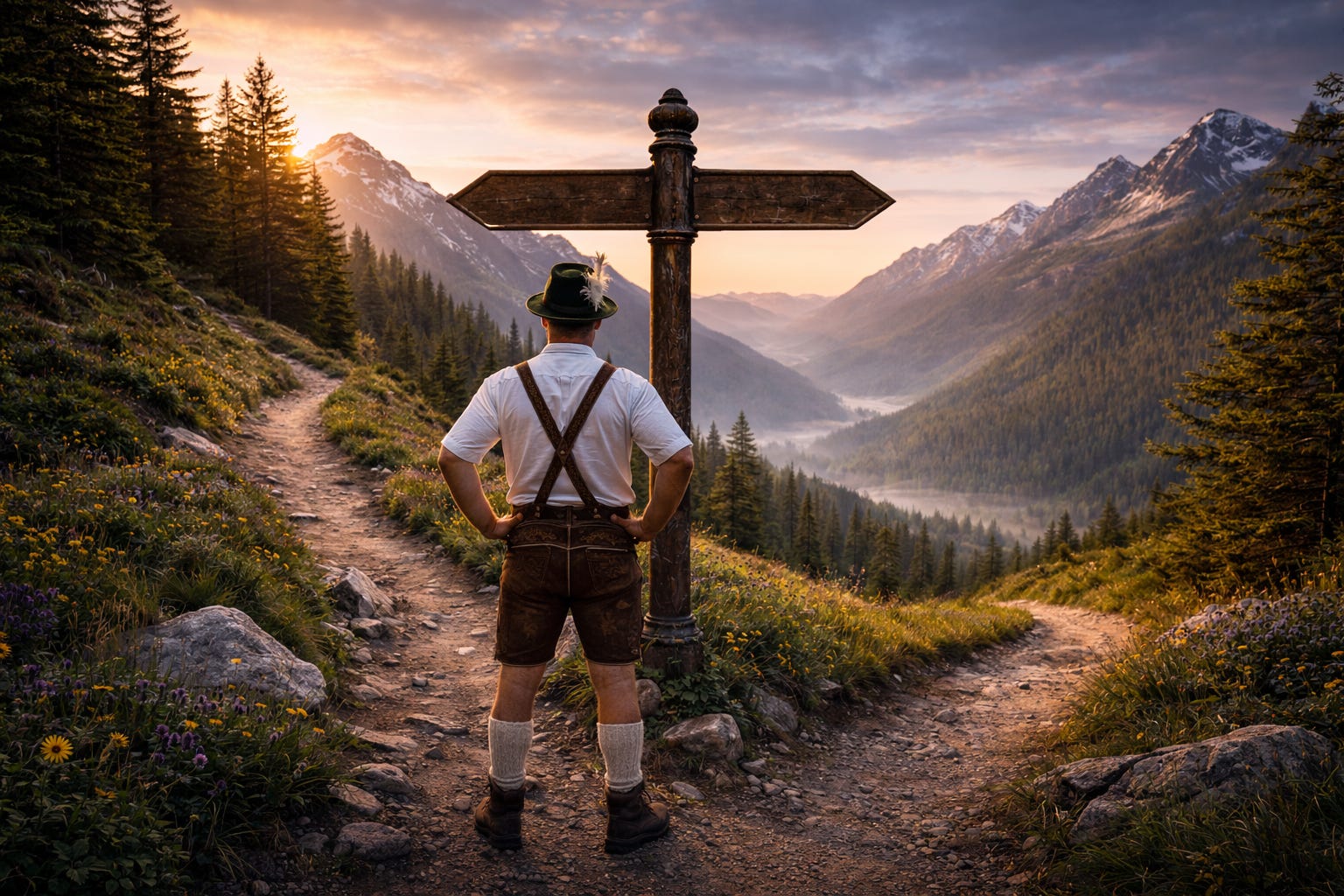
And that leaves the West at a fork in the road.
If Rubio’s doctrine holds, the alliance becomes stronger but narrower.
If it fails, the transatlantic relationship drifts into polite irrelevance.
Which hierarchy do you trust?
Which diagnosis better explains the last twenty-five years?
Which path produces resilience rather than managed decline?
The West will survive the next decade. The question is whether it survives on its feet — or on ceremony.
I only watch the Super Bowl for the halftime show. Luckily, I am bi-lingual. Ha!
What happens in my house today is far more important to me than who wins the Super Bowl. But more people will watch the Bowl than would be interested in my home life. The world leaders, those who were elected or appointed or self-installed claim to be protectors of my home, but they are more interested in the Bowl games. I will vote for my home protection, and ignore the games. Perhaps the leaders should really listen to that.