


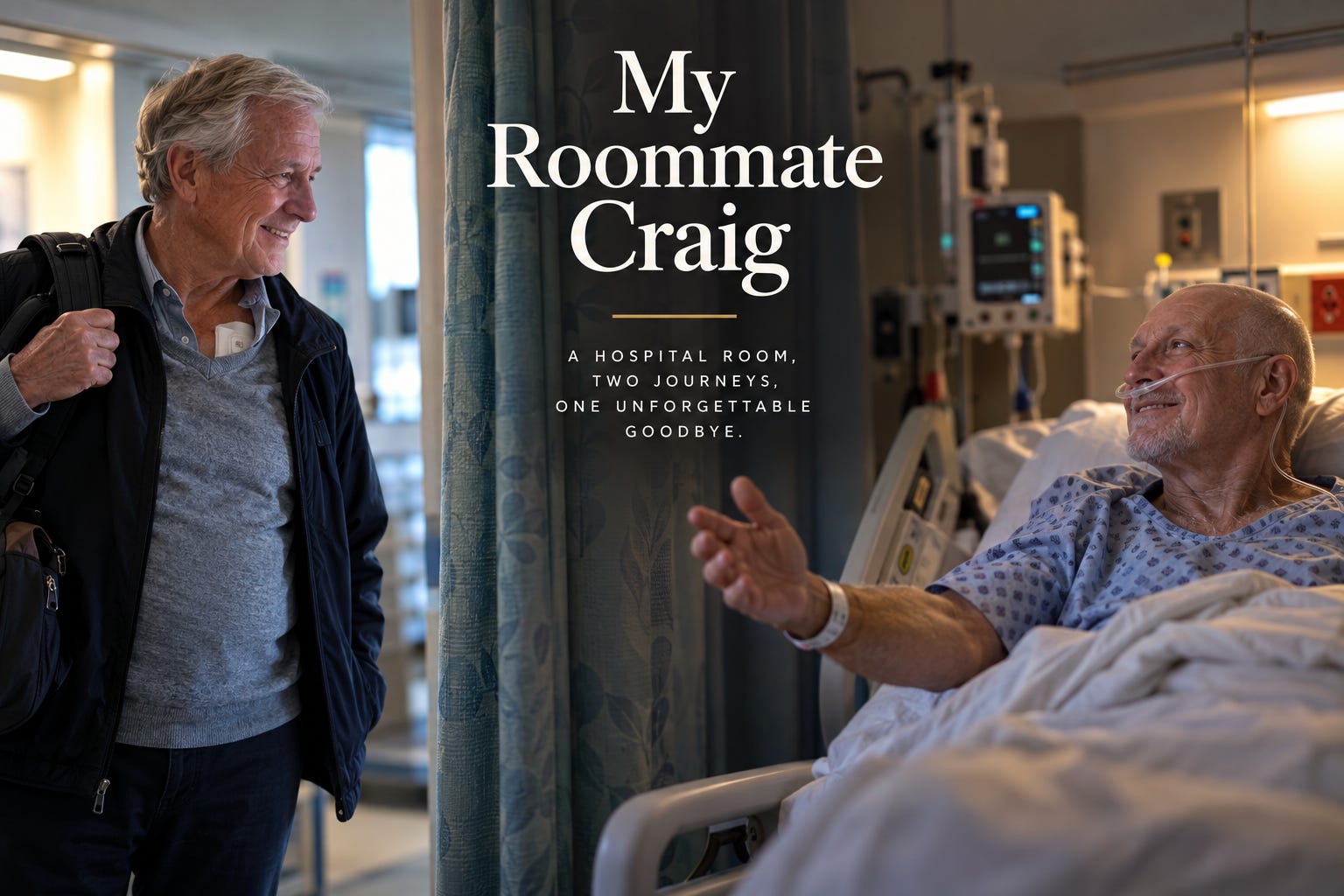
My Roommate Craig
By Jim Reynolds | www.reynolds.com
September 30, 2026
I knew something was wrong before I walked into the urgent care center.
For several days, my home blood-pressure monitor had been having trouble getting a reading. I could feel my heartbeat plainly enough, but it was unusually slow. At urgent care, they discovered just how slow.
My heart rate was in the low thirties.
That number tends to get people’s attention.
They had difficulty getting a reliable blood-pressure reading, too. Protocol took over. An ambulance was called to take me to Saddleback Medical Center, about fifteen blocks away.
I had the option of declining the ambulance. I felt surprisingly good. I could walk around, carry on a conversation and do most of the things I normally did.
But the numbers were dreadful.
So I did the prudent thing and took the ride.
The emergency room was what emergency rooms usually are: periods of intense activity separated by long stretches of waiting. Tests were run. Blood was drawn. Machines beeped. Eventually a cardiologist came by and explained the situation.
The electrical signal controlling the upper part of my heart was no longer communicating properly with the lower part.
I needed a pacemaker.
There was considerably more to the explanation, but that was the essential part. I have a technical background, and the doctor quickly figured out that he could dispense with much of the simplified version. My heart had essentially found a backup rhythm that was keeping the blood moving despite an extraordinarily low pulse.
That explained something that had been puzzling everyone.
On paper, I looked terrible.
In person, I looked pretty good.
A few hours later I was moved into a regular hospital room.
I noticed that I had a roommate behind the curtain, but I knew nothing about him.
At first I was much more interested in myself.
The nurses kept trying to take my blood pressure, and their digital machines hated me. My pulse might be 35, then 31, sometimes lower, and it wasn’t particularly rhythmic. The machines had apparently been designed for people whose hearts behaved more conventionally.
Sometimes it took four or five attempts before they got a reading.
I eventually developed my own theory. If they let me get out of bed and walk to the bathroom, perhaps my heart rate would rise enough to make the machine happy.
So I would walk to the bathroom and occasionally do a few knee bends while I was there.
Strangely enough, it seemed to help.
The nurses were understandably less enthusiastic about this experiment than I was. A man with a heart rate near 30 is not normally encouraged to wander around unassisted. My bed was armed with an alarm, so every trip to the bathroom required negotiations with somebody.
They were doing their jobs.
And they did them extremely well.
That first night, while I was sleeping, my pulse apparently dropped to around 22. I later learned that several nurses had been watching my monitor at the nursing station, wondering whether they were about to have a much more exciting evening than anyone wanted.
They came into the room to make sure I was still breathing.
I was.
The next morning I felt fine.
By then I had also begun learning something about the man on the other side of the curtain.
His name was Craig.
I learned about him the way you learn about a hospital roommate: accidentally.
There is almost no privacy in a shared hospital room. You don’t deliberately listen to another person’s conversations, but there is a curtain between you, not a concrete wall.
Craig had cancer.
It was a rare form, and it had already cost him a limb years earlier. Now it had returned and spread to his lungs. He was having increasing difficulty breathing and was on oxygen. He was also in considerable pain.
Over those two days I heard his doctors and nurses repeatedly ask him how he was doing.
Usually he was doing a little worse.
The Percocet increased. Other pain relief was added. His breathing became more difficult.
Yet Craig remained remarkably upbeat.
Every man who walked into his side of the room seemed to become “brother.”
“Thanks, brother.”
“Appreciate it, brother.”
It was simply the way he talked to people.
At one point I was having a particularly animated conversation with one of the orderlies on my side of the curtain. We were laughing at the absurdity of something—which I no longer recall.
Craig’s voice suddenly came from the other side.
“You guys should take your act on the road!”
We all laughed.
That was Craig.
Meanwhile, my pacemaker was supposed to be installed Tuesday afternoon.
Then two genuine emergencies arrived.
Two hearts had stopped so I got bumped.
I could hardly complain. Whatever was wrong with me, I was sitting upright in bed writing on an iPad with a heart rate of 30. Somewhere else in the hospital were people whose problems apparently could not wait.
Mine could.
So I wrote.
I wrote a long message to friends explaining what had happened. I worked on essays. I even published something from the hospital.
Waiting is easier if you have something useful to do.
My cardiologist, Dr. Shah, came by and explained that we could perhaps do the procedure late that night with a reduced staff, or wait until the next morning.
I chose morning. I figured he may want to go home and see his family. I could wait.
By then I understood the situation well enough that I wasn’t particularly frightened. My heart’s electrical system was malfunctioning, but the rest of the machinery was apparently strong enough to compensate.
The pacemaker would fix the electrical problem.
Craig had no equivalent repair waiting for him.
That became increasingly clear on Wednesday.
His cancer doctor came in first.
He was direct, professional and attentive. He did not manufacture hope where there wasn’t much to offer. He explained that the cancer was spreading and that Craig had decisions to make.
Later someone came to discuss palliative care.
Then someone discussed hospice.
Another person discussed what might happen after he left the hospital.
A member of the clergy came by and quietly talked with him about faith.
None of these people was cold.
Quite the opposite.
What struck me was how positive everyone remained in a situation where there was very little positive news to give.
The doctors, nurses, aides, hospice people and clergy all seemed to understand exactly what Craig was facing. They treated him with extraordinary patience and kindness. Nobody talked down to him. Nobody treated him as if he had already disappeared.
They were professionals doing an enormously difficult job.
But from Craig’s bed, I could also hear how overwhelming it all was.
Different people were explaining different possibilities, and at one point someone arrived apparently prepared to move forward with an arrangement Craig didn’t realize he had agreed to.
“Wait a minute,” he said.
He wasn’t angry.
That wasn’t Craig.
He simply explained that several people had come in discussing several different things, and he wasn’t quite sure what he had actually decided.
I understood exactly what he meant.
Later I heard him explaining the confusion over the phone, apparently to his sister.
Until then I had wondered how much support Craig had outside that room. Nobody had visited him during most of the time we were together. I had heard fragments about relatives, but nothing very clear.
Then I heard his sister on speakerphone.
She was reassuring him. She was going to be there. She would help.
I was relieved.
Which was strange in itself.
I had never spoken a word to this man.
Wednesday morning my pacemaker was delayed again.
Another emergency.
Fine.
I got out the iPad.
Eventually, around midday, everything suddenly moved very quickly. A gurney arrived, and I was taken downstairs.
The operating-room crew was entirely male.
I looked around and asked, “Is this the dude OR?”
They laughed.
One of them told me that apparently I had done something wrong because the patients they liked went to the operating room next door.
That seemed promising.
The procedure itself took about half an hour.
Not long afterward I was back upstairs.
My heart rate was now a steady 60.
Just like that.
Later, a young nursing student walked several laps around the floor with me. I felt fine.
By late afternoon Dr. Shah gave the word.
I could go home.
Everything happened quickly after that. Papers appeared. Instructions were given. I got dressed. My wife, Vicki, was coming to pick me up.
I didn’t need a wheelchair.
I was walking out.
Craig wasn’t.
By then there was no avoiding what I had been hearing for two days.
I had arrived at Saddleback with a potentially life-threatening heart problem. There had been uncertainty, discomfort, waiting and some genuine risk.
But there was a fix for mine.
A small electronic device had been placed inside my chest, and I was being given back something close to the life I had walked in with.
On the other side of the curtain, Craig had been receiving very different news.
His doctors could treat his pain.
They could help him breathe.
They could surround him with people who cared.
But they could not give him what they had just given me.
More time.
I went into the bathroom one final time and came out dressed to leave.
For the first time, Craig and I were standing there looking directly at one another.
For two days we had observed the unwritten code of male hospital roommates. You don’t intrude. You let the other guy deal with his problems while you deal with yours.
We had heard almost everything about each other.
We had never actually met.
Craig looked at me.
“Hey man, you got through this. Go on and have a great rest of your life.”
Of all the things he might have said at that moment, that was what he chose.
I finally called him by his name.
“Craig, I know you have a real rough time ahead of you. I wish you all the happiness in the world.”
We stepped toward each other and hugged.
Not the quick slap-on-the-back hug men sometimes give each other.
We held on for perhaps ten seconds.
Then we separated.
I looked him in the eyes.
“God bless you, man.”
And I walked out the door.

Precious in the eyes of the Lord is the death of his favored ones. Psalm 116:15
😊for you 😢 for Craig