


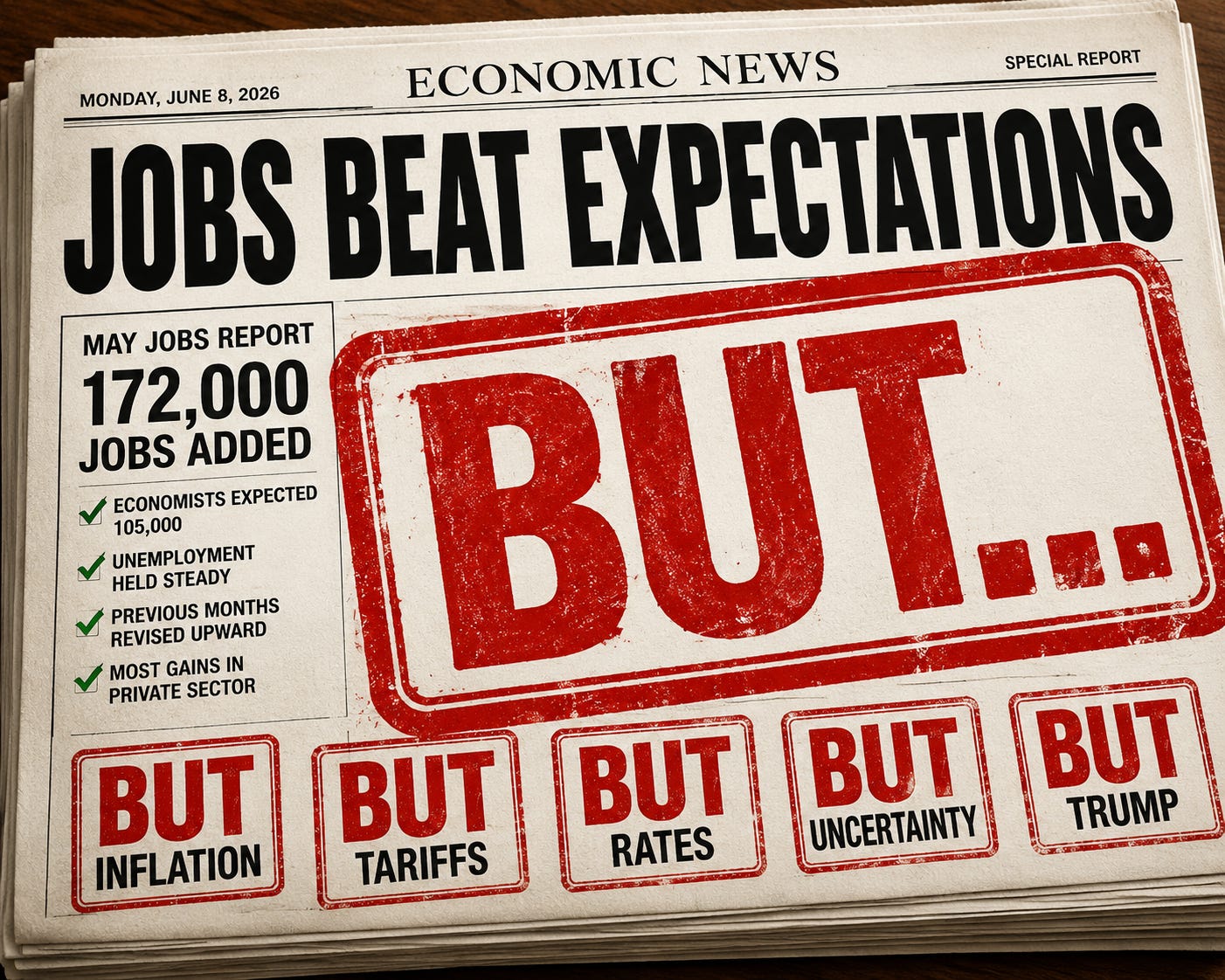
NO FLOWERS FOR THE JOBS REPORT
By Jim Reynolds | www.reynolds.com
June 8, 2026
Note: This essay is not really about a jobs report.
It is about a pattern.
For nearly a decade, positive economic news under Trump has often been followed by the same familiar word:
“But.”
Once you notice the pattern, you begin to see it everywhere.
The May jobs report should have been easy.
The economy added 172,000 jobs. Economists expected 105,000.
The jobs report beat expectations by nearly two-thirds.
The experts, meanwhile, continue to perform exactly as expected.
Unemployment held steady.
Previous months were revised upward.
Remember when the revisions always seemed to get worse? Not this time.
Most of the gains came from the private sector, not government payrolls.
In a normal world, that would be called good news.
Instead, the financial press immediately went looking for the “but.”
You’ve seen the headline before.
· Jobs beat expectations, but inflation.
· Jobs beat expectations, but rates.
· Jobs beat expectations, but tariffs.
· Jobs beat expectations, but uncertainty.
· Jobs beat expectations, but Trump.
The “but” always arrives on schedule.
This isn’t new. We’ve watched the same movie for ten years.
During Trump’s first term, we were repeatedly told that tax cuts would fail, deregulation would fail, tariffs would fail, and growth would fail. We were informed that unemployment had nowhere left to fall and that prosperity was largely an illusion.
Then unemployment fell.
Growth accelerated.
Wages rose.
The experts adjusted their story and moved on.
Then came COVID.
Governments shut down businesses by decree. Restaurants closed. Factories slowed. Offices emptied. Millions of Americans were told they could not work.
Blue states, led by blue governors and cheered on by much of the national press, were the primary accelerants. Schools closed. Small businesses disappeared. Families were separated from jobs, classrooms, churches, and normal life.
The resulting economic collapse was then discussed as though it had descended from the heavens like an unavoidable natural disaster.
It wasn’t.
It was the predictable consequence of political decisions made by elected officials who believed they could suspend large sections of the economy indefinitely without paying a price.
When the bill arrived, many of the same people who advocated the lockdowns spoke as if no one had ordered them in the first place.
Let’s say that again.
The people who demanded the shutdowns spent remarkably little time discussing their own role in producing the shutdown economy.
Businesses did not close themselves.
Schools did not lock their own doors.
Workers did not fire themselves.
Governors issued orders. Bureaucracies enforced them. Much of the press applauded them.
Then, when the economic damage arrived exactly as common sense suggested it would, the story gradually shifted from who caused the collapse to who inherited it.
The lesson was never learned.
Or perhaps it was learned too well.
Now we find ourselves watching the sequel.
Trump is back.
Peter Navarro is back.
Tariffs are back.
And so are the predictions of imminent catastrophe.
We were assured that tariffs would ignite inflation, destroy jobs, crush consumers, and send the economy into recession.
Yet here sits another jobs report refusing to cooperate.
Notice something else.
These are not primarily government jobs.
That distinction matters.
Government jobs require taxes, borrowing, or both.
Private-sector jobs generate the wealth that supports everything else.
A government can hire thousands of people while becoming poorer. Governments do not create prosperity simply by expanding payrolls.
Private employers hire when they believe customers exist, opportunities exist, and profits exist.
That is a far more meaningful vote of confidence.
The press understands this perfectly well.
Their problem is not the jobs report.
Their problem is what the jobs report implies.
For years they predicted that Trump’s economic agenda would end badly.
Every positive jobs report creates tension.
How do you report good news without helping the man you spent years warning people about?
Simple.
You acknowledge the good news and immediately pivot to the danger supposedly hiding behind it.
Hence the eternal “but.”
The jobs report is good, but…
The market is strong, but…
Consumers are spending, but…
Inflation is easing, but…
Manufacturing is improving, but…
The catastrophe is always just over the next hill.
At some point this stops looking like analysis and starts looking like narrative maintenance.
A mature audience understands what is happening.
The objective is not necessarily to deny the facts. The facts are often impossible to deny.
The objective is to manage their interpretation.
The gatekeepers of the Left have an important responsibility. They must ensure that no positive development under Trump arrives without a warning label attached.
The economy grows, but.
The market rises, but.
Jobs increase, but.
The reader is expected to absorb the first half and remember the second.
Yet reality has a stubborn habit of interfering.
The experts spent years predicting that Trump would drive the economic bus into a ditch.
Instead, they keep finding the bus further down the road than expected.
That doesn’t mean Trump is always right.
It doesn’t mean every policy succeeds.
It means the public has learned to recognize a pattern.
The jobs report arrives.
The experts sigh.
The “but” appears.
And another prediction of disaster is quietly postponed until next month.
The catastrophe is always coming.
It simply never seems to arrive on schedule.
Bob noticed it years ago.
🅱️ “The experts keep standing on the platform waiting for the train wreck. The awkward part is that the train keeps arriving on time.”
What timing...spoke with an older couple from Grand Junction at a rest stop as we are passing through for Ohio, not sure why they were out but we're on vacation. She commented about the drought, I reminded her that we are not forsaken from the Lord. She lit up and agreed. Don't let me media scare you. How many times have they lied to you?