


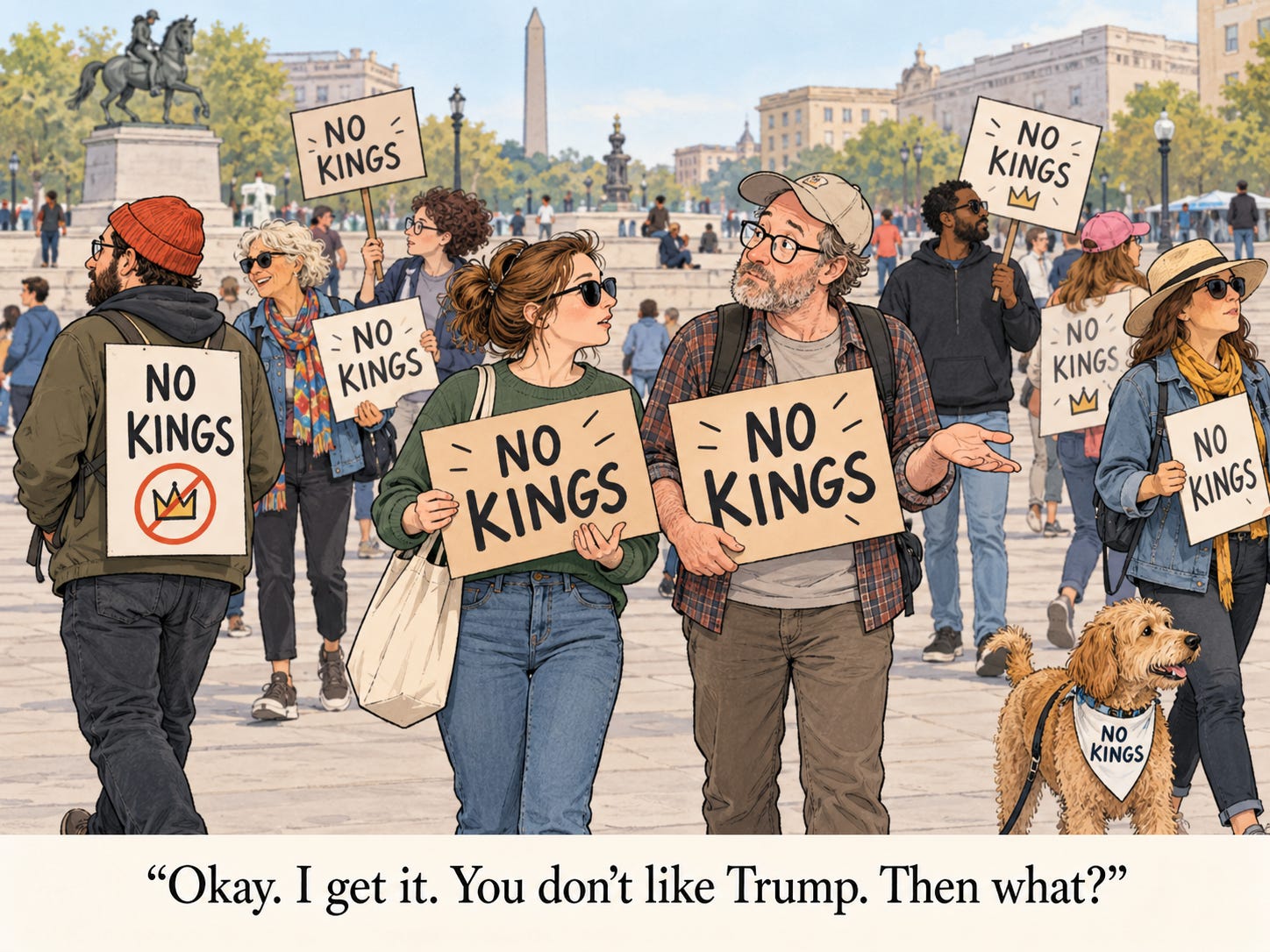
No Kings. Then What?
What a reporter in Oregon discovered when she asked protesters why they were marching
By Jim Reynolds | www.reynolds.com
October 12, 2026
I haven’t paid much attention to the No Kings protests.
I’ve seen the crowds, the signs, and the occasional television report. But I have to admit that I don’t really understand what the movement is all about.
No Kings?
Donald Trump had just been elected president by more than 77 million Americans. He won the popular vote and the Electoral College. We have a Constitution, three branches of government, and regular elections. Nobody crowned him. The voters elected him.
So what, exactly, are these people protesting?
I understand that they don’t like Trump. That’s hardly surprising. But what has he done that makes him a king? Which presidential powers do they believe he has exceeded? And what would they like to see happen instead?
These seem like reasonable questions.
Consider executive orders. On his first day in office, Joe Biden signed 17 executive actions, including orders reversing Trump administration policies. None required a new vote in Congress.
Was Biden exercising legitimate presidential authority, or exceeding it?
The number of executive orders doesn’t answer that question. Presidents have long used them to administer the executive branch and implement existing laws. Their legality depends on the authority behind them and what they actually require.
But that gives us a reasonable test for the No Kings argument: What specific actions make Trump a king, and would the same standard apply to Biden?
I have no particular desire to attend one of these demonstrations myself. It’s not that I find the participants objectionable. They simply haven’t struck me as especially interesting. People gathering to express their dissatisfaction with a politician is hardly a new phenomenon.
Still, I was curious. I wanted to understand what brought these people together, beyond their shared opposition to the president.
Then I came across an account of a No Kings demonstration in Bend, Oregon, written by someone who had actually gone out and asked the participants why they were there.
Evelyn Quartz is a former Capitol Hill staffer and writer whose political outlook no longer fits neatly into the usual categories. She has worked in Democratic politics but has also written critically about the progressive movement and the political establishment.
Earlier this month, she published an account of a No Kings demonstration in Bend, Oregon.
She freely admits that she was trying her hand at reporting. She gathered some pens and a notebook, put on a green cargo jacket—her idea of what a reporter might wear—and drove to the demonstration.
I rather liked that.
She wasn’t there to deliver a political speech. She wanted to talk to people. And she did.
Her account gave me an opportunity to examine the movement through the words of people who had actually shown up.
The first was Seth, a man in his thirties carrying an enormous American flag. But instead of fifty stars, the blue field contained the logos of Fortune 500 companies.
Seth was concerned about corporate power and its influence over government. He had attended a previous No Kings demonstration in Portland, where protesters had blocked highways, but preferred the atmosphere of the smaller Bend gathering.
Quartz asked whether his concerns about corporate influence might resonate with Trump supporters.
He agreed that they might. He even worked with some Trump supporters.
Did they ever discuss it?
Apparently not.
Here was a man protesting Trump over corporate influence who acknowledged that some Trump supporters might share his concerns. Yet there was little indication that he had tried to find common ground with them.
Next came an older couple who identified themselves as evangelical Christians. They were horrified by Trump and wanted Quartz to understand that they weren’t like the evangelicals commonly portrayed in the news.
Their church supported charitable causes, including assistance for poor people and immigrants. Their concerns appeared quite different from Seth’s. His focus was corporate power. Theirs involved Trump and the social responsibilities they associated with their faith.
Quartz then encountered a young transgender activist named Blue, who explained that much of their political experience took place online. Being outside with other people was a welcome change.
Quartz noticed that this sentiment appeared repeatedly. People enjoyed being together. Passing motorists honked their horns. Cyclists carrying American flags drew cheers.
For some participants, the gathering itself seemed to be an important part of the experience.
Then came Bill.
Bill was a bearded man in his sixties wearing a Revolutionary War costume. He carried a sign listing numerous ways he believed Trump had violated democratic norms.
When Quartz asked how Trump was behaving like a king, Bill referred her to his sign.
Here, finally, was someone who might explain the accusation behind the movement’s name. Unfortunately, Quartz doesn’t tell us what was written on his sign.
Their conversation eventually turned to what he wanted government to do.
Bill favored a living wage, affordable healthcare, and an end to funding for what he called the military-industrial complex.
Quartz suggested that these sounded like progressive positions.
Bill disagreed.
By now, we had encountered objections to corporate influence, concerns about Trump’s conduct, religiously informed social priorities, the desire for community, healthcare, wages, and military spending.
The demonstration was called No Kings. Its central message was presumably opposition to what participants considered excessive presidential power.
Yet the conversations were producing a much broader collection of grievances, many of which had little obvious connection to presidential authority.
And then Quartz met Erik.
Erik was a heavyset man in his fifties carrying two flags, one American and one Ukrainian. They had spoken earlier, but as Quartz prepared to leave, he approached her again.
He had thought of something she should write down.
Erik pointed to Project 2025, the conservative policy blueprint produced by the Heritage Foundation. Trump had repeatedly disavowed the project during his campaign, but that distinction wasn’t Erik’s concern.
Democrats needed something comparable.
At least, Erik reasoned, people would know where they stood.
Quartz asked what he would include in such a plan.
Erik returned to his earlier objection to corporate money in politics. Democrats should stop accepting it.
Then he laughed.
He didn’t believe they would.
I found that exchange more revealing than anything else in the account.
Here was a man attending a demonstration against the sitting president who wanted the opposition party to explain what it intended to do instead. And when he identified a specific change he wanted, he doubted that party would embrace it.
Erik wasn’t merely protesting Trump. He was expressing dissatisfaction with the political alternative.
What unites the No Kings movement?
There is certainly a common opposition to Trump. The movement’s name also suggests a shared concern about presidential power and the limits of executive authority.
But opposition to a president is not the same thing as agreement about what should replace his policies.
The people Quartz interviewed had different concerns and different priorities. Some wanted substantial policy changes. Others emphasized democratic norms. Still others valued the opportunity to gather with people who shared their dissatisfaction.
Perhaps that’s enough to organize a demonstration. Whether it’s enough to build a coherent political program is another question.
A handful of conversations at one demonstration cannot establish what the entire movement believes. But Quartz gave us something more useful than another collection of slogans.
She gave us the participants’ answers.
I began reading Quartz’s account wondering what these protesters had in common. By the end, I had my answer. They knew whom they opposed. What they wanted instead was considerably less clear.
Erik came closest to recognizing the problem. He wanted Democrats to produce a plan, something voters could examine and judge. He even offered a place to start: get corporate money out of politics.
Then he laughed. He didn’t believe his own party would do it.
There’s nothing unusual about people uniting against a politician they dislike. The harder task is agreeing on what should come next.
No Kings is a slogan. Then What? is a question that still needs an answer.

A classic example of a loud mouth with no thoughts. Hey, let's join a No Kings protest. Now ask "why?" Well, I don't know why other than I protest! The "no kings" thing doesn't really make sense because it is too un-specific. Even the questioned participants can't articulate a cohesive theme. Disorganized thinking...which is exemplary of the entire approach of the Dems. They are united only in the idea that Trump is somehow bad. How he is bad they can't define, just that he is bad. Speaking as a Republican, I'm gad the DSA and Co. are so scattered in their thinking.
Two ladies here, I call them AWOL. Angry white old ladies, wear shirts saying revolution is a right, no kings and defund ICE. The highlight of their lives is going to a no kings protest.