

No Teeth, No Change
By Jim Reynolds | www.reynolds.com
April 24, 2026
There is a point where words stop mattering.
You can protest.
You can vote.
You can march, chant, organize, and plead.
But if the men with guns decide they are done listening, the question changes.
It is no longer:
Who is right?
It becomes:
Who can make whom stop?
That is not cynicism.
That is politics at bedrock.
We like to believe we live inside systems of rules.
Laws.
Rights.
Courts.
Elections.
But none of those things enforce themselves.
A right that cannot be defended is not a right.
It is a request.
A population with no arms, no defensive weaponry, no practical means of resistance is not fully free.
It may be tolerated.
It may be managed.
But it is not free in the final sense.
This is why the Second Amendment matters.
Not because guns are magic.
Not because armed people always win.
They don’t.
The point is simpler:
A gun in the hand of a citizen changes the calculation.
It tells the criminal: this may cost you.
It tells the mob: this house is not helpless.
It tells the state: these people are not merely subjects.
That is what “teeth” means.
Cost.
The ability to make aggression expensive.
Force is not everything.
But it is underneath everything.
Police carry guns because some men cannot be reasoned with.
Soldiers carry rifles because some enemies do not care about treaties.
The question is not whether guns matter.
Everyone in power already knows they matter.
The question is who is allowed to have them.
If only the government has guns, it has final leverage.
If only criminals have guns, they have immediate leverage.
But if the citizen is the only one unarmed:
he exists by permission.
He may speak.
He may vote.
He may complain.
But when the armed side decides the discussion is over,
he has nothing left but hope.
Hope is not a plan.
And it is not a right.
This is not a call to violence.
It is a recognition that violence does not disappear just because decent people dislike it.
Disarm the decent, and the violent do not become peaceful.
They become dominant.
Police do not prevent all crime.
Governments do not protect everyone.
So every person eventually faces the same question:
If someone comes through your door to harm your family,
do you have the means to stop him?
Not persuade him.
Stop him.
That is why defensive weaponry matters.
Now scale it.
Not one man.
A population.
Not one criminal.
A regime.
Same question:
Can the people make repression costly?
Or can they be controlled, punished, and killed without meaningful consequence?
That calculation decides the terms.
This is where people retreat into language:
influence
persuasion
moral authority
All of it matters,
until the men with guns decide it doesn’t.
Then the theory ends.
Look at Iran.
A population can be brave.
It can fill the streets.
It can speak the truth.
But if the regime is armed, organized, and willing to kill,
while the population has no comparable means of resistance,
then the regime does not have to win the argument.
It only has to wait.
It only has to make dissent more painful than submission.
This is the difference:
A population that can be oppressed only at great cost
and a population that can be controlled cheaply.
One creates risk.
The other creates opportunity.
And predators understand opportunity.
Take away the gun, and you do not remove violence.
You remove one side’s answer to violence.
You make the citizen negotiable.
You make his rights conditional.
That is not freedom.
That is custody.
So yes, words matter.
Votes matter.
Courts matter.
But they matter most when power knows there is a limit.
A line.
A cost.
Without that:
Politics becomes theater.
Rights become paper.
Change becomes something granted,
not something the people can compel.
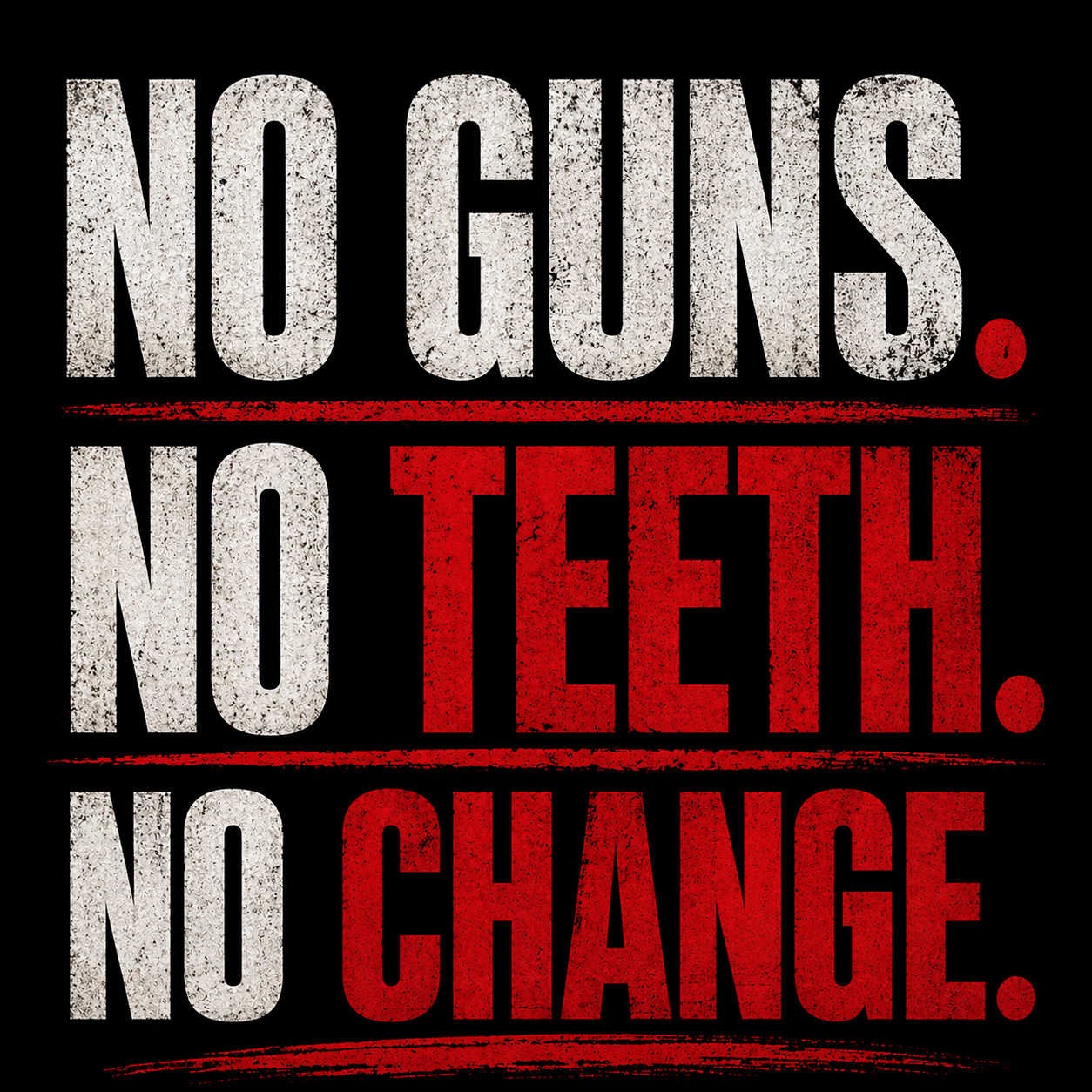
No guns.
No teeth.
No change.
In Iran only the revolutionary guards have guns. Hasn’t worked out well for the citizenry or the world.