



Over the Line
By Jim Reynolds | www.reynolds.com
July 31, 2026
Growing up in the 1950s and ’60s, we played three sports.
We did not schedule them. We did not register for them. We did not wait for adults to organize them.
We found whoever was available, counted heads and invented a competition.
Basketball was the easiest.
Two boys could play one-on-one or H-O-R-S-E. Four became two-on-two. Six became three-on-three. The game simply expanded as more players arrived. If ten showed up, the only real question was whether we had enough ambition to play full-court.
Football required a little more imagination.
When we were young, we played tackle football on somebody’s front lawn. No helmets. No pads. No yard markers. No real sidelines, either. You were not out of bounds until you fell into the street.
Small trees were part of the field.
There was lots of tackling, very little blocking, and an astonishing number of improvised passes and laterals. Sometimes it was difficult to remember who was on which team.
But we always had a huddle.
That was where somebody scratched a play into the all-but-destroyed lawn.
“You go long.”
“You cut behind the tree.”
“If they rush me, I’ll pitch it to you.”
By our early teens, the game moved to the park and became touch football. The field opened up, the passing game took over, and I learned how to become a throwin’ quarterback. Teams might have two, three, four or five players on a side. As with basketball, the game adjusted itself to whoever happened to be there.
Then the Parks Department began improving the park.
The open grass gave way to tennis courts, picnic tables and kiddie jungle gyms.
Progress.
Baseball was the difficult one.
Basketball could be reduced to two players. Football could be played with four. But baseball resisted reduction.
The real game required too much equipment and too many people.
You needed a backstop. You needed a catcher. If the pitcher could really bring it—and I was one of those—the catcher needed proper equipment. You needed someone to call balls and strikes. You needed batting helmets. You needed enough fielders so every decent hit did not roll halfway to the next neighborhood.
Without those things, you could imitate baseball, but you could not really play it.
So we found another way.
We played Over the Line.
Over the Line preserved the most demanding parts of baseball and discarded nearly everything that slowed it down.
No catcher.
No umpire.
No baserunning.
No tags.
No force plays.
No waiting for nine boys to appear.
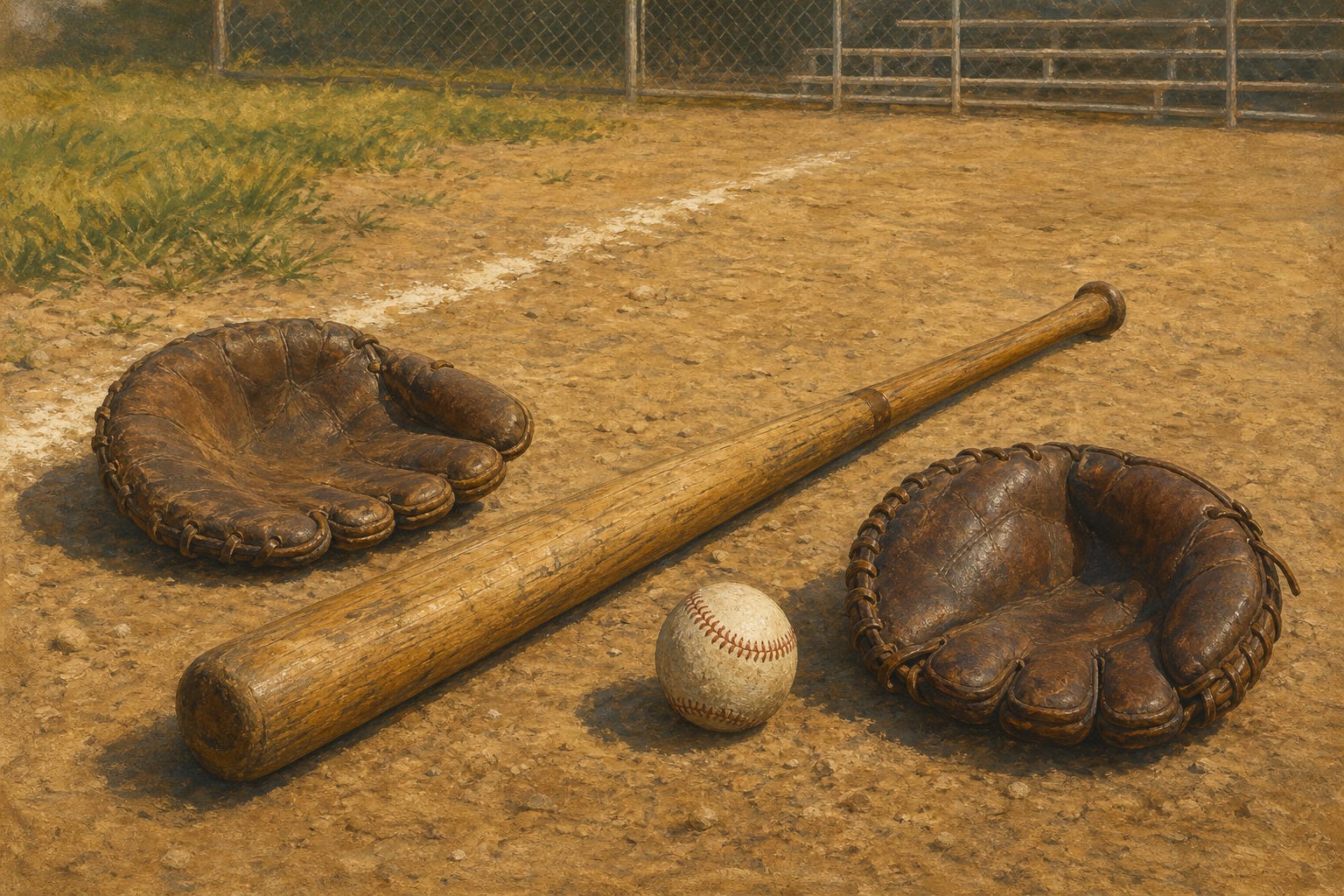
The game could be played with two players on each side, although three or four made it better. We usually played on a practice baseball diamond. The pitcher used the mound. The batter stood at home plate. The opposing players spread out in a designated section beyond an agreed line.
The hitting area might run between two bases, or it might be narrower. With more fielders, we could widen it. With fewer, we tightened it.
The field adjusted itself to the number of boys available.
The pitcher was on the batter’s team.
That was one of the most important features of the game.
He was not trying to strike the batter out. He was trying to give his teammate the right ball to hit.
That did not make pitching unimportant. It made control more important than power.
A poor pitcher could ruin the game. A wild pitch wasted everybody’s time. The pitcher had to place the ball where the hitter could make clean contact and direct it toward the part of the field being used.
We alternated sides of the diamond.
One inning might require hitting toward left field. The next might be played toward right. That prevented a hitter from simply pulling every ball in the direction that felt most natural.
When the batter had to hit to the opposite field, his pitcher placed the ball on the outside of the plate. That allowed him to stay with the pitch and drive it naturally the other way. When the game shifted to the pull side, the pitcher could work farther inside.
The pitcher and hitter operated as a pair against the defense.
The pitcher created the opportunity.
The batter still had to do something with it.
He had to put the bat on the ball.
He had to strike it cleanly enough to get it off the ground.
He had to clear the line.
He had to keep the ball inside the agreed boundaries.
And he had to place it where the opposing fielders could not get to it.
That was much harder than simply swinging as hard as possible.
A ground ball did no good because it failed to clear the line. A towering fly ball gave the fielders too much time to get underneath it. A hard foul ball was still a foul ball.
The ideal hit was usually a line drive—cleanly struck, rising over the line and directed into a gap.
Power mattered, but only when controlled.
A strong hitter could drive the ball beyond everyone. But raw strength without placement produced a great deal of noise and not many runs. The better hitter learned to go with the pitch, disguise his intention and hit the ball where the defense was not.
That required more than one kind of swing.
You had to learn to pull the ball.
You had to learn to hit to the opposite field.
You had to understand how pitch location affected the direction of the hit.
You had to keep your hands back, contact the ball cleanly and control the path of the bat.
In ordinary baseball, a batter could sometimes survive a poor swing because he was fast enough to beat out a ground ball. There was no such escape in Over the Line.
The ball had to be struck properly.
Fielding was equally important.
With only two, three or four defenders, every player had ground to cover. You had to be quick, flexible and alert. You had to judge the ball immediately and move before it reached its highest point.
There was no room for daydreaming.
Fielders adjusted constantly. They could play shallow or deep. They could shade toward a batter’s natural side. They could leave what appeared to be an inviting opening and then close it the moment the pitch arrived.
The batter could fake the fielders as well.
He might glance toward one side, set his body as though he intended to pull the ball, and then punch it the other way. The fielders watched his feet, his shoulders and the angle of the bat. The hitter watched them creeping into position.
It became a small contest of deception played inside the larger contest of hitting and catching.
With only two fielders, there were large gaps but a narrower hitting lane. With three or four, the field could be widened and the defensive strategy became more sophisticated. Players could shift, overlap coverage or tempt the hitter into trying for a gap that was not quite as open as it appeared.
The essential action never stopped.
Pitch.
Swing.
Catch it—or don’t.
Throw the ball back.
Do it again.
There was almost no wasted time.
There was also very little opportunity to cheat.
The ball either crossed the line or it did not.
It landed within the boundaries or outside them.
It was caught or it was not.
There were no phantom tags, arguments over whether a runner had left early, or debates about whether someone had beaten a throw to first base. Almost everything that mattered happened in plain view.
The game was honest because it was simple.
It was also remarkably complete.
It rewarded the pitcher who could place the ball exactly where his teammate needed it.
It rewarded the hitter who could make contact, control the bat and drive the ball to either side of the field.
It rewarded the fielder who could read a swing, react quickly and make a difficult catch.
It rewarded power, but only when power was joined to judgment.
And it rewarded teamwork in an unusual way. The pitcher and hitter had to understand one another. The fielders had to divide the available space. Everyone was involved in nearly every pitch.
There were no players standing far away in right field hoping something might eventually happen.
Something was always happening.
The rules were not handed down by a governing body. We adjusted them to the field, the number of players and the daylight remaining.
Too many easy hits?
Move the line back.
Too many fielders?
Widen the boundaries.
Only four boys showed up?
Two on a side.
Six or eight?
Even better.
Nobody needed to call a meeting.
The purpose of the rules was to make the game work.
That was how we approached all three sports. We did not begin by asking whether we had enough players, enough equipment or an official field.
We began with whoever was standing there.
Then we figured out what game could be played.
But Over the Line was something more than an improvised substitute for baseball.
In some ways, it was a better teaching game.
It concentrated baseball into its most essential skills: control, contact, placement, anticipation and fielding.
A pitcher who relied only on speed had to learn accuracy.
A batter who swung wildly had to learn discipline.
A pull hitter had to learn the opposite field.
A slow fielder had to learn anticipation.
A powerful player had to learn that strength without control was often useless.
Nobody explained these lessons to us. The game did that.
We were not being coached. We were not performing drills. We were trying to beat the boys standing across from us.
That was enough.
Perhaps that is what was different about childhood then.
We did not wait for an adult to provide the completed experience.
We built it out of what we had.
A ball.
A bat.
A practice field.
Four boys, or six, or eight.
The full game of baseball may have been impossible, but that did not mean there was nothing to play.
We kept the best parts.
Then we made our own game.
Yes, we were all kids living in different places doing essentially the same things. It is worthwhile to remember our roots. And how much fun we had.
Stick ball sounds urban. OTL was strictly a suburban brand of ball.