


Persia, the Shah, and the Ayatollahs
Part III – The Islamic Revolution and the Iran We Confront Today
By Jim Reynolds | www.reynolds.com
Revolutions are strange creatures.
The people who start them rarely end up controlling them.
That was certainly the case in Iran in 1979.
The uprising that toppled the Shah began as a broad coalition of students, intellectuals, labor activists, religious leaders, and ordinary citizens angry about corruption, repression, and foreign influence. Many of those people believed they were fighting for a more democratic Iran.
But revolutions create power vacuums. And power vacuums rarely remain empty for long.
Into that vacuum stepped a quiet but relentless cleric who had spent years denouncing the Shah from exile.
His name was Ayatollah Ruhollah Khomeini.
And once he returned to Iran, the revolution rapidly became his.
⸻
The Birth of the Islamic Republic
In February 1979, Khomeini returned to Tehran after more than a decade in exile. Millions of Iranians lined the streets to greet him.
Within months the monarchy that had ruled Persia in one form or another for more than two thousand years was gone.
In its place, Khomeini and his allies built something entirely new.
They called it the Islamic Republic of Iran.
The structure of this new state was unlike anything in modern politics. Iran would have elections, a parliament, and a president. But above those institutions stood a religious authority known as the Supreme Leader, whose duty was to guard the Islamic character of the state.
In practice, this meant the clerical establishment held ultimate power.
Iran had transformed from a monarchy aligned with the West into a revolutionary theocracy.
⸻
The Break With America
The new regime quickly defined itself through confrontation with the United States.
In November 1979, revolutionary students stormed the U.S. Embassy in Tehran and seized dozens of American diplomats.
The hostages were held for 444 days, a crisis that dominated the final year of the Carter presidency and humiliated the United States on the world stage.
The ordeal ended on January 20, 1981, when the hostages were finally released just minutes after Ronald Reagan was sworn in as president.
For Americans watching at the time, the symbolism was unmistakable.
For the new Iranian regime, the episode became a defining act of revolutionary defiance. The United States was branded the “Great Satan,” accused of supporting the Shah and interfering in Iranian sovereignty.
Diplomatic relations between the two countries collapsed and have never fully recovered.
⸻
Revolution Exported
Khomeini did not see the Islamic Revolution as merely a national event.
He believed it should spread across the Muslim world.
Iran began supporting militant groups aligned with its revolutionary ideology. Over time this network included organizations such as Hezbollah in Lebanon, along with various Shiite militias across the region.
At the same time Iran fought a devastating eight-year war with neighboring Iraq during the 1980s.
The war killed hundreds of thousands and hardened the revolutionary character of the regime.
From that point forward, Iran’s leadership viewed itself as locked in a long struggle with Western influence in the Middle East.
⸻
The Nuclear Era
In the decades that followed, Iran developed increasingly sophisticated missile programs and pursued nuclear technology that many Western governments believed could eventually lead to nuclear weapons.
For Israel in particular, the possibility of a nuclear-armed Iran represented an existential threat.
This created a long-running shadow conflict.
For years that conflict was fought through proxies, covert operations, cyber attacks, and targeted strikes rather than direct war.
But tensions steadily escalated.
And now, after decades of indirect confrontation, the conflict has burst into the open.
⸻
The War That Is Happening Now
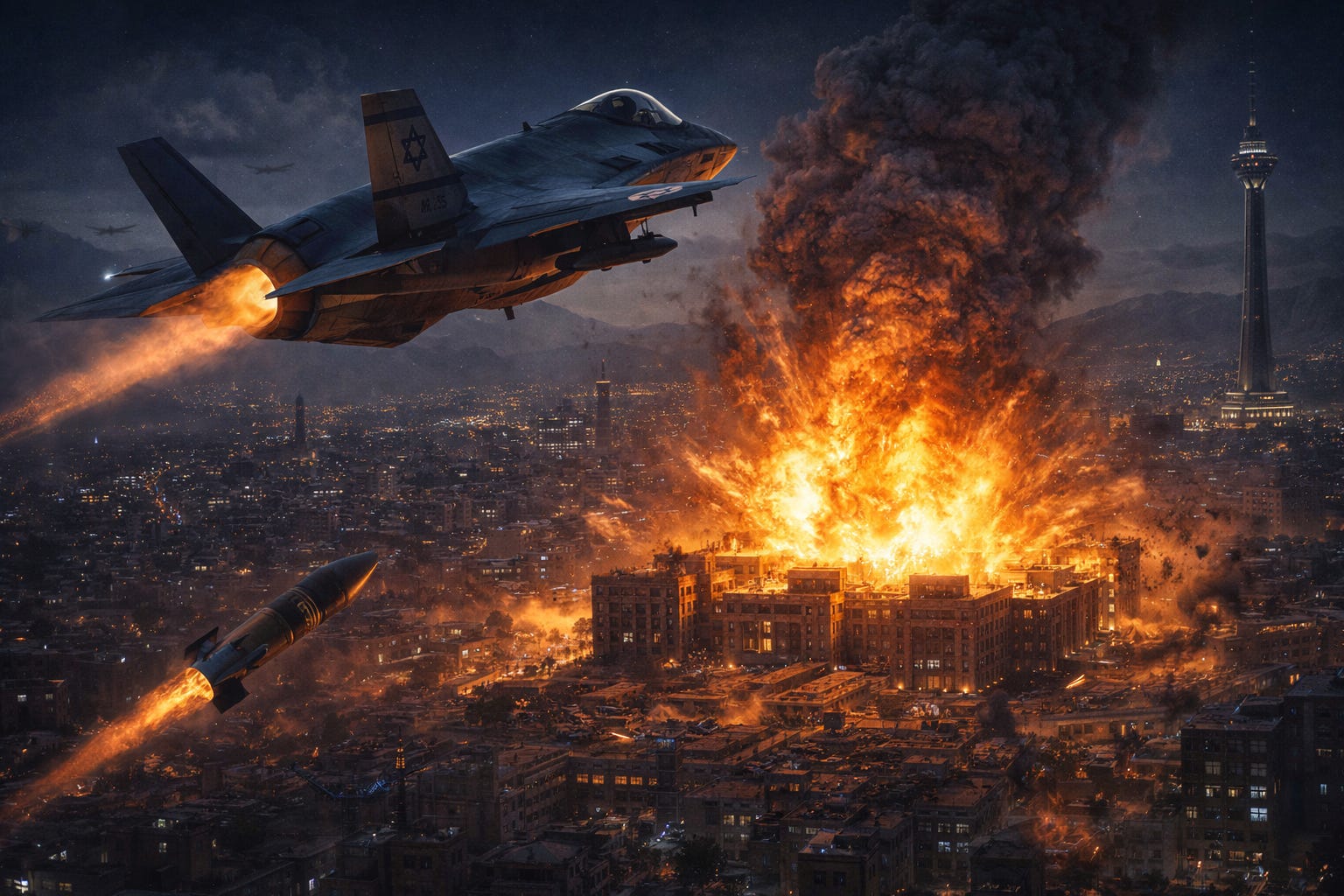
Over the past week, the long shadow conflict between Iran, Israel, and the United States has finally blown into the open. What had been a slow‑motion struggle of proxies, sanctions, and deniable strikes has turned into a concentrated air and missile campaign that is tearing through the core of the Islamic Republic’s military power.
In the opening hours of the war, a combined U.S.–Israeli operation struck Tehran and other key sites with thousands of precision weapons. Those strikes killed Supreme Leader Ali Khamenei and dozens of top commanders gathered with him at a secure compound, along with other senior Revolutionary Guard and security officials across the capital. Iran has announced a temporary leadership council to assume his functions, but by its own admission the system built since 1979 is now operating under emergency conditions.
At the same time, U.S. and Israeli forces have gone after Iran’s ability to fight. Air‑defense radars, missile batteries, command bunkers, airfields, and Guard bases have been hit in wave after wave of strikes. American commanders say Iranian theater ballistic‑missile launches are down 86 percent from the first day of the war, with a further 23 percent drop just in the last 24 hours, and that drone launches are down roughly three‑quarters. That is what a missile force looks like when its launchers, stockpiles, and command networks have been systematically hunted.
The skies tell the same story. Israeli and U.S. jets are flying large strike packages deep into Iranian airspace, and so far there are no confirmed American or Israeli aircraft shot down by Iranian defenses. Iranian fighters that have tried to scramble have been met and shot down by Israeli F‑35s—the first manned air‑to‑air kills for that aircraft, and a stark symbol of how thoroughly the balance of technology and training favors the attackers.
At sea, the United States has made its point just as bluntly. A U.S. submarine sank one of Iran’s newest warships, the IRIS Dena, off Sri Lanka with a single heavyweight torpedo—the first time since World War II that the U.S. Navy has sunk an enemy ship this way. Sri Lankan rescue crews have recovered dozens of bodies and pulled a handful of survivors from the Indian Ocean. For a regime that spent decades boasting about driving the U.S. Navy from the region, seeing its “prize ship” broken in half and lying on the sea floor is more than a tactical loss. It is a message about what happens when rhetoric collides with hard steel.
Iran is still firing what it can. Missiles and drones have been launched at U.S. bases, Gulf states that host them, Israeli cities, and commercial shipping near the Strait of Hormuz. But the pattern has shifted. With its ability to sustain heavy salvos on high‑value military targets badly degraded, the regime has begun lashing out more at softer and civilian targets across the region—classic behavior for a wounded power trying to prove it can still inflict pain.
Inside Iran, the strain is visible. Security forces have locked down major cities. Communications are restricted. Protests and clashes have been reported from multiple provinces as ordinary Iranians absorb the loss of their supreme leader and the scale of the destruction. The revolutionary state that once prided itself on exporting turmoil is now struggling to maintain control of its own streets.None of this means Iran is harmless. The regime still has proxies, sleeper cells, cyber tools, and enough missiles and drones to kill more people and disrupt global energy flows. But the military machine that Tehran spent decades building has been mauled in a matter of days. For the first time since 1979, it is not obvious that the Islamic Republic will survive this crisis in anything like its current form. For a country that once ruled much of the known world, that realization is as shocking as it is sudden.
⸻
What Happens Next
No one knows exactly what the next phase will look like.
The United States has signaled that it does not intend to occupy Iran or impose a new government through military force. President Trump has stated repeatedly that there will be no American ground invasion and no prolonged nation-building effort.
Instead, the stated position is that the ultimate political future of Iran must be determined by the Iranian people themselves.
Whether that results in reform, another revolutionary upheaval, or a reconstitution of the existing regime remains unclear.
But what is certain is that the system created by Ayatollah Khomeini in 1979 is facing the most severe challenge in its history.
⸻
The Long Arc of Persian History
To understand this moment, it helps to step back.
Iran is not simply another nation caught in a regional conflict.
It is the heir to a civilization more than 2,500 years old.
It has been:
• an ancient empire
• a crossroads of global trade
• a battleground of Cold War politics
• a modernizing monarchy
• and a revolutionary theocracy
Each phase left its mark.
The events unfolding today are the latest chapter in that long history.
The Persian Empire once ruled much of the known world.
The Islamic Republic sought to reshape the Middle East through revolutionary ideology.
Now Iran itself stands at a crossroads once again.
What comes next will not only shape Iran’s future.
It may reshape the Middle East—and perhaps the world—for decades to come.
⸻
End of Series
⸻
So does my dentist.
Thanks. I’m not a historian, just someone curious about the forces shaping the news around us. My job is to deliver information with clarity, compression, and velocity. I respect my readers’ time. I rarely read long articles myself—I usually have them summarized. The truth is that most good articles contain their real informational value in about a third of the space. The rest is throat-clearing, repetition, and wandering around the point. But you all knew that already.