


Persia, the Shah, and the Ayatollahs
Part II – Oil, Empire, and the Shah
By Jim Reynolds | www.reynolds.com
The modern history of Iran did not begin with religion or revolution.
It began with oil.
In 1908, British explorers drilling in the deserts of southwestern Persia struck a massive petroleum deposit. At the time, oil was rapidly becoming the most valuable strategic resource in the world. Industrial economies ran on it. Modern navies were switching from coal to fuel oil. Whoever controlled oil supplies would possess enormous geopolitical power.
The British government understood this immediately.
Within a few years Britain secured control over Persian oil through the Anglo-Persian Oil Company, the enterprise that would later become British Petroleum.
The arrangement was extremely favorable to the British. Persia received only a small share of the revenue generated from its own natural resources. Foreign companies extracted the wealth, while the Persian state remained weak and underdeveloped.
To many Iranians this arrangement looked less like commerce and more like imperial exploitation.
Over time resentment grew into one of the most powerful forces in modern Iranian politics: resource nationalism.
And the man who would act on that resentment was Mohammad Mossadegh.
⸻
The Rise of Mossadegh
Mossadegh was an aristocrat, an educated lawyer, and one of the most popular political figures in Iran during the early twentieth century.
But he was also a fierce nationalist.
In Mossadegh’s view, Iran had been treated as a pawn by foreign powers—especially Britain. The country’s oil wealth flowed outward while ordinary Iranians saw little benefit.
His solution was simple and radical.
Iran should take control of its own resources.
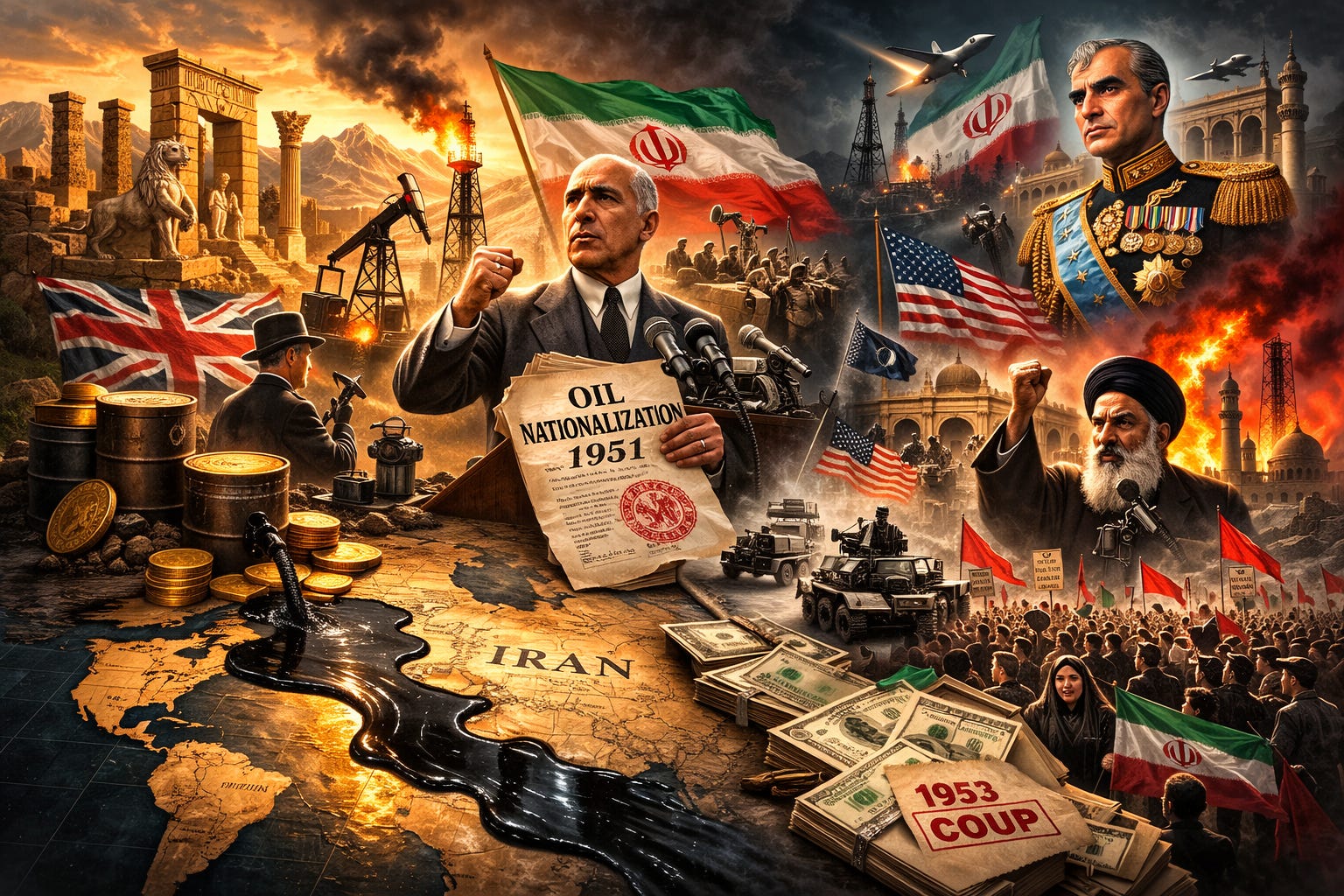
In 1951, after rising to the position of prime minister, Mossadegh moved to nationalize Iran’s oil industry, effectively expelling British control from the country.
For Iranians this was a declaration of sovereignty.
For Britain it was a geopolitical crisis.
⸻
The Crisis Over Oil
Britain responded immediately.
The British government imposed economic pressure and sought international support to force Iran to reverse the nationalization. Oil exports collapsed as Western companies refused to buy Iranian crude.
But Mossadegh remained defiant.
Meanwhile, the Cold War had begun to shape global politics. Western leaders feared instability in Iran might create opportunities for Soviet influence in the region.
Iran sat directly on the southern border of the Soviet Union. In Washington and London, policymakers began to worry that Mossadegh’s weakening government might fall into the communist sphere.
Those fears helped lead to a dramatic decision.
⸻
Operation Ajax: The 1953 Coup
In 1953, the United States and Britain secretly organized a covert operation to remove Mossadegh from power.
The plan—known as Operation Ajax—was carried out by the CIA with assistance from British intelligence.
The operation involved a mixture of tactics:
• propaganda campaigns against Mossadegh
• bribing politicians and military officers
• organizing street protests
• exploiting divisions within Iranian society
The effort succeeded.
Mossadegh was arrested and removed from office.
In his place, the United States and Britain backed the restoration of the Iranian monarch:
Mohammad Reza Shah Pahlavi.
The Shah had technically been king already, but after the coup he became the undisputed ruler of Iran.
For Western governments the objective was stability.
For many Iranians the coup would later symbolize something very different.
Foreign interference in their country’s political destiny.
⸻
The Shah’s Iran
The Shah ruled Iran for the next quarter century.
His goal was to transform the country into a modern industrial state aligned with the West.
Under the Shah, Iran experienced rapid modernization.
The government invested heavily in:
• infrastructure
• industry
• education
• military expansion
Women gained greater legal rights. Universities expanded. Tehran began to resemble a modern global city.
Oil revenues fueled ambitious development projects that reshaped the country.
To American policymakers, the Shah appeared to be a valuable ally.
Iran became a central pillar of U.S. strategy in the Middle East during the Cold War.
⸻
The Dark Side of Modernization
But the Shah’s modernization also created deep tensions inside Iranian society.
Rapid economic change disrupted traditional life. Rural populations moved into expanding cities. Wealth became concentrated among elites connected to the monarchy.
At the same time the Shah governed with increasing authoritarianism.
Political opposition was suppressed. Parties were controlled or dissolved. Critics risked arrest or exile.
The regime’s secret police force, SAVAK, became notorious for surveillance and repression.
Many Iranians came to believe that modernization was occurring without political freedom—and that the Shah’s power rested heavily on foreign support.
Meanwhile a different source of opposition was quietly gaining strength.
Religious leaders.
⸻
The Return of Religion to Iranian Politics
Among the clerics critical of the Shah was a relatively obscure religious scholar named Ruhollah Khomeini.
Khomeini condemned the Shah’s Westernization policies and accused the monarchy of undermining Islamic values.
In the 1960s his speeches began attracting followers.
Eventually the Shah forced him into exile.
From abroad—first in Iraq, later in France—Khomeini continued to build influence through religious networks and recorded sermons distributed inside Iran.
By the late 1970s the Shah’s government faced growing unrest from many different groups:
students
intellectuals
workers
religious activists
What had begun as scattered dissatisfaction was gradually turning into something far more dangerous.
A revolutionary movement.
⸻
The Shah’s Fall
In 1979, after months of mass protests and political turmoil, the Shah left Iran.
His government collapsed shortly afterward.
Into the power vacuum stepped the cleric who had spent years denouncing the monarchy.
Ayatollah Ruhollah Khomeini returned to Iran and began constructing a new political order.
The monarchy that had ruled Persia in various forms for more than two thousand years was gone.
In its place rose something entirely new.
A state governed not by kings—but by religious revolutionaries.
⸻
Next:
Part III – The Islamic Revolution
How the overthrow of the Shah created the Islamic Republic and transformed Iran into the adversary the West confronts today.
⸻
That is why I am writing this series. We do not yet know how the current Iranian story ends, but understanding the past is the only way to make better choices about the future. Iranians have perfectly rational reasons to distrust the West; that much is obvious. The question is what realistic alternatives exist. The angry students of the late 1970s never imagined they were clearing the way for an autocratic theocracy, and from our position at arm’s length there is only so much we can shape — nor should we want to get any closer.
Interesting isn't it that a righteous movement for justice and fairness frequently ends with the same corruption it meant to correct. When power is wrenched from one and taken by another, it inevitably corrupts the later just as it did the former.
Some thing never change--except the actors.