


Author’s Note
During a walk the other day I asked my wife what I should write about next. She said she would like to understand more about the history of Iran. Like me, she knew the country had enormous historical significance, but neither of us had a clear sense of how that history actually unfolded.
It turns out the story is extraordinary.
For more than two thousand years Persia — modern-day Iran — stood at the center of world history. Its empires rivaled Rome, its culture shaped the Islamic world, and its strategic geography placed it at the crossroads of East and West. Across the centuries Persia was conquered by Macedonians, Arabs, Turks, and Mongols, yet it repeatedly rebuilt itself and preserved a remarkably durable identity.
This short series is an attempt to sketch that long arc in plain language.
Rather than an academic deep dive, the goal is something simpler: a clear narrative explaining how an ancient civilization became the modern nation we now call Iran.
This is the first of three condensed installments covering the history of Persia — from its ancient imperial beginnings to the complicated country we see today.
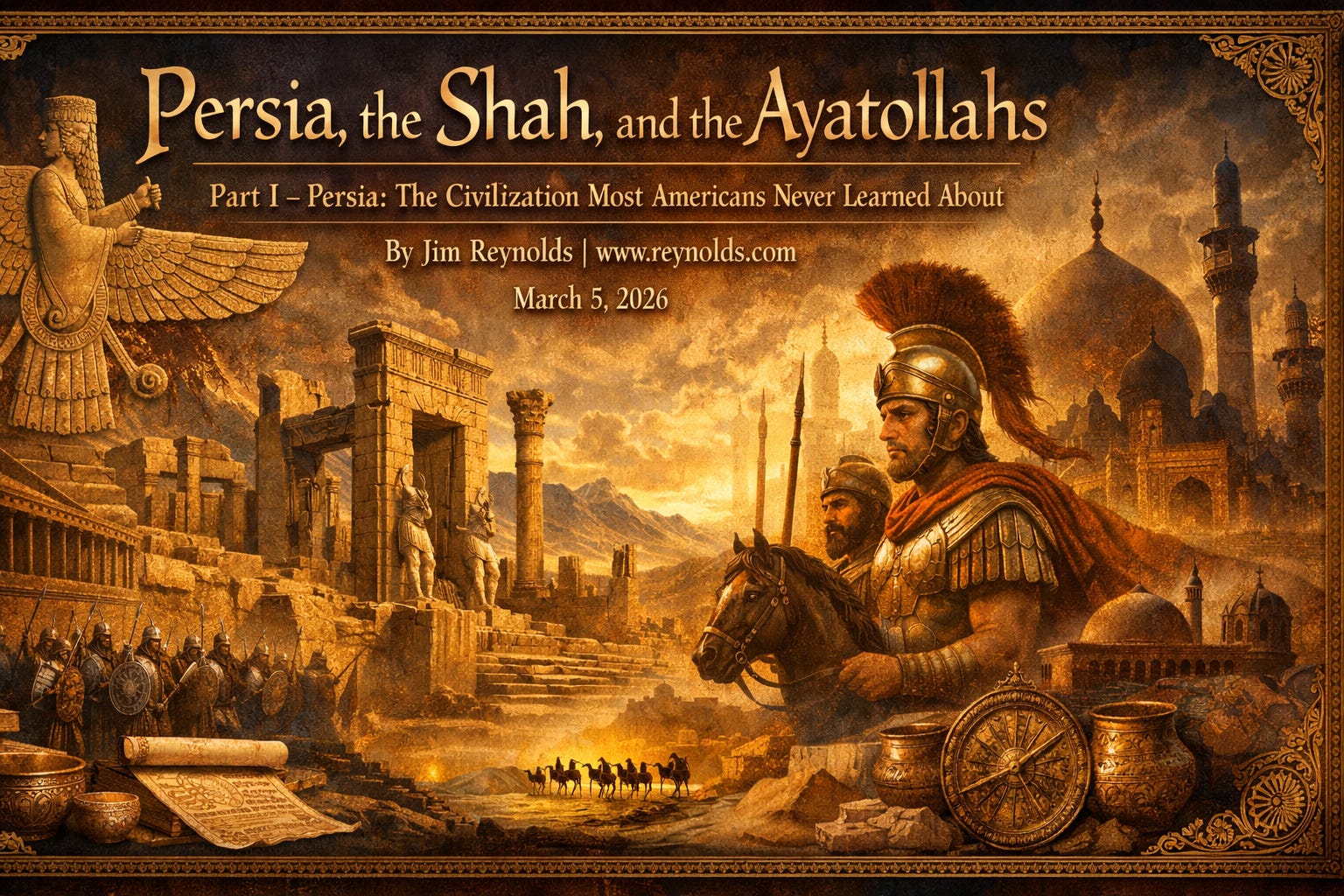
Persia, the Shah, and the Ayatollahs
Part I – Persia: The Civilization Most Americans Never Learned About
By Jim Reynolds | www.reynolds.com
March 5, 2026
Before Iran became America’s most persistent adversary in the Middle East, it was something very different.
For most of recorded history, Persia was one of the great civilizations of the world.
In fact, if you had asked an educated person in 400 BC what the world’s dominant power was, the answer would not have been Greece, Rome, or China.
The answer would have been Persia.
Yet most Americans today know almost nothing about it. In Western education, Persia usually appears only as the villain in Greek history—the empire defeated at Marathon or Thermopylae. The story is told through Greek eyes, which makes Persia seem like a passing antagonist rather than what it really was.
In reality, Persia was one of the most sophisticated and powerful civilizations of the ancient world. To understand modern Iran—and why it behaves the way it does today—you have to start there.
There are at least a few things about Persia that most Americans were never taught.
⸻
The First True World Empire
Around 550 BC, a ruler named Cyrus the Great united the Persian tribes and began building what historians consider the first true multinational empire.
Within a few decades the Persian Empire stretched across an astonishing span of territory. At its height it controlled lands from:
• Egypt
• Turkey
• Mesopotamia
• Persia (modern Iran)
• Afghanistan
• parts of India
Nearly forty percent of the world’s population lived under Persian rule.
What made Persia remarkable was not only its size but how it governed. Rather than trying to erase local cultures, Persian rulers generally allowed conquered peoples to keep their traditions, religions, and internal leadership structures.
The empire was organized into provinces governed by regional officials called satraps, connected by an extensive road network and supported by a surprisingly sophisticated administrative system.
In many ways, Persia invented the model that later empires—from Rome to Britain—would follow.
⸻
Persia and the Greek Wars
Most Americans encounter Persia through the famous wars with Greece.
Stories like Marathon, Thermopylae, and Salamis are part of Western cultural mythology. Greek city-states defending themselves against the massive armies of the Persian king have long been portrayed as a battle between freedom and tyranny.
Those battles were dramatic, but they were not decisive in the way they are often remembered.
They were essentially frontier conflicts between a loose coalition of Greek city-states and the western edge of a vast empire.
Persia remained the dominant regional power for another century and a half after those wars.
⸻
Alexander and the Destruction of the Empire
The Persian Empire finally fell to Alexander the Great in 330 BC.
Alexander defeated the Persian king Darius III and marched into the imperial capital of Persepolis, where the great palace complex was famously burned.
But even Alexander’s conquest did not erase Persia.
The administrative systems, culture, and identity of the region survived and continued to influence the rulers who followed.
Persia had been conquered—but it had not disappeared.
⸻
Persia Outlives Its Conquerors
After Alexander’s empire fragmented, Persia reemerged under new dynasties.
First came the Parthians, followed by the Sassanid Empire, which ruled from the third to the seventh centuries AD.
The Sassanids became the great rivals of Rome and later the Byzantine Empire. For centuries the two powers fought massive wars across the Middle East.
Then a new force swept out of Arabia in the seventh century.
The Islamic conquests shattered the Sassanid state and brought Persia into the Islamic world.
Yet once again, Persian civilization survived the conquest. Persian language, culture, and intellectual traditions remained influential across the Islamic world.
⸻
The Shiite Identity of Iran
A critical turning point came in the early 1500s.
The Safavid dynasty took control of Persia and made Shiite Islam the official religion of the state.
This decision permanently separated Persia from the largely Sunni Islamic world surrounding it.
Over time, this created a powerful class of Shiite religious scholars and clerics who would play a major role in Iranian society and politics.
That religious structure still influences Iran today.
⸻
Geography: The Strategic Core of Persia
Another reason Persia endured is geography.
Iran sits on a vast plateau surrounded by mountains and deserts that act as natural defensive barriers. The Zagros Mountains shield the western frontier while the Alborz range guards the northern coast.
These natural defenses made the region difficult to conquer and even harder to control.
Iran also sits at the crossroads of several major regions:
• the Middle East
• Central Asia
• South Asia
• the Caucasus
For thousands of years trade routes connecting East and West passed through Persian territory.
Even today Iran occupies one of the most strategically important positions on earth. It borders the Persian Gulf and the Strait of Hormuz, through which a huge portion of the world’s oil supply travels.
Geography ensured that Persia—and later Iran—would always matter.
⸻
The End of Empire
By the nineteenth century, however, Persia was no longer the dominant power it once had been.
The country had fallen behind technologically and economically while European empires expanded across the globe.
Persia found itself caught between competing outside powers—especially Britain and Russia—both of whom sought influence in the region.
Then something was discovered beneath Persian soil that would dramatically increase foreign interest in the country.
Oil.
In 1908, a vast petroleum reserve was discovered in southwestern Persia. At the time, oil was rapidly becoming the most important industrial resource in the world.
That discovery would pull Persia directly into the geopolitics of the twentieth century.
And it would eventually lead to one of the most consequential covert operations of the Cold War—a coup in 1953 that reshaped the future of Iran and set the stage for the revolution that would follow.
That story begins with oil.
And with the rise of a modern Iranian nationalist named Mohammad Mossadegh.
⸻
Next:
Part II – Oil, Empire, and the Shah
How Western oil politics, the 1953 coup, and the rise of the Shah set the stage for the Iranian Revolution.
⸻
I know a few Iranian-Americans. All smart and very patriotic — but not for the current regime.
Great summary Jim.
Persia has a rich history.
Jewish and Christian scholars alike name the Medo-Persian empire as the second beast written about in Daniel 7. While Persia ultimately fell to Alexander the Great, Persian King Cyrus was a friend of the Jews, allowing them to freely return to Judah after Babylon fell.
Another great story arises from Persia. Queen Esther prevented the total destruction of the Jewish people remaining there after many of the Jews returned to Judah. That event is still celebrated today as the Feast of Purim.
Imagine the Persians and the Israelis as brothers and friends! It has been so and will be again.
Persia is not the Islamic Republic of Iran--it's more enlightened and delightfully complex than the caliphate the Islamic extremist hoped to build.