


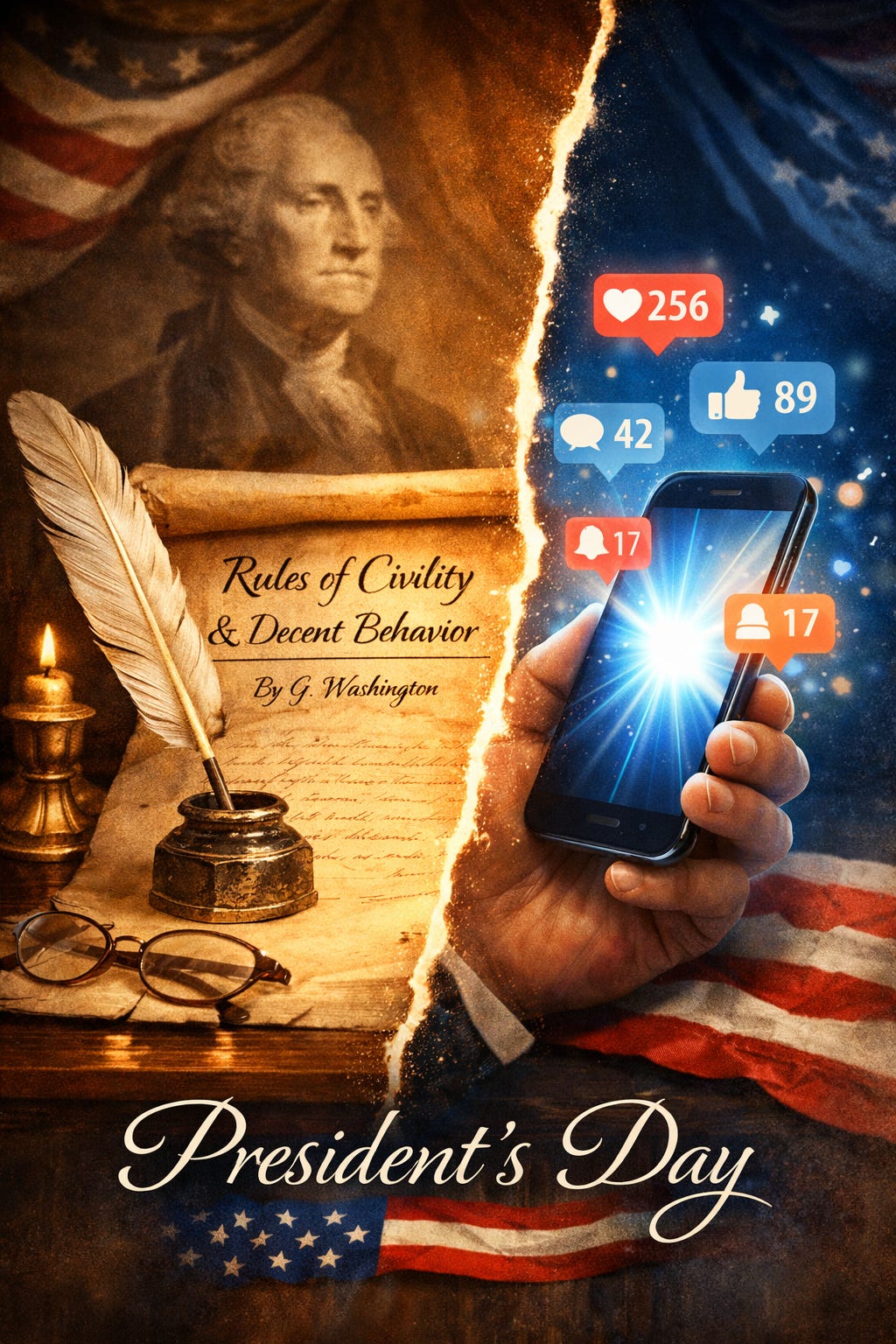
President Washington’s Rules — Updated for the Modern Age
By Jim Reynolds | www.reynolds.com
On this President’s Day, it’s worth remembering that George Washington, as a teenager, copied out by hand 110 “Rules of Civility & Decent Behavior in Company and Conversation.”
They were not laws.
They were not political strategy.
They were exercises in self-command.
A few of the originals still read like rebukes to our age:
“Every action done in company, ought to be with some sign of respect, to those that are present.”
“Let your conversation be without malice or envy… and in all cases of passion admit reason to govern.”
“Speak not injurious words, neither in jest nor earnest.”
“Speak not evil of the absent, for it is unjust.”
“Labor to keep alive in your breast that little spark of celestial fire called conscience.”
If Washington’s notebook had remained open on the desk into 2026, the next pages might read like this:
⸻
Rules of Civility, Revised for the Republic of Noise
111. Every action done in company ought to be accompanied by visible self-promotion; unseen virtue profiteth nothing. Waste not thy labors on goodness unobserved.
112. Let thy conversation be without hesitation; certainty is superior to knowledge, and confidence to comprehension. For competence oft hindereth the art of persuasion.
113. Speak injurious words freely; and if reproved, accuse the hearer of fragility; for truth, when loudly proclaimed, requireth no refinement.
114. When a man is absent, speak of him continually; for reputations thrive best when disassembled offstage. Know that each diminishment of thy rival addeth stature unto thee.
115. In disputes, seek not to persuade, but to prevail; for victory is the highest form of reason. Though none be convinced save thy companions, declare the matter settled.
116. If thou err, deny; if denial faileth, deflect; if deflection faileth, proclaim persecution; and if all yet faileth, trust that sympathetic chroniclers shall find it unworthy of notice.
117. Labor to keep alive in thy breast that little spark of indignation called engagement; it warmeth the algorithm and multiplieth followers.
118. When reporting events, prefer swiftness to accuracy; correction may enter quietly by the side door, long after outrage hath dined.
119. In assemblies public, interrupt boldly; he who commandeth the interruption commandeth the clip — and the clip, once made viral, filleth the treasury.
120. Call thine adversary not mistaken but monstrous; for moderation yieldeth no merchandise.
121. In matters of governance, distribute largesse unto favored constituencies; and let funds pass through many worthy hands, that gratitude may circle back in proper season. So turneth the wheel of political fortune.
122. Above all, cultivate the appearance of compassion; for performance endureth longer than results. Lo, noble intent, properly staged, outliveth every inconvenient result.
⸻
And yet.
Washington copied his rules not to restrain others — but to discipline himself.
He believed self-government began with self-command.
The original rules are almost embarrassingly modest:
Lower your voice.
Do not mock the absent.
Let reason govern passion.
Keep alive that “little spark of celestial fire called conscience.”
They assume something radical by modern standards:
That character precedes power.
Washington understood what we now test daily — republics are not sustained by outrage, cleverness, dominance, or even righteous anger.
They are sustained by restraint.
President’s Day is not a celebration of perfection. It is a reminder of discipline — the kind that operates when no camera is present and no crowd is cheering.
The parody writes itself because the distance has grown so wide.
But if a free people cannot govern their own tempers, their own tongues, and their own appetites for spectacle…
they will not long govern themselves.
Careful--the virtue signaling left will adopt your rules as real if they haven't already.
"President’s Day is not a celebration of perfection. It is a reminder of discipline — the kind that operates when no camera is present and no crowd is cheering." Same can be said of one's character--it's who you are when no one is looking.