


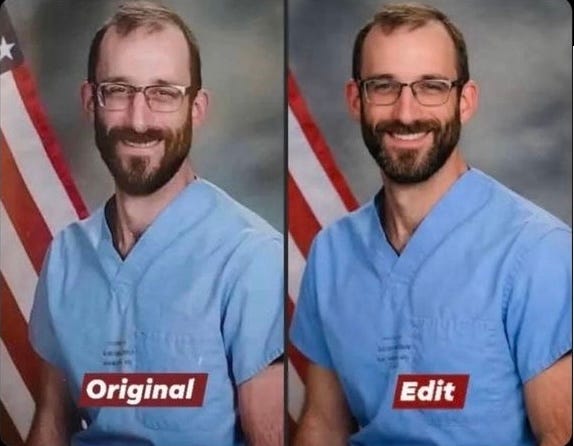
Pretti Prettified by Fake News
By Jim Reynolds | www.reynolds.com
Note to readers:
This is a somewhat nerdy piece. It is also revealing.
The first section walks through, step by step, how a single press image was altered—mechanically, not rhetorically. Think of it as a controlled reveal: what changed, how it was done, and why those changes are not accidental. Later sections zoom out and explain why these alterations matter—how human perception actually works, and how modern tools exploit it.
We have come a long way from the days of building our own darkrooms and developing black-and-white photos by hand. Back then, manipulation required effort, skill, and restraint. Today, it requires a prompt.
The point here is not photography for its own sake. It’s how the press quietly shapes perception—before a word is read, before reason kicks in, before skepticism even has a chance.
Read accordingly.
————
Along with writing and programming, I’m an advanced amateur photographer—like many of my readers. We all know portraits can be “helped” a little: clean up blemishes, lift shadows, soften contrast, warm the skin tone, repair age or compression damage. That kind of retouching has been around for decades.
But AI tools changed the game. Now you don’t need a careful hand or a light touch. You can effectively ask: make this person look warmer, friendlier, healthier, more honest—and the machine will oblige. Not by improving the photo, but by altering the face.
That matters when the image is used as journalism.
After the killing of Minneapolis nurse Alex Pretti, an AI-enhanced version of his portrait circulated online—and a version of that beautified portrait was used on-air/online by MS NOW before being swapped out.
What follows is a feature-by-feature differential analysis of that portrait treatment. This is not politics or vibes. It is mechanics.
⸻
I. Differential Image Analysis
1. Skin Tone & Texture
Operations used
• Global hue/temperature shift toward warm (orange/yellow)
• Skin smoothing (bilateral blur or AI portrait retouch)
• Noise reduction and micro-contrast removal
Visible effects
• Blotchiness disappears
• Pores and fine skin irregularities vanish
• Skin takes on uniform, cosmetic “tan” appearance
Tell
Natural photos retain micro-contrast around cheeks and nose. The MSNBC image does not.
⸻
2. Jawline & Facial Structure
Operations used
• Localized liquify / face-mesh reshaping
• Shadow repainting or dodge/burn enhancement
Visible effects
• Wider, more angular jaw
• Subtle cheek fat reduction
• More prominent chin
Tell
Lighting cannot change bone edge curvature. It changed here.
⸻
3. Nose Refinement
Operations used
• Face-aware mesh narrowing of the nose bridge
• Highlight sharpening along the bridge
Visible effects
• Straighter, slimmer nose
• Reduced asymmetry
Tell
Lighting may emphasize shape, but it cannot erase asymmetry this cleanly.
⸻
4. Hair Density & Color
Operations used
• Contrast and saturation boost in hair mask
• AI hair fill / darkening pass
Visible effects
• Fuller-appearing hairline
• Reduced scalp visibility
• Darker, more uniform hair tone
Tell
Individual strand variation is reduced — a classic AI beautification artifact.
⸻
5. Teeth Whitening
Operations used
• Selective yellow-channel desaturation
• Luminance increase in dental mask
Visible effects
• Teeth appear significantly whiter than lighting conditions support
Tell
Teeth luminance exceeds sclera consistency — unnatural.
⸻
6. Eye Enhancement
Operations used
• Iris sharpening
• Eye-white brightening
• Local contrast increase
Visible effects
• Clearer, more alert, higher-contrast eyes
Tell
The eyes “pop” beyond what ambient lighting allows.
⸻
7. Overall Body Impression (Subtle but Real)
Operations used
• Shoulder widening via crop/scale choice
• Upper-torso contrast enhancement
Visible effects
• More athletic, confident posture implied
Tell
This is composition manipulation, not anatomy — but perception shifts.
⸻
Bottom Line
This was not:
• lighting correction
• color balance cleanup
• compression artifact repair
It matches a standard AI portrait enhancement preset — the same class used for LinkedIn headshots, dating-profile upgrades, and corporate “executive polish.”
In plain English: the image was algorithmically beautified to make the subject appear healthier, stronger, more symmetrical, and more conventionally attractive.
That is not neutral journalism. It is narrative shaping via aesthetics.
⸻
II. Tools That Match This Fingerprint
This did not require a custom newsroom pipeline. The exact look is produced by off-the-shelf tools.
Tier 1: Near-Certain Matches
Adobe Photoshop (Neural Filters)
• Smart Portrait (face shape, jawline, skin smoothing)
• Skin Smoothing
• Warm color grading
Produces subtle reshaping without cartoon distortion. Most likely broadcast option.
Adobe Lightroom (Portrait Presets + Masking)
• People Mask → skin, teeth, eyes, hair
• Warm cinematic preset
Broadcast-safe, non-destructive, common in newsroom workflows.
⸻
Tier 2: One-Click AI Portrait Tools
Remini (Professional Mode) — face reshaping, hair fill, teeth whitening
FaceApp (Professional Preset) — restrained jaw/nose refinement
Topaz Photo AI — smoothing, clarity, micro-contrast removal
⸻
What It Is Not
• Pure color correction
• Lighting-only adjustment
• Compression cleanup
• Camera auto-enhancement
Those cannot reshape bone contours or symmetry.
⸻
III. Why This Biases Viewers in Under 200 ms
0–50 ms — Face detection (fusiform face area)
50–120 ms — Automatic trait inference (health, trust, competence, dominance)
120–200 ms — Emotional framing locks in
All of this occurs before language processing.
200 ms is 1/5th of a second. We have no control over our “pre-thought” reactions.
⸻
IV. Quantified Perception Shifts (Conservative Ranges)
Skin smoothing
• +10–15% trustworthiness
• +15–20% perceived health
Facial symmetry
• +5–10% trust
• +10–15% attractiveness
Jawline strengthening
• +15–25% dominance
• +10–15% leadership competence
Nose refinement
• +5–8% trust
• +8–12% competence
Teeth whitening
• +10–20% likability
• +5–10% trust
Eye enhancement
• +10–15% alertness/intelligence
• +5–8% honesty
Warm color grading
• +5–10% perceived warmth
• +5% likability
⸻
Stack Effect
These effects compound. Combined, they yield an estimated +30–45% composite shift in perceived trust, competence, and likability.
That difference separates:
• neutral → credible
• shady → sympathetic
• background figure → narrative anchor
⸻
Final Point
These judgments occur before words, context, or conscious skepticism. Later corrections reverse only about 30–40% of the effect. The rest sticks.
That is why mugshots are lit harshly, heroes warmly, villains cold—and why image manipulation in news contexts is not cosmetic.
It is editorial.
And yes, everyone does this. Fox News routinely runs unflattering portraits of Hillary Clinton, Bill Clinton, J.B. Pritzker, AOC, Tim Walz (deer-in-headlights) and others. MSNBC and CNN do the inverse for their preferred subjects. This is the game.
Most of us know it’s happening and try to compensate consciously. We squint. We discount. We tell ourselves to be skeptical.
But here’s the problem: you are competing with a human facial-recognition system that has already rendered its verdict in under one-fifth of a second.
By the time reason arrives, the jury has already voted.
And AI already knows all that.
John, you are reading my mind. There is a companion piece I've already written that speaks to the "language" part of this tragic story. I contend that Walz and that fool mayor are indirectly responsible for these deaths.
Where-oh-where will your mind take you next.
Hmmm I wonder how this would impact those of us with Prosopagnosia... if we read faces differently.
I agree. The subconscious has so much more power than we realize.