


Requiring Citizenship. Requiring Proof of Citizenship. Two Different Things.
Abbott’s vote barely moved. The Democratic total rose by nearly half. Follow the registration drives, the transportation records, and the money.
By Jim Reynolds | www.reynolds.com
November 9, 2026
Note: American elections exist to allow eligible citizens to decide who governs them. If noncitizens vote, their votes are illegal and must be addressed under election law. Otherwise the results may not reflect the decision of the people entitled to make it. That is why we need to know how many people voted without verified citizenship—and whether any of them were actually noncitizens.
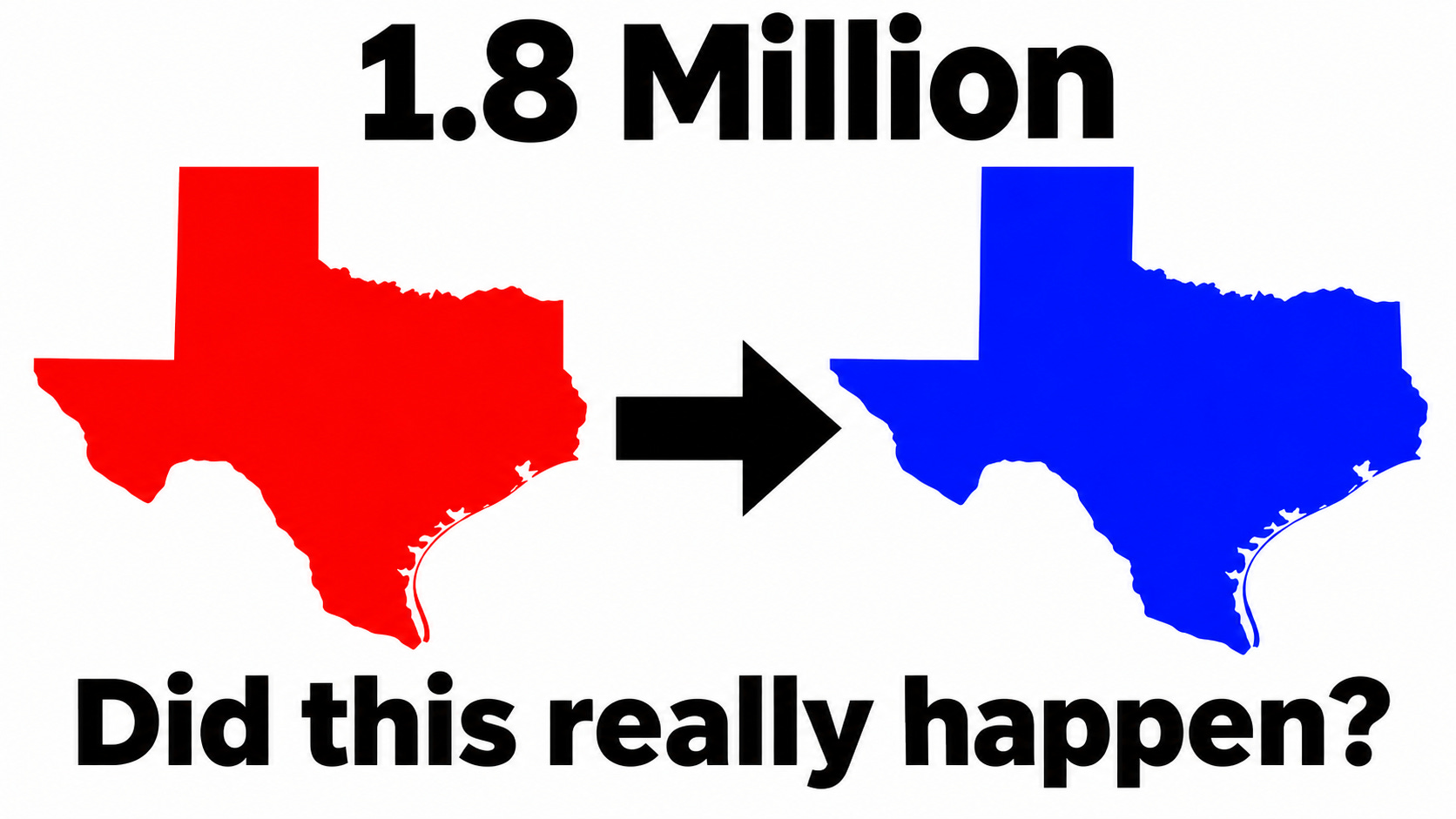
Greg Abbott received 4,437,099 votes in 2022. The posted 2026 returns give him 4,524,527—an increase of just 87,428, or about two percent. The Democratic total rose from 3,553,656 for Beto O’Rourke to 5,230,789 for Gina Hinojosa, a gain of 1,677,133 votes, or 47.2 percent.
Across all candidates, the governor’s race attracted 1,804,473 additional votes. Hinojosa’s posted margin was 706,262. These returns were not yet certified.
The same pattern appears against 2018. Abbott received 4,656,196 votes that year, and Democrat Lupe Valdez received 3,546,615. Compared with 2018, Abbott’s 2026 total was 131,669 lower while the Democratic total was 1,684,174 higher. The increase in total votes was about 1.56 million, not 1.8 million. Different baseline. Nearly the same Democratic increase.
We cannot know whether Abbott retained the same individual voters, but nearly all the net gain since 2022 appeared on the Democratic side. Who produced it, where did they vote, and what brought them to the polls?
The money makes the question sharper
Abbott was hardly short of campaign funds. On October 27, The Texas Tribune reported that from Hinojosa’s October 2025 campaign launch through October 24, Abbott had spent about $281 million to her $36.8 million—roughly $7.60 for every dollar she spent.
Yet the better-funded Republican won almost the same number of votes as four years earlier, while the Democratic total climbed by almost 1.68 million. Money alone cannot explain the contrast. We need to look at the people and organizations working to bring voters into the election.
First, establish the magnitude
Before chasing organizations, registration drives, or transportation networks, we need one number: How many people voted in the 2026 Texas election without their citizenship having been verified?
Texas has registration and participation histories, SAVE citizenship-check results, and state and county follow-up records. Match them. Count the voters who had no documented citizenship check and those whose checks remained inconclusive or unresolved. Then show how many in each group voted in 2026 but not in 2022. Publish the totals statewide, by county, and where possible by precinct.
There is another reason to demand the follow-up records. On September 25, 2026, the Supreme Court allowed the expanded SAVE program to resume while litigation continues. Under the modified system described in the ruling, an agency receiving an inconclusive result must contact the individual and request proof. How many Texas cases were inconclusive? How many were followed up? How many of those people voted? The ruling did not itself require Texas to screen every voter.
An inconclusive check is not proof that a voter is a noncitizen. But we cannot judge the magnitude of the verification gap until Texas supplies the count. Five hundred, five thousand, and five hundred thousand would call for very different investigations. We need totals, matching methods, and an accounting of missing records—not public disclosure of private documents.
First find out how many. Then find out where they were, how they registered, and whether any were ineligible.
Changing the electorate was an announced objective
Beto O’Rourke’s Powered by People worked to enlarge Democratic participation. Its stated ambition was long-term change to the Texas electorate: identify potential Democratic voters, help eligible people register, and stay in contact through Election Day. Republicans had registration drives and get-out-the-vote operations of their own.
Did the Democratic increase come from people who sat out 2022, new registrants, independents changing sides, or all three? How many people did these organizations bring to the polls, and in which counties? Participation records can help answer that question. The citizenship-verification records tell us whether an eligibility problem accompanies the turnout increase.
The transportation records belong in the same inquiry
During the Biden administration, federal agencies and nonprofits coordinated services and travel assistance for migrants released from custody. FEMA funding supported transportation, including onward travel. In Texas, the work involved public agencies, shelters, nonprofits, and commercial carriers.
San Antonio’s Migrant Resource Center received people brought from border-city nonprofit partners after federal release. Catholic Charities was a central partner; others provided food, shelter, and assistance. San Antonio describes itself as a transit hub, and the center stopped accepting new arrivals in February 2025.
El Paso’s September 24, 2024 transportation award named five carriers, seven destinations, and an estimated $1.5 million over five years including options. El Paso County separately documented transportation funding and shelter partners.
These records give us somewhere to start. How many migrants were transported, to which destinations, by whom, and at whose expense? How many stayed in Texas? Can transportation, settlement, voter registration, and participation be connected?
The difficulty is not hard to see. Immigration agencies hold entry and release records. Carriers have passenger and destination information. Election offices have registration and participation histories. Other agencies hold citizenship-verification results. They use different identifiers; some records are incomplete or legally restricted.
Matching them would be difficult, but reliable matches could establish whether individuals transported into Texas later settled there, registered, and voted—and, if they voted, whether they were citizens at the time. A bus ride is not a voter registration. A shared county is not an individual match. The records have to establish the connection.
Follow the people as well as the totals
Begin with counties and precincts showing the largest Democratic gains. Compare their 2022 and 2026 turnout, registrations, and returns. Match participation histories to distinguish people who voted in both years, registered voters who skipped 2022, and people registered afterward.
Check verification status for each group. For newer registrations, examine the dates and sources: DPS transactions, mail applications, agencies, and registration drives. Separate first registrations from address changes, transfers, and reinstatements. Then investigate any concentrations or documented links to particular organizations or transportation routes.
One limit is unavoidable: the secret ballot. Participation records show who voted, not whom they voted for. Precinct returns show where Hinojosa gained support, not the choice made by any individual voter.
Put the records together
The organizing efforts, the migrant transportation network, Abbott’s spending advantage, and the additional votes are documented. What has not been established is how these things connect.
Begin with the missing citizenship-verification count. Map the voters, examine their registration histories, and match other records wherever reliable and lawful. Keep unresolved checks separate from confirmed ineligible voting. Then we can determine what the evidence actually shows.
Abbott’s vote barely moved. The Democratic total rose by nearly half. 1.8 million additional votes. How many participants lacked completed citizenship verification—and what do the records reveal?
🅱️ Bob: “Sounds pretty complicated. Maybe that’s the point. If AI had the data, it could probably solve it in an afternoon.”

Addendum: Now I Understand
This was the most difficult essay I have ever written. Now I understand why. I was trying to solve a problem without fully understanding how the system worked.
Here is what finally brought it into focus.
Texas does not generally require people to present documentary proof of American citizenship when registering to vote. Applicants declare that they are citizens, sign under penalty of perjury, and provide identifying information. The state uses additional checks, including DPS records and the federal SAVE system, to identify possible eligibility problems.
But those checks are not the same as requiring affirmative documentary proof from every applicant before registration.
That means the system begins with an assertion of citizenship and relies on a combination of existing records, subsequent verification, and legal penalties to guard against false declarations.
Most states use a similar registration model.
This doesn’t establish that large numbers of noncitizens voted. It establishes why determining whether they did is a much more complicated question than I originally imagined.
And it brings us back to the first question in this essay: How many people actually voted without their citizenship having been affirmatively verified, and how many of those were ultimately found to be ineligible?
Until we know that, we cannot establish the magnitude of any problem.
That is the number I have been trying to find all along.
So, is there anything keeping a noncitizen from registering to vote in Texas?
And is there anything in Texas law that keeps that registered voter from participating in a statewide election?
Not really.

Your essay and conclusion are terrifying if you are a Republican or an Independent.