


Response to a Reader Comment About Iran/USSR Comparison
By Jim Reynolds | www.reynolds.com
April 10, 2026
Reader Comment:
Would you opine on the differences between this Iranian doctrinal regime which seems unlikely to fall, and the one we saw in the USSR for so many years which did fall? Can the removal of their money accomplish what happened in 1990 as the USSR oil revenues fell, inflation exploded, and their economy collapsed...It takes time of course, but it feels similar to many of us. Glasnost and Perestroika helped of course, but nonetheless, with the loss of revenues there was an accompanying loss of faith in the Communists. Differences in the USSR and Iran include: Iran is more centralized and coercive, as the Soviet system had already begun liberalizing under Gorbachev. Furthermore, the USSR had component republics that exited, while Iran is a unitary state, not a federation. And Iran has built, already, trade networks that will not collapse easily. The USSR’s ruling ideology had already lost credibility, but Iran’s ruling system still has a committed core and loyal security forces.
===============
Author note: My first draft response was strong structurally, but missed the deeper layer. Both systems are anchored in doctrine, but there is a fundamental difference in what that doctrine is based on. Not calling out that difference misses the discussion’s center of gravity.
Here’s the rewrite of my reply—clean, direct, and without flinching from the point.
⸻
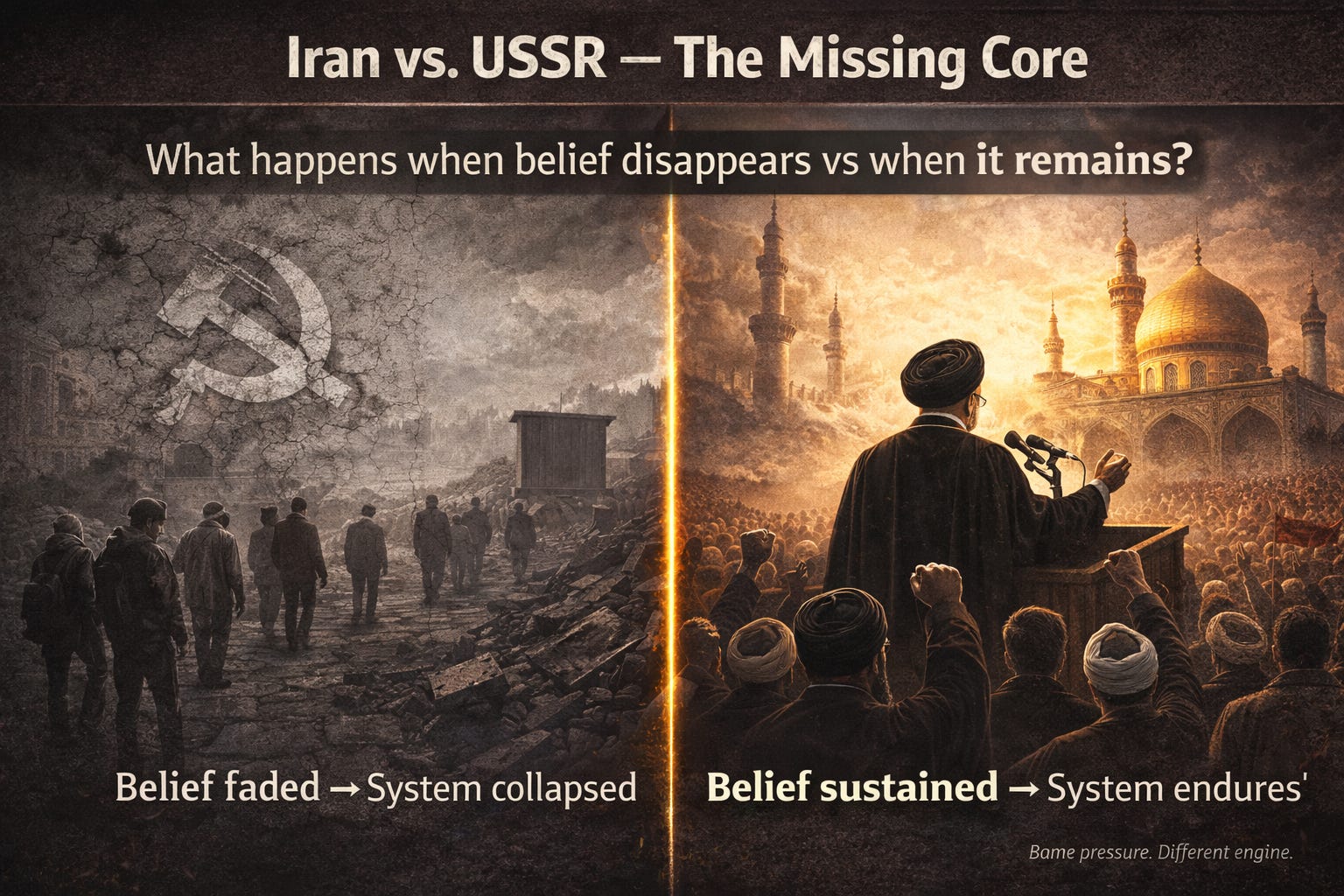
Response: Iran vs. USSR — The Missing Core
Your comparison is thoughtful—and you’re circling the key differences.
But there’s one factor that sits underneath all the others:
The Soviet system was explicitly godless.
The Iranian system is explicitly religious.
That alone changes the durability equation.
⸻
1. Atheism vs. Theocracy
The USSR didn’t just separate from religion—it actively suppressed it.
Its ideology was materialist.
Historical.
Economic.
It claimed inevitability—but not divinity.
So when the system began to fail economically and politically, there was nothing deeper holding it together.
No higher authority.
No sacred layer.
Once belief eroded, collapse followed.
⸻
Iran is built differently.
Its governing system is rooted in a specific religious doctrine—velayat-e faqih, the idea that a religious jurist must govern in accordance with Islamic law.
That means:
• political authority = religious authority
• obedience = not just civic, but moral
• dissent = not just disagreement, but deviation
This is not just governance.
It is a claim about truth.
⸻
2. Daily Reinforcement vs. Ideological Drift
You pointed to something important:
A system where people are tied into shared religious practice has a built-in reinforcement loop.
That doesn’t mean everyone believes equally.
But it does mean:
• the language of the state is familiar
• the rituals are continuous
• the framework is constantly reintroduced
The Soviet system had none of that.
Its ideology became abstract, bureaucratic, and eventually hollow.
⸻
3. Legitimacy: Earth vs. Heaven
Communism claimed historical correctness.
Iran’s system claims religious legitimacy.
That difference matters when pressure rises.
Economic collapse can discredit a material system.
It does not necessarily discredit a system that sees itself as:
• divinely guided
• historically tested
• morally obligated
In fact, pressure can reinforce it.
Hardship becomes proof of righteousness.
Opposition becomes confirmation of purpose.
⸻
4. Why Pressure Works Differently
You asked the key question:
Can economic pressure produce a Soviet-style collapse?
Maybe.
But the mechanism is different.
In the USSR:
• economic failure → loss of belief → fragmentation
In Iran:
• economic failure → strain → but not necessarily loss of core belief
Because the system is not anchored in outcomes alone.
It is anchored in meaning.
⸻
5. The Bottom Line
The Soviet Union collapsed when its ideology stopped being believed.
Iran’s system—whatever its internal tensions—still has a core that believes.
And more importantly:
It is structured to tie political authority to religious obligation.
That makes it more resistant to the kinds of pressure that ended the Soviet system.
⸻
A simpler way to say it:
The USSR was a system people eventually stopped believing in.
Iran is a system that asks people to believe—and organizes power around that belief.
That doesn’t make it permanent.
But it does make it fundamentally different.
Bob sits back and thinks about it for a while. Then, “Sometimes the uncomfortable answer is the real one.”