


Seconds in the Loop: How the OODA Cycle Ended in Tragedy on a Snowy Minneapolis Street
By Jim Reynolds | www.reynolds.com
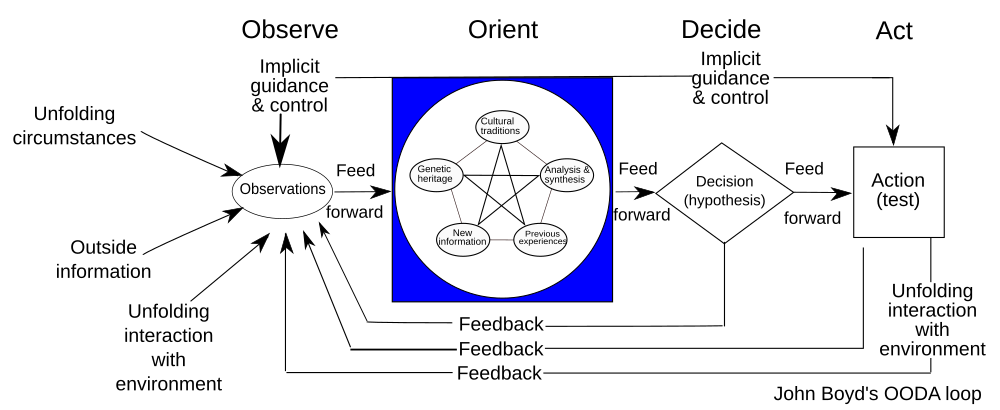
The tragic shooting of Renee Nicole Good in south Minneapolis on January 7, 2026, offers a stark real-world illustration of John Boyd’s OODA loop—Observe, Orient, Decide, Act—under extreme stress. Developed by the U.S. Air Force colonel to explain aerial combat, the model describes how humans process rapidly unfolding threats, and how failure at any stage can produce irreversible outcomes.
This encounter did not occur in a vacuum. It unfolded inside a political environment deliberately made volatile—where federal enforcement was publicly delegitimized, resistance was rhetorically encouraged, and responsibility for the resulting chaos was carefully disclaimed. The seconds that mattered on Portland Avenue were shaped long before Renee Good put her foot on the accelerator.
A crowd had gathered amid a prolonged ICE operation in a snowy residential neighborhood. Streets were blocked. Tempers were high. Good, 37—a U.S. citizen, mother of three, and poet—sat in her maroon Honda Pilot, stopped perpendicularly across Portland Avenue near East 34th Street, obstructing traffic.
The OODA Loop Breakdown
Multiple verified videos—including bystander footage, the ICE agent’s 47-second cellphone recording released January 9, and frame-by-frame analysis—show how quickly the decision cycle collapsed into seconds, with sharply disputed interpretations of intent.
1. Observe
ICE agent Jonathan Ross, an Iraq War veteran, approached the driver’s side, grabbing the door handle while recording on his phone. Good was visible through the open window, speaking calmly (“It’s fine dude, I’m not mad at you”). Ross observed the blocked roadway, non-compliance with exit commands, icy conditions, and a hostile crowd.
Good observed masked federal agents surrounding her vehicle, physical contact with the door, shouted commands, and an unstable scene.
2. Orient
Orientation—the most decisive phase of Boyd’s loop—is shaped by experience and context.
Ross’s orientation was colored by recent trauma. In December 2025 he testified about being dragged nearly 100 yards by a vehicle during a prior immigration operation. Vehicles were no longer neutral objects; they were potential weapons.
Good’s orientation likely drew from her role as a community supporter tied to “ICE Watch” networks, heightened emotions from the day’s confrontations, and degraded situational awareness on ice. Critics argue her actions reflected an attempt to escape, not attack.
Bob would call this the part where adults fail.
The agent is required to act. The civilian is encouraged to resist. Leadership stands safely upstream issuing slogans instead of instructions—and then acts shocked when seconds, not speeches, decide the outcome. This isn’t confusion. It’s abdication dressed up as compassion.
3. Decide
The decision window was brutally narrow.
Good briefly reversed, then shifted into forward gear. Ross decided the forward movement—estimated at 2–5 mph with visible tire spin—posed an imminent threat justifying lethal force.
Video details matter. The front wheels are turned sharply right, away from the agent directly ahead, suggesting an attempt to maneuver around rather than ram. Multiple experts interpret this as escape. Federal accounts insist the vehicle was “weaponized,” citing brief contact.
This created an environment where misinterpretation wasn’t just possible—it was inevitable.
4. Act
Ross fired three shots through the windshield, the first two within roughly 0.4 seconds. Good was struck fatally, accelerated forward, and crashed into a parked vehicle. The loop ended.
How Leadership Poisoned the Loop
This tragedy was not simply the product of individual fear. It was the predictable result of local leadership creating incompatible directives—and then walking away.
Federal agents were legally obligated to enforce the law. That mandate did not change. What changed was the environment. Minnesota’s state and city leadership spent years signaling that ICE enforcement was illegitimate and dangerous—without possessing the authority to stop it.
Non-cooperation is lawful. Obstruction is not. Rhetoric blurred that line.
OODA loops do not operate in isolation. Orientation is shaped by context. When leaders delegitimize enforcement while knowing it will proceed anyway, they distort everyone’s orientation. Agents expect hostility. Civilians expect confrontation. Risk migrates downhill—from press conferences to the street.
Local leaders chose symbolism over control. Outrage over de-escalation. Slogans over instructions. They implicitly encouraged resistance while leaving federal agents to absorb the physical risk.
When leaders encourage confrontation they will never personally face, they are not protesting enforcement—they are outsourcing danger.
Bob would call this governance by abdication.
Why the Loop Failed
Boyd taught that survival depends on clarity and speed. In law enforcement, that means early threat recognition, disciplined orientation, proportional decisions, and controlled action.
But when rhetoric primes resistance and authority disowns consequences, the loop collapses. Fear accelerates. Margins disappear. Outcomes harden.
Local leadership was not a bystander. By escalating rhetoric while disclaiming responsibility, state and city officials ensured enforcement continued under the worst possible conditions: hostility, confusion, and zero tolerance for error.
The federal government was not backing off. That left local leaders as the only actors capable of lowering the temperature. They chose not to.
Conclusion
The death of Renee Good was not the result of a single bad decision. It was the end state of a system in which local leaders inflamed tensions they could not control, knowing enforcement would proceed regardless.
They created an environment where seconds ruled, fear dominated orientation, and lethal outcomes became more likely.
If leaders want fewer bodies on icy streets, they must stop pretending rhetoric is costless and resistance is consequence-free. OODA loops collapse fastest in environments poisoned by political cowardice.
Bob would put it simply: if you build the collision and walk away, you don’t get to act surprised by the wreck.
Thanks, GB, for the background on the OODA Loop. It’s highly applicable to this tragedy. The loop here was not operating in a neutral environment—it was tainted by political rhetoric that encouraged confrontation while disclaiming responsibility. That kind of leadership doesn’t just confuse situations; it quietly puts people in harm’s way.