


Show Me the Denominator
Before you panic about measles, look at how Americans actually die.
By Jim Reynolds | www.reynolds.com
August 26, 2026
People are terrible at judging very small risks.
Tell somebody that 0.001 percent of people die from something and his eyes glaze over.
So let’s try something easier.
Imagine 100,000 people.
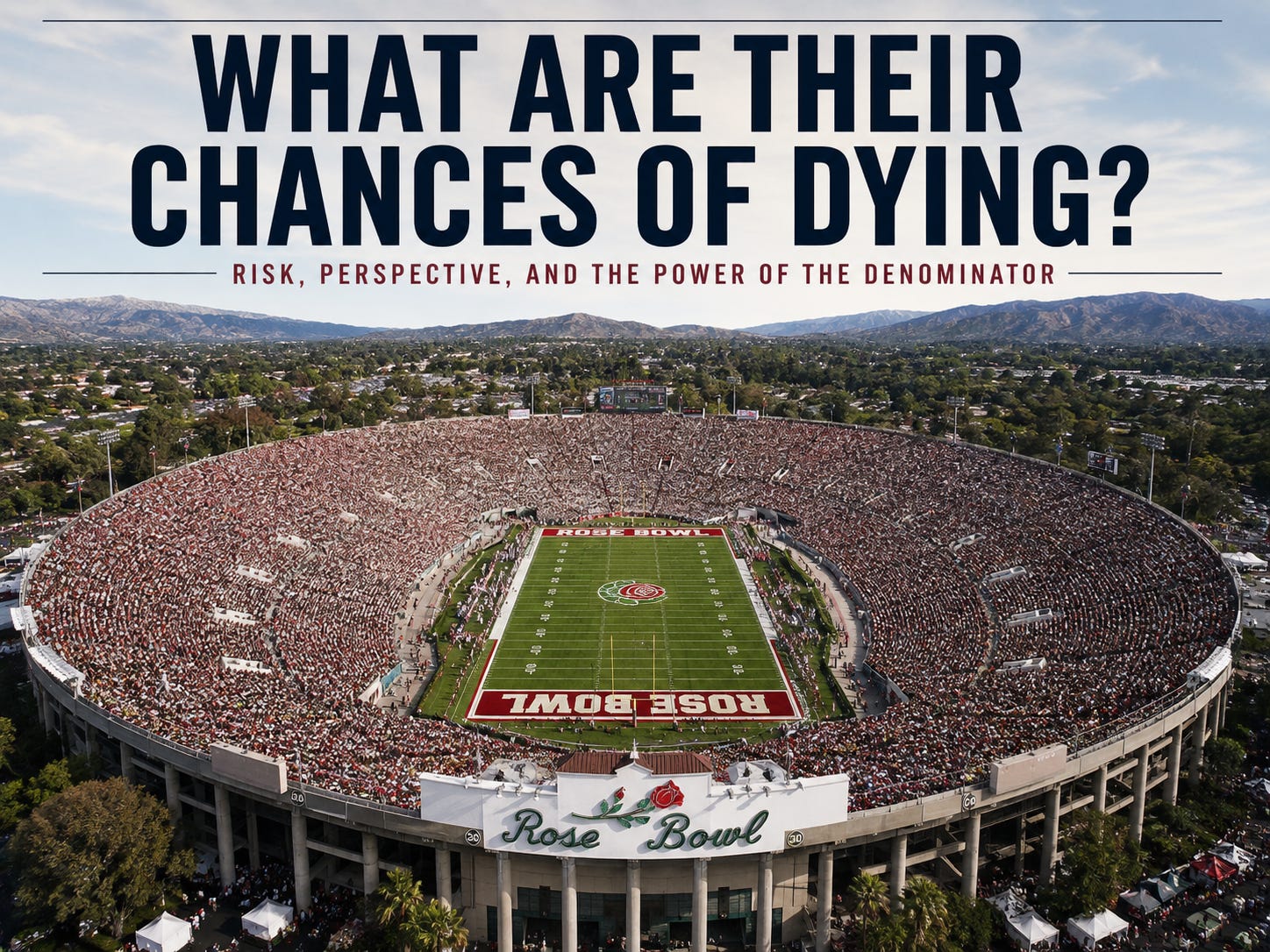
Close enough to a packed Rose Bowl.
Now ask a simple question:
How many of those 100,000 people will die from a particular cause this year?
Not eventually.
Not sometime during their lives.
This year.
The government keeps very good records on this stuff.
Let’s start with American children between five and nine years old.
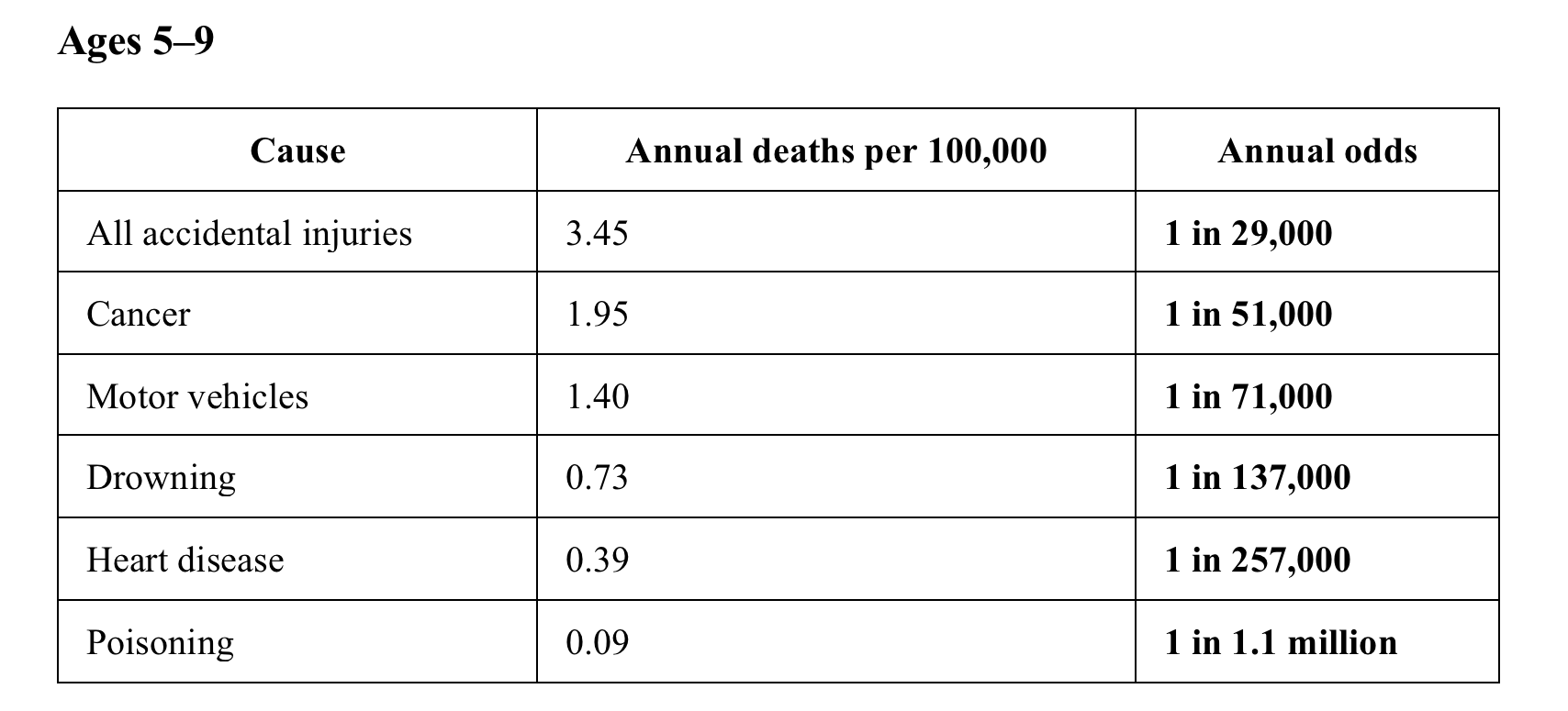
Look at those numbers.
Fill our imaginary Rose Bowl with 100,000 children.
Over the course of an entire year, statistically:
Three or four die accidentally.
About two die from cancer.
One or two die in motor-vehicle accidents.
Less than one drowns.
Even familiar causes of childhood death are remarkably rare when you put the denominator back into the equation.
That doesn’t make them unimportant.
It makes them understandable.
Now let’s grow those kids up.
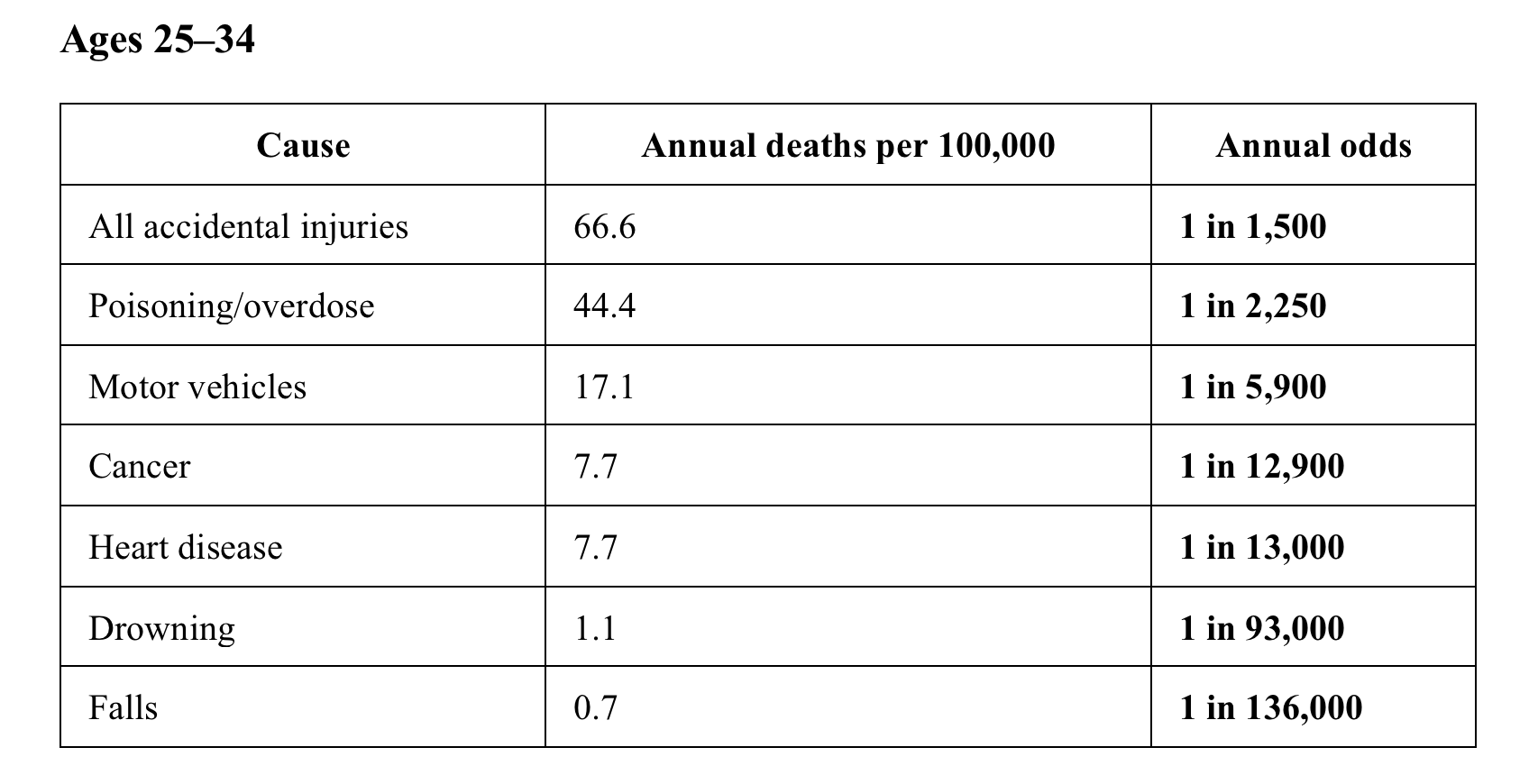
Quite a change.
Why?
Mostly because life changed.
The nine-year-old doesn’t drive to work.
The 30-year-old does.
The nine-year-old generally isn’t using fentanyl.
The 30-year-old might be.
Cancer has had another 20 years to develop.
Heart disease is beginning to appear.
More exposure. More opportunities. Different risks.
Nothing mysterious about it.
In fact, when you follow mortality through the age groups, you can almost watch human life unfolding in the numbers.
At 15, cars suddenly matter.
In the 20s and 30s, overdose deaths explode.
By the 40s, cancer and heart disease begin climbing quickly.
For Americans ages 45–54, the annual chance of dying from cancer is about 1 in 1,230.
Guess what?
I got a potentially deadly throat cancer at 47.
Never smoked.
Suddenly, I was one of the people hiding somewhere inside those statistics.
But notice something else.
I did not die.
That distinction matters.
Getting a disease, becoming seriously ill from it, and dying from it are three different things.
Headlines have a habit of sliding from one to the other as though they were interchangeable.
They aren’t.
By ages 55–64, cancer is killing roughly 1 person in 400 each year, while heart disease kills roughly 1 in 500.
Falls, nearly irrelevant to children and young adults, become increasingly important as we get older.
Our causes of death mutate with us.
It all makes sense.
You start driving, you acquire the risks of driving.
You get older, cancer and heart disease become more important.
You reach old age, falls become dangerous.
The numbers tell the story of a human life.
Which brings me to measles.
What About Measles?
Suddenly we are hearing a lot about measles.
Pennsylvania Governor Josh Shapiro held a press conference this week after his health department announced two “measles-associated deaths.”
Those are the state’s words.
Not mine.
Pennsylvania says they are the state’s first measles-associated deaths in 35 years. Both individuals were reportedly unvaccinated. Their ages were not initially disclosed.
The national media immediately went into action.
Deaths.
Outbreak.
Unvaccinated.
Vaccination rates.
Community protection.
Kennedy.
Trump.
We have heard this music before.
So let’s do something unfashionable.
Show me the denominator.
In all of 2025, the United States recorded three confirmed measles deaths: two school-aged children and one adult.
Three.
In a country of roughly 340 million people.
That works out to an annual population risk on the order of:
1 in 110 million.
Don’t confuse that with the risk of dying if you actually contract measles.
That is a different calculation.
I am asking a simpler question:
What is the annual chance that an ordinary American dies from measles?
Using 2025 as the example, roughly one in a hundred million.
Now go back to the Rose Bowl.
One Rose Bowl: 100,000 people.
Ten Rose Bowls: 1 million.
One hundred Rose Bowls: 10 million.
One thousand Rose Bowls: 100 million.
You would need to fill something like a thousand Rose Bowls with Americans to statistically reach one measles death at that recent national rate.
One.
Now compare that with a child dying in a motor-vehicle accident.
Roughly 1 in 71,000 per year for a child ages five through nine.
You don’t even fill one Rose Bowl.
Drowning?
About 1 in 137,000.
Cancer?
About 1 in 51,000.
And these aren’t hypothetical threats.
Children actually die from them every year.
No governor holds a national press conference because two children drowned.
We don’t get rolling cable-news coverage when a child dies of cancer.
Nobody blames the opposition party because somebody drove through an intersection at the wrong time.
Those risks simply exist.
We understand that life contains risk.
So Why Measles?
That is the interesting question.
Not whether measles exists.
It does.
Not whether somebody can die from it.
They can.
Not whether vaccination greatly reduces a person’s chance of contracting measles.
It does.
The question is one of proportion.
Why does a risk measured recently in the tens or hundreds of millions to one suddenly produce national headlines, gubernatorial press conferences, political blame and renewed lectures about “community protection”?
Why this risk?
Why now?
And why are Donald Trump and Robert F. Kennedy Jr. already being worked into the story?
That is where my antenna goes up.
During Covid we became accustomed to frightening numbers presented without useful denominators.
Cases.
Deaths.
Hospitalizations.
Percent increases.
Charts pointing upward.
A 100-percent increase sounds terrifying.
Unless you discover the number went from one to two.
The denominator changes everything.
That is why I used stadiums back then.
It forced the numbers back into the physical world.
Put 100,000 people in front of me.
Show me who dies.
Now I understand the risk.
And once you do that with measles, something rather remarkable happens.
The disease doesn’t disappear.
The hysteria does.
Bob: 🅱️ That may be precisely why nobody wants to show you the Rose Bowl.
P.S. One More Thing
A large share of my readers are old enough to remember actually having measles.
I certainly do.
If that describes you, your personal risk is even smaller than the already microscopic national numbers above.
The CDC considers people born before 1957 presumptively immune to measles. Why? Because measles was so common that nearly everybody in those generations was exposed to it naturally. A documented previous infection is also accepted evidence of immunity. (CDC)
So if you are one of those people who had measles as a kid, recovered, and acquired natural immunity, your chance of now contracting measles and dying from it is, for practical purposes, extraordinarily close to zero.
I remember my case.
A few splotches. I noticed them on my hands. A few days home from school.
Then back to life.
And, apparently, one more statistical crisis I no longer have to worry about.
🅱️ Bob: Sometimes the denominator is just a whole lot of Rose Bowls.
Sells media, newspapers, ads, eyeballs, attention. No more, no less. Panic is good for business.
Brilliant analysis Jim! Born in 1950, I got measles as a kid--didn't die eithe3r. Still alive 76 years later.
I wonder if we simply cannot fathom having a discussion without the hysteria? I'm becoming exhausted with the incessant fear mongering. It seems to be the only currency in which the pols traffic.
The Why? may have yet more components, not the least of which is money. That seems to be the driving force behind most mass psychosis today. Big pharma doesn't seem to mind.