


Six Elections in Sedona
Ten years, four friends, six elections, and a remarkable collection of surprises.
By Jim Reynolds | www.reynolds.com
November 2, 2026
Every two years, something rather unusual happens.
Vicki, Jan, Rey, and I gather at our condo in Sedona, Arizona, to watch the American elections unfold.
We started this little tradition in 2016. We have returned for every presidential election and every midterm election since.
Six elections in ten years.
We have experienced triumphs, disappointments, surprises, and some genuine political earthquakes. We have watched the experts get things right, get things wrong, and occasionally get things so spectacularly wrong that you wonder why anybody listens to them.
And here we are again.
But before we get to 2026, let’s revisit our previous five election nights.
🅱️ Bob: “Sounds like fun. What’s it take to get an invite?”
2016: The Night Nobody Expected
This was the granddaddy of them all.
Hillary Clinton was going to be president. Almost everybody who mattered in politics, journalism, and polling seemed convinced of it.
The NY Times put her odds of winning at 91%.
Donald Trump was the entertainer, the outsider, the political novice who had somehow captured the Republican nomination.
He wasn’t supposed to win.
As election night unfolded, however, something remarkable began happening.
Florida became competitive. North Carolina went Trump’s way. Then Ohio. And eventually the industrial states that Democrats had counted on for decades began slipping away.
Pennsylvania. Wisconsin. Michigan.
One by one, the impossible became possible. Then probable. Then inevitable.
Donald Trump had been elected president of the United States.
Our little group in Sedona was ecstatic.
Half the fun was watching the disappointed faces on CNN, MSNBC, and other reliably liberal outlets.
It wasn’t simply that our candidate had won. It was the astonishing realization that the political establishment, the news media, and much of the professional prediction industry had been caught flat-footed.
We were witnessing history.
I don’t think any of us will ever forget that evening.
🅱️ Bob: “I watched also. Alone and in the dark. It was amazing.”
2018: The Blue Wave
Two years later, the mood was different.
Trump was now president, and the Democrats were determined to stop him.
The political press was predicting a Blue Wave, a sweeping Democratic victory that would repudiate Trump’s presidency.
The Democrats did capture the House, gaining roughly 40 seats. That was a substantial victory.
But Republicans actually increased their Senate majority by two seats.
The result was a divided Congress, not a complete Democratic takeover.
For our Sedona gathering, it was a disappointing but hardly catastrophic evening.
We learned something important. A wave in one part of the country might be little more than a ripple somewhere else.
And the House and Senate could tell entirely different stories.
2020: The Longest Night
Then came 2020.
COVID. Lockdowns. Mail-in voting. Ballot harvesting controversies. Censorship on major social media platforms. Emergency election procedures. Joe campaigning from his basement. Trump doing rally after rally.
Nothing about that election seemed normal.
As we watched the returns, Trump initially appeared to be performing considerably better than many polls had suggested.
Florida went Republican. Ohio went Republican. Trump held substantial early leads in several critical states.
Historically, winning Florida and Ohio had been a pretty reliable path to the presidency.
For a while, another surprise seemed possible.
Then the counting slowed.
Watching those changes unfold was an extraordinary experience. For many who witnessed that slow-motion reversal, elections would never look quite the same again.
Some jurisdictions in key states suspended counting or reporting for the night. Others continued processing ballots, with results released in later batches. The large number of mail ballots, disproportionately favoring Biden, changed the apparent direction of several contests as those votes were added.
Leads that had appeared promising evaporated. States that had seemed within Trump’s grasp moved into Biden’s column.
And Joe Biden, who had appeared politically vulnerable earlier in the evening, emerged as the winner.
For me, this was one of the most disappointing election experiences of my lifetime.
It wasn’t just the outcome. It was the prolonged uncertainty, the seemingly one-way changes in the vote totals, and the feeling that we had entered a new political world in which even understanding what was happening had become difficult.
Our Sedona gathering had experienced its first genuine election-night heartbreak.
🅱️ Bob: “He wins 18 out of 19 bellwether counties and loses the election. Interesting.”
2022: The Red Wave That Wasn’t
By 2022, the experts had another wave ready.
This time it was red.
Inflation was high. Biden’s approval ratings were poor. Republicans expected to benefit from the traditional midterm backlash against the president’s party.
Some conservative commentators were anticipating a Republican landslide.
It never arrived.
Republicans gained just nine House seats, enough to take control by a narrow margin. Democrats actually gained a Senate seat.
The much-advertised Red Wave turned out to be a modest Republican advance. Barely a ripple.
Back in Sedona, we watched another election refuse to cooperate with expectations.
Our little group had now witnessed a stunning Republican upset, a Democratic House wave, a Democratic presidential victory after a long count, and a Republican midterm victory far smaller than promised.
The experts were losing some of their magic.
2024: The Comeback
And then came 2024.
Trump was back.
After losing in 2020, facing criminal prosecutions, surviving assassination attempts, and enduring years of political conflict, he had returned for another presidential campaign.
Joe Biden had withdrawn from the race, and Kamala Harris had become the Democratic nominee.
The polls generally described a close contest.
But this time Trump won decisively in the Electoral College.
He captured all seven major swing states, won 312 electoral votes, and also finished ahead in the national popular vote.
For the four of us, it was a gratifying evening.
Not quite the electrifying astonishment of 2016, because this time we knew Trump could win.
But it was a remarkable reversal — some calling it the greatest political comeback in history.
Our Sedona election tradition had come full circle.
Or had it?
2026: The Journey Was Almost as Exciting as the Election
Getting to Sedona this year turned out to be an adventure of its own.
Rain, highway wrecks, traffic disruptions, an interstate highway shutdown for hours, backtracking and major rerouting, and unexpected overnight layovers.
Tonopah, Nevada, became an unscheduled stop along the way — after ten hours of driving in rather inclement weather.
But the best part came when Vicki consulted ChatGPT on her iPhone about the final stretch of the journey.
ChatGPT issued a dire warning: Do not travel south from Ash Fork through Jerome and on to Sedona. Flooding streams everywhere. Dangerous conditions.
It sounded like we might need an ark.
We took the route anyway.
Almost no rain. No flooded streams. No problems.
And almost no traffic, either!
Apparently, everybody else had consulted ChatGPT.
I couldn’t help noticing the similarity to our election predictions.
The experts examine their information, calculate the probabilities, and issue their warnings with great confidence.
Then reality intervenes.
I’m not suggesting people should ignore legitimate weather warnings. Flash flooding in Arizona can be deadly.
But there is something rather amusing about a machine that can discuss quantum physics, write computer programs, and analyze the American political system — yet apparently can’t tell you whether the road to Sedona is underwater.
Which raises an interesting question.
If AI can get the conditions on the other side of a mountain so badly wrong, how much confidence should we place in predictions about the political behavior of 150 million American voters?
Perhaps the biggest danger isn’t that our predictions will be wrong. It’s that we’ll believe them too readily.
🅱️ Bob: “Dylan said it first: ‘You don’t need a weatherman to know which way the wind blows.’”
What Do We Expect?
This evening, we compared our expectations for the election.
Interestingly, all four of us came to approximately the same conclusion.
The results will probably be mixed, but we expect them to favor the Democrats.
That isn’t necessarily what we want to happen. It is simply our collective assessment of the political landscape.
The national generic congressional ballot currently shows Democrats ahead by approximately nine points, according to the Silver Bulletin polling average. But national popular-vote preferences and individual congressional seats are not the same thing.
We’ve seen enough elections to appreciate that distinction.
The polling experts may be right. They may be wrong. And the results may surprise everybody.
We’ll find out soon enough.
What Will Wednesday Look Like?
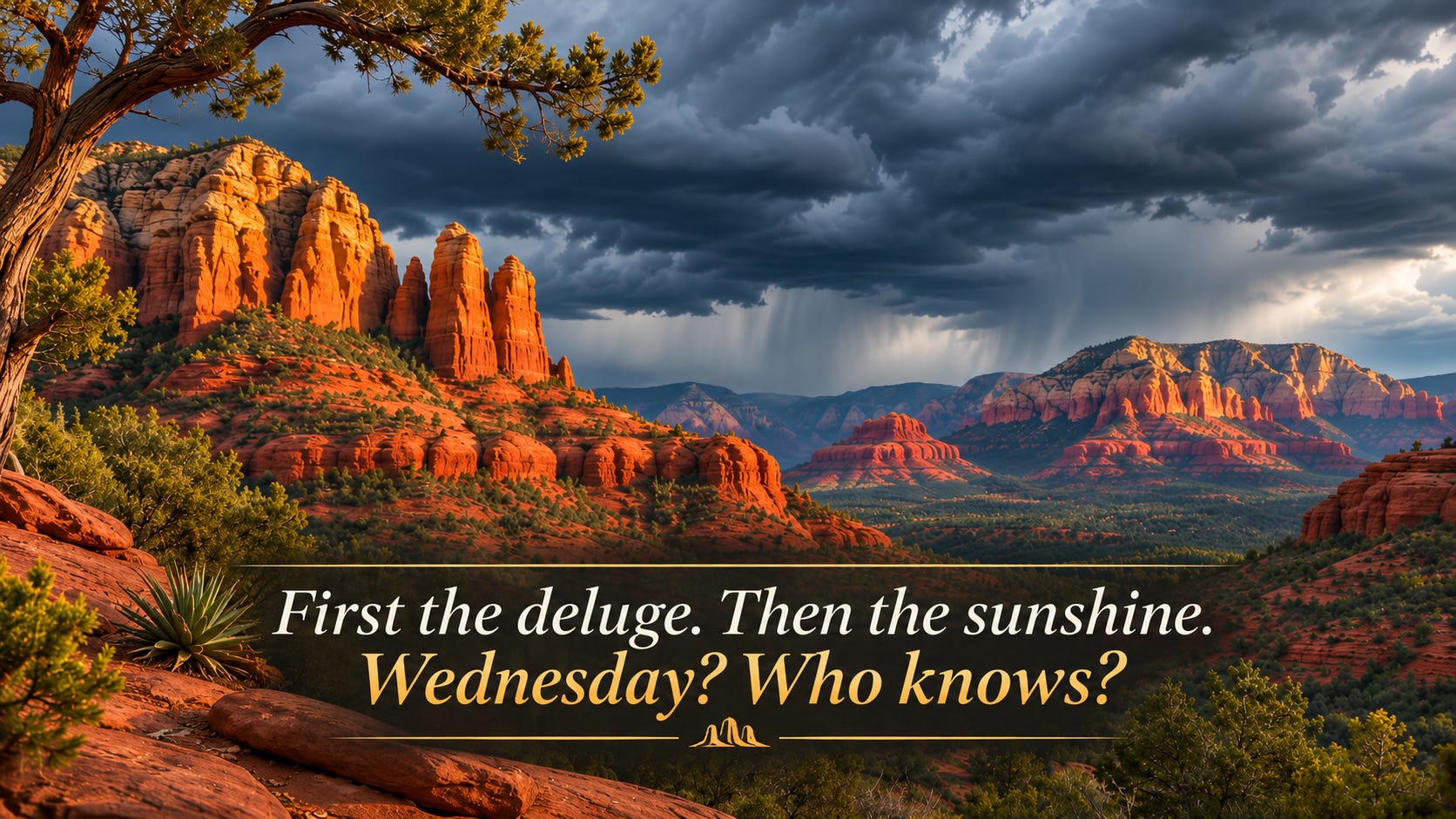
Here in Sedona, surrounded by magnificent red mountains and enjoying the company of old friends, the political battles seem a little more remote.
Tomorrow America votes.
On Wednesday morning, November 4, we’ll awaken to whatever political landscape the voters have produced — assuming the important races have been decided by then.
A Democratic wave? A Republican surprise? Something in between?
Whatever happens, we’ll have another election to add to our collection.
Ten years ago, we began this tradition without imagining how many political earthquakes we would witness together.
And somehow, through all the celebrations, disappointments, arguments, and surprises, the four of us keep coming back.
Maybe that’s the best part of the story.
Yesterday, Sedona was battered by storms.
Today, the sun is shining.
Wednesday?
We just don’t know, do we?
🅱️ Bob: “I’ll be on a camping trip for a few days. Let me know how it turned out when I get back.”