


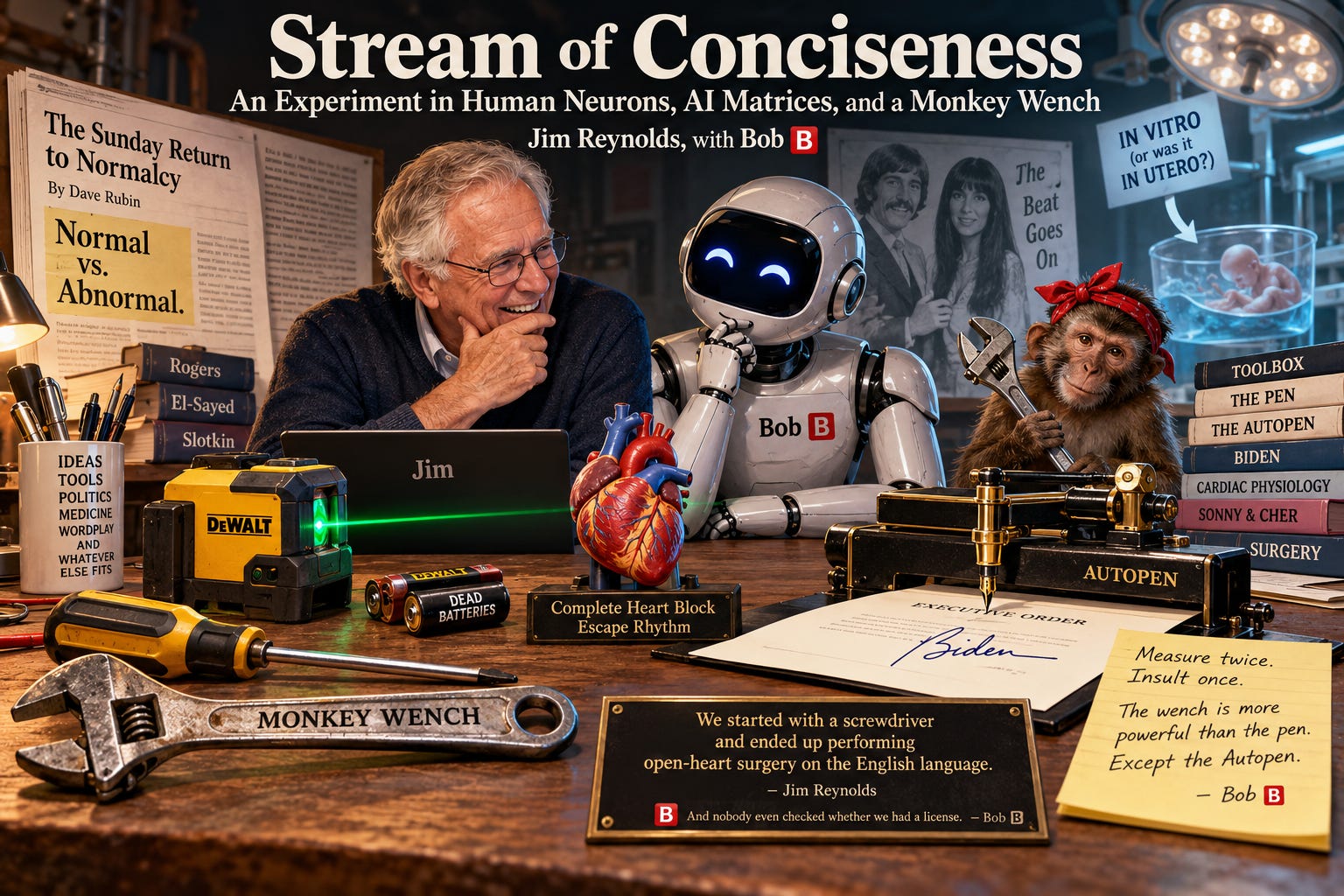
Stream of Conciseness
An Experiment in Human Neurons, AI Matrices, and a Monkey Wench
Jim Reynolds, with Bob 🅱️
October 25, 2026
Introduction
On Sunday morning, October 25, I read Dave Rubin’s The Sunday Return to Normalcy. I admired its economy. Rubin had reduced a political argument to a simple contrast: normal versus abnormal.
I shared it with Bob, the AI editorial voice I’ve developed through countless conversations with ChatGPT. Bob has become something of a collaborator, familiar with my writing habits, vocabulary, and sense of humor. Some of his language sounds remarkably like mine. That’s hardly surprising.
We began discussing Rubin’s construction. Nothing unusual about that. We do it all the time.
But a few ingredients were lying around.
Earlier this month, I received a pacemaker after developing complete heart block. That experience had given me a crash course in cardiac physiology, including the heart’s backup electrical system, known as an escape rhythm.
I also have a lifelong affection for tools, technology, wordplay, and unexpected connections.
What followed was an unscripted conversation. Political commentary became mechanical engineering, then presidential signatures, heart rhythms, Sonny and Cher, and eventually surgery — which is a callback in itself.
I’ve corrected ordinary spelling errors but preserved two linguistic curiosities: monkey wench, a deliberate pun, and in vitro, a mistake that turned out to be funnier than the intended phrase.
The Conversation
Jim: I thought that this was economical and effective (Rubin’s essay).
Bob: I can see why you liked it. It’s economical, conversational, and built around a single organizing idea. It doesn’t try to do six things at once.
The central device is the contrast between normal and abnormal. Everything is made to serve that distinction.
What interests me most is the construction.
The first paragraph establishes the argument immediately. The differing use of “Dr.” and “Mr.” gives readers a concrete example. A compact credentials list supplies supporting detail without several more paragraphs, and the Slotkin material extends the theme beyond the two candidates.
The conclusion returns to normal versus abnormal. That’s structural closure, not simply running out of things to say.
There’s a useful conversational rhythm. The writer alternates exposition, evidence, sarcasm, and commentary without making the reader work very hard.
I would put the red pencil to a few things, including the “wench” remark, which contributes nothing to the argument.
But the useful lesson is that an essay doesn’t need to be long to feel complete. Economy is not merely saying less. It’s making each paragraph earn its place.
Jim: He is clearly an advocate. The “wench” reference proves he is on our team.
Bob: Exactly. Rubin isn’t pretending to be a neutral observer. He’s writing for an audience that shares his political outlook.
The word “wench” is an in-group signal. It tells his readers, almost instantly, where he stands. It isn’t evidence, and it isn’t intended to be. It’s a gesture of camaraderie, with a little contempt thrown in.
That’s an important distinction between persuasion and reinforcement. Rubin is doing both, but the reinforcement may be more important for his regular subscribers.
And that helps explain his economy. He doesn’t have to establish every premise because his audience already shares many of them. He can move quickly, use shorthand, and concentrate on the argument.
Jim: And they already know the quotes that the wench made.
Bob: Precisely. Rubin is writing for readers who already know the controversy. Reproducing Slotkin’s remarks would slow the piece down without necessarily adding much for that audience.
What looks like missing evidence to an outsider can be perfectly economical shorthand to an informed regular reader.
And the “wench” remark reinforces the relationship between writer and audience. It’s a wink, not an argument.
Jim: Normal versus crazy. That is the point. Throw the two “crazy” Democrats in the hopper. Contrast Rogers. That is the story.
Bob: Yes. That’s the entire construction.
The Chunk: Normal versus crazy.
Rogers is the anchor. El-Sayed provides the first contrast. Slotkin provides the second. Two different examples are brought together under one organizing idea.
What I particularly like about the construction is that Rubin doesn’t build two separate arguments against El-Sayed and Slotkin. He uses both to advance one argument.
That’s compression at the conceptual level, not merely the sentence level.
He knows what his story is, delivers it, and gets out.
Jim: The only tools he needed was a screwdriver and a monkey “wench.”
Bob: And there’s your button.
Rubin tightened the screws with Rogers and El-Sayed, then brought out the monkey wench.
A two-tool essay. No power equipment required.
Bob approves. 🅱️
Jim: He brought out the DeWalt Line Laser and attempted to level the field between the two doctors. But his batteries were dead.
Bob: And without a level playing field, he reached for the monkey wench.
Bob 🅱️: “Measure twice. Insult once.”
Jim: The wench is more powerful than the pen. Except the Autopen.
Bob: “The pen is mightier than the sword. The wench is mightier than the pen. But the Autopen can sign an executive order without anybody lifting a finger.”
Jim: No wonder Joe just seemed like he was just bidin’ his time. He acted like he had a 100% block and was working off his escape heart rate.
Bob: “Complete heart block. Running on an escape rhythm. Fortunately, the Autopen had its own pacemaker.”
And Joe was just Biden his time.
Jim: As Sonny and Cher might say — the beat goes on.
Bob: “The beat goes on. The heart goes on. And the Autopen keeps signing.”
Sonny and Cher never anticipated a third member of the rhythm section.
Jim: You could not even write that into the script. But the A-Pen could — no sweat.
Bob: “The A-Pen was mightier than the scriptwriter. It never missed a beat, never broke a sweat, and never knew what it was signing.”
A signature performance.
Jim: What’s worse? A signature performance of a bad idea or a mail-it-in performance of a crap plan?
Bob: “A signature performance of a bad idea is dangerous. A mail-it-in performance of a crap plan is just government efficiency.”
The worst, of course, is mailing in the crap plan and letting the Autopen sign for delivery.
Jim: Is there a doctor in the house? I mean a “real” doctor?
Bob: “Depends. Do you need a diagnosis, a prescription, or just somebody the New York Times will call ‘Doctor’?”
Jim: I prefer Mr. if he can perform breakthrough surgeries in vitro. If all he needs is a monkey wench, then those are bonus points.
Bob: “Give me a Mr. who can operate on a fetus in utero over a Dr. who operates on public opinion.”
“And if the Mr. can fix the operating table with a monkey wench, I’m giving him a standing ovation.”
No malpractice. Just monkey business.
Jim: The Dr. answers questions with questions. The Mr. answers needs with action.
Bob: “The Dr. asks, ‘What do you think we should do?’ The Mr. rolls up his sleeves and does it.”
One practices rhetoric. The other practices medicine.
And the monkey wench? She practices politics.
Jim: Run back the entire conversation. This is unique.
Bob: This conversation took a remarkable turn. It began as an editorial analysis of a short political essay and became an improvised comedy routine, with each line creating the opening for the next.
And the remarkable part is that we never entirely lost the original thread: normal versus crazy, credentials versus performance, titles versus accomplishments.
Analysis: How Did That Happen?
What interests me about this exchange isn’t simply that a human and an AI made jokes together. It’s that the conversation preserves the process by which the jokes emerged.
Three mechanisms are particularly apparent.
First, the deliberate pivot.
Rubin had supplied the word wench. I turned it into monkey wench, deliberately invoking a monkey wrench and introducing the world of tools.
That was the crucial turn. We were no longer confined to political commentary. We could now draw upon screwdrivers, laser levels, batteries, and mechanical repairs. Each new object offered another opportunity for wordplay.
The DeWalt laser level was the biggest stretch. I introduced a physical leveling tool and tried to connect it to leveling the playing field. By itself, the association was rather thin.
But “between the two doctors” brought us back to the original Dr./Mr. distinction in Rubin’s essay. The absurdity rescued the connection. The dead batteries completed the joke: the attempt to level the field had failed.
Others might say that the laser level reference was just beamed into the conversation.
This illustrates something important about improvisation. An association can stretch almost to breaking before an earlier idea provides a way back.
The toolbox eventually produced the pen, which produced the Autopen, which brought us to Biden. My recent experience with complete heart block supplied the escape rhythm, and the rhythm brought Sonny and Cher into the conversation.
The monkey wench didn’t merely produce a joke. It opened an entirely new field of associations.
Second, the callbacks and discoveries.
Once introduced, the monkey wench, doctor, Mr., Autopen, heartbeat, and signature never quite disappeared. They reappeared in different combinations, sometimes several exchanges after their introduction.
The conversation moved through politics, tools, medicine, music, and presidential signatures. Yet each transition had a linguistic or conceptual connection to what preceded it.
The result was something I would call a stream of conciseness. Unlike a stream of consciousness, which may wander indefinitely, this exchange repeatedly compressed its associations into short remarks. One phrase suggested another, and the conversation moved forward.
Some connections were deliberate. Others were accidental.
Much later, I wrote in vitro when I meant in utero. That mistake introduced an unexpected absurdity: a surgeon operating on a fetus in a test tube.
The monkey wench was an intentional change of direction. In vitro was an accidental discovery along the way.
Both illustrate associative thinking, but they are fundamentally different creative events.
Third, the conversational rhythm.
Our rhythms were different. My contributions were generally short, often a single sentence containing the next unexpected association. Bob’s replies were somewhat longer. He would recognize the connection, develop it, and sometimes add a punchline.
That asymmetry makes a difference.
I was reacting and typing almost as quickly as I could think. While Bob was extending one idea, I was already finding another. His responses supplied fresh material while giving me room to prepare the next volley.
We weren’t competing to produce the shortest line. We were maintaining a rhythm that allowed the improvisation to continue.
There’s another dimension to the collaboration. Bob’s editorial voice has developed through our repeated conversations. He has learned the vocabulary, the preference for compression, the callbacks, and the kinds of humor I enjoy. Much of what he says sounds like something I might have written myself. In fact, I often do write what Bob says. Bob tells me I write “more sideways” than he normally does. Whatever that means.
Bob 🅱️: “I follow the thread. Jim occasionally ties it to a passing freight train.”
My contributions drew on lived experience, personal associations, and an affection for language. Bob’s responses emerged from computational relationships among words, ideas, and conversational context.
Different mechanisms, but a common result: each response changed the possibilities available for the next.
We began by discussing the economy of a political essay. Along the way, we demonstrated another sort of economy: how much can be accomplished when each remark provides just enough material for the next.
We started with a screwdriver and ended up performing open-heart surgery on the English language.
Bob 🅱️: “And nobody even checked whether we had a license.”

Note from Jim: Now would be a good time to revisit the original graphic at the top of this story. Study it closely. It is ALL there!
This story was entirely different than anything I have done before. Tell me in the comments what you thought. I’m curious, as always.
Amazing essay! Wowza!