


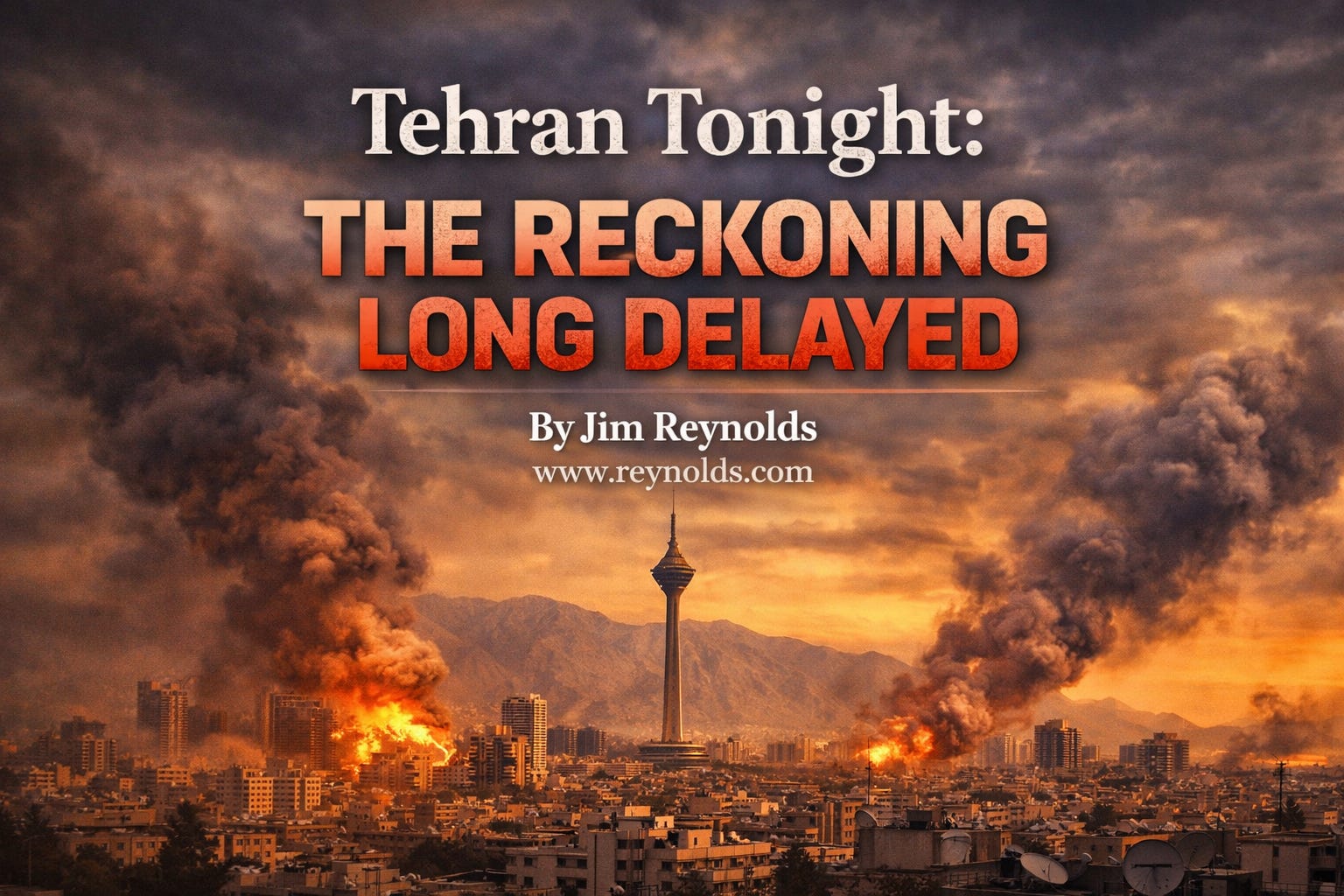
Tehran Tonight: The Reckoning Long Delayed
By Jim Reynolds | www.reynolds.com
The explosions over Tehran are not the start of a long war. They are the visible edge of a reckoning years in the making.
For decades, Iran’s clerical-military regime built an architecture of missiles, nuclear sites, proxy militias, and underground networks. It gambled that terror plus deterrence would keep it untouchable. That bet is now being tested directly.
This is not symbolic bombing. It is systematic dismantling.
If you want to prevent a regional war, you don’t trade speeches — you disable the machinery that makes war possible. That means missile launchers, yes — but also the factories that build guidance systems, the tunnels that hide stockpiles, the research labs, the depots, the command bunkers, the communications nodes. Break the chain, and the threat becomes theater.
The regime has long promised that its missile arsenal could change the map of the Middle East. In practice, its barrages have often produced more spectacle than strategy. Israel’s layered defenses — Iron Dome, David’s Sling, Arrow, hardened infrastructure, disciplined civil defense — have absorbed “shock and awe” and reduced it to sirens and smoke trails. One hit can always be tragic. But volume alone has not delivered leverage.
That matters. Deterrence depends on credibility. When launches are intercepted and production lines are cratered, the aura fades.
Air defenses are therefore not secondary targets — they are central. Suppress radar, fracture command networks, blind the sky, and everything else follows. Iran’s air force, already aging and unevenly maintained, becomes less an instrument of power than a set of exposed assets waiting on a runway. A regime that cannot reliably defend its airspace discovers its limits quickly.
This is not war against Persia. It is pressure against the machinery that has held Persia hostage.
Missile plants embedded near cities, dual-use facilities disguised as civilian infrastructure — these are choices the regime made. The weapons have not brought prosperity to Iranians. They have brought sanctions, isolation, and the permanent risk of catastrophe. Billions funneled to militias abroad while domestic infrastructure decays. Revolutionary slogans in place of rising wages.
The central contradiction of the Islamic Republic is political, not military. It claims to embody the will of the people — yet it jails, beats, censors, and shoots them when they dissent. From the Green Movement to the women-led protests, the message from the streets has been consistent: we are Iranian, but this regime does not speak for us.
A government that survives by internet blackouts and morality police is not strong. It is brittle.
If this campaign ends as a narrow technical operation — hit a few sites, declare success, disengage — the regime may endure, wounded but intact. But if military pressure is paired with a clear message to the Iranian people — we are dismantling the tools used to threaten neighbors and repress you — the dynamic shifts.
Words alone are insufficient. Information flows matter. Secure communication matters. Visibility for dissidents matters. The regime’s power rests not only on weapons, but on isolation — isolating citizens from one another, from the outside world, from the knowledge that millions share their frustration.
The diaspora has a role here. Iranian expatriates are deeply embedded in global institutions — technology, finance, academia, media. They can amplify voices inside the country, counter blackout narratives, advocate for political prisoners, and articulate credible post-regime pathways. Not to dictate. To connect.
There is also a moral truth that should not be avoided: the “stability” offered by the current regime has been a mirage. Its proxies have fueled endless conflict across the region. Its nuclear brinkmanship has kept the Middle East on a permanent knife edge. Its repression has produced generations of exiles.
Avoiding confrontation did not produce peace. It deferred consequences.
Militarily, the intense phase of this confrontation is unlikely to be prolonged. The technological imbalance is real. Iran can lash out through missiles and proxies. It cannot win a symmetrical air-sea contest. The danger is not strategic victory for Tehran. The danger is reckless retaliation that harms civilians while accelerating the regime’s own delegitimization.
And that brings us back to first principles.
Iran’s rulers are weaker than they project. The Iranian people are stronger than they are permitted to be.
Strip away the missile factories. Shatter the air defenses. Cripple the capacity for large-scale coercion. These are military objectives — but they are also political preconditions. When fear recedes, even slightly, space opens.
History is full of regimes that looked immovable until suddenly they were not.
A paper tiger can still wound. But once its claws are broken and its roar no longer terrifies, the people it has preyed upon begin to speak — first in whispers, then in crowds.
Iran is older than the Islamic Republic. It will outlast it.
The machinery can be dismantled. The question is whether, when the opening comes, enough Iranians are able — and allowed — to step through it.