


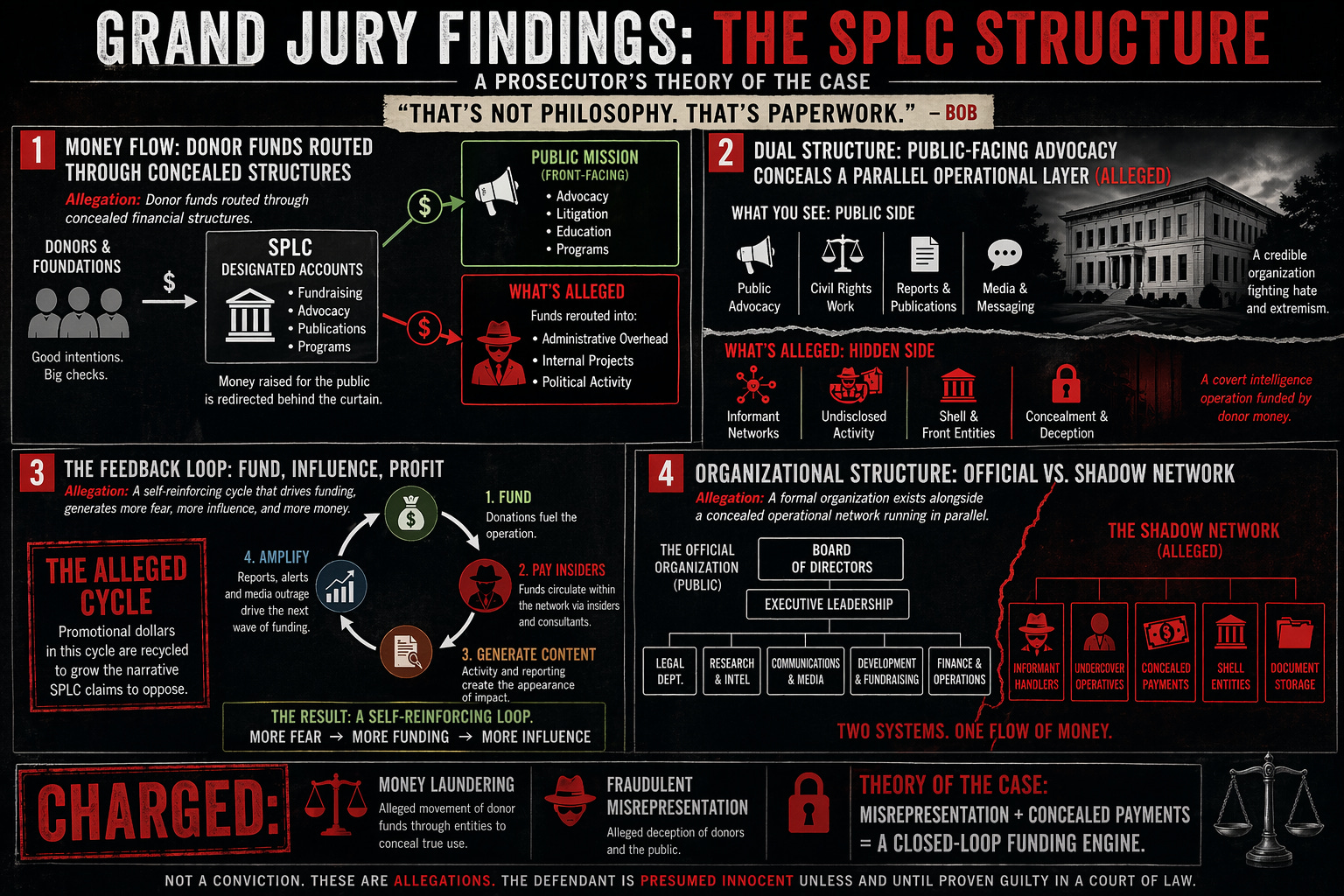
[Original graphic from Jeff Childers Substack. Edited for this story]
That’s Not Philosophy. That’s Paperwork.
By Jim Reynolds | www.reynolds.com
April 23, 2026
Bob didn’t start with the politics.
He started with the bank accounts.
“Fake accounts?” he said.
“Now we’re not talking theory anymore.”
Start With What Actually Matters
Here’s the trigger for all of this.
A federal grand jury has brought serious financial charges against the Southern Poverty Law Center (SPLC)—alleging that money moved through fictitious entities, concealed accounts, and misrepresented financial channels.
Those are allegations. They must be proven.
But if investigators can document them, the story changes categories.
Because that’s no longer about speech or ideology.
That’s banking system territory.
And banking systems don’t tolerate fiction.
Why the Structure Matters More Than the Story
The headlines focus on who got paid.
That’s not the main issue.
The main issue is how the money moved.
Because if you need:
shell structures
disguised accounts
concealed ownership
you’re not just operating.
You’re hiding the operation.
And hidden operations invite harder questions.
Break that—and every downstream claim deserves scrutiny.
Now Step Back—Look at the Pattern
Ignore the labels. Watch the behavior.
A cycle appears:
Identify or highlight extremism
Channel money into the ecosystem around it
Generate outrage and coverage
Convert outrage into funding
Repeat
Fear becomes fuel.
Outrage becomes revenue.
And the system begins to feed itself.
Systems don’t drift. They optimize.
And that’s why the identity matters.
This isn’t an obscure organization.
It’s the Southern Poverty Law Center — one of the most influential groups in the country when it comes to defining extremism.
The Question That Follows
If money is flowing into the same ecosystem being reported on…
then what exactly is being funded?
Observation?
Access?
Influence?
You don’t have to answer that definitively.
But you do have to ask it.
The Riot Question
Look at recent unrest—Los Angeles and elsewhere.
In many of these events, the same questions keep appearing:
Who organized the presence?
Who handled logistics?
Who sustained activity over time?
What role, if any, did nonprofit or NGO networks play?
Some answers are documented. Others remain conspicuously unclear.
The question isn’t:
“Did one group cause this?”
The question is:
“Is there an ecosystem where funding, activism, and escalation intersect?”
Because if that ecosystem exists—
then funding flows matter a lot more than public statements.
Now Bring the DOJ Back In
People instinctively focus on the DOJ.
That’s backwards.
The DOJ is the response vector.
The system is the story.
And when that system involves:
alleged financial concealment
donor misrepresentation
structured payment channels
it eventually stops being political—
and becomes investigable.
The Timing Question
Seven months before an election.
Of course people notice.
And they should.
But timing cuts both ways.
If nothing illegal happened, timing looks political.
If something illegal did happen—
what exactly is the “right” time to enforce the law?
After the election?
Next year?
Never?
Law delayed is law denied. Law ignored is something worse.
What Makes This Different
This isn’t just about ideology.
It’s about money moving through hidden structures.
And once financial systems are involved:
records exist
trails exist
accountability exists
Or at least—it’s supposed to.
The Core Issue
If an organization like the SPLC is:
raising money based on threat narratives
channeling funds into opaque structures (alleged)
and operating inside the same ecosystem it publicly warns about
then you don’t just have a messaging problem.
You have a system integrity problem.
Bob’s Bottom Line
Bob leaned back.
“Look,” he said, “I don’t need to prove everything to notice something’s off.”
Pause.
“But fake accounts?” he added.
“That’s not philosophy. That’s paperwork.”
The Real Question
Not whether every allegation is true.
That’s for the courts.
But whether the nature of the allegation changes how we should look at the story.
Because if even part of it is proven—
this isn’t just political noise.
It’s a system operating in ways that don’t serve the public.
And if that’s the case—
it doesn’t matter who’s in charge.
It needs to be dealt with — directly.