


The 80–20 Lie: What Are Democrats Protecting?
By Jim Reynolds | www.reynolds.com
March 23, 2026
Some issues are complicated.
This isn’t one of them.
Voter ID is about as basic as it gets:
If you vote, you prove you are who you say you are—and that you’re eligible to vote.
We require ID to:
• board a plane
• open a bank account
• pick up medication
• enter a federal building
But when it comes to the single act that determines who runs the country…
…suddenly ID is “too much.”
⸻
The Part That Doesn’t Add Up
Here’s the problem—and it’s not small:
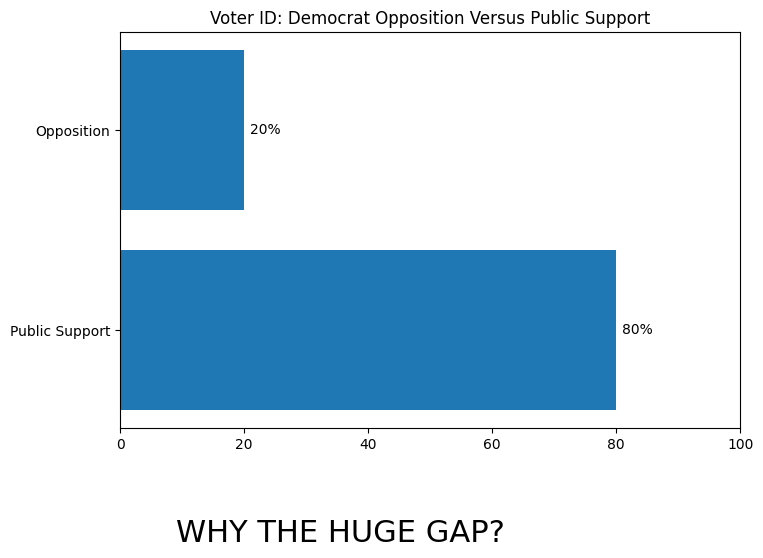
The American public overwhelmingly supports voter ID.
Not 51–49.
Not even 60–40.
We’re talking landslide agreement—often 70, 80 percent or more.
That includes Democrats.
That includes minorities.
That includes the very groups we’re told are “at risk.”
So stop right there.
If this were really about:
• elderly access
• rural inconvenience
• paperwork confusion
…then this would be a fixable problem, not a political war.
You don’t go to the mat over edge cases.
You fix them.
⸻
But Democrats Don’t Fix It
They fight it.
Relentlessly. Uniformly. Without compromise.
No voter ID.
No tightening.
No real negotiation.
Just slogans:
• “suppression”
• “access”
• “equity”
None of which explain the behavior.
Because the behavior is the clue.
⸻
Follow the Only Thing That Matters: Incentives
Politics isn’t about words.
It’s about what you’re willing to fight for—and what you’re not.
So ask the only question that matters:
Why would Democrats oppose a wildly popular, common-sense safeguard this aggressively?
There are only two possibilities:
They believe it hurts them
Or they believe stricter verification would change who shows up—and who wins
That’s it.
No third option.
⸻
The Edge Case Excuse
You’re told:
“Some people don’t have ID”
Fine.
Then:
• make ID free
• send mobile units
• solve the problem in a week
Done.
But that’s not what happens.
Because solving the problem would eliminate the excuse.
And the excuse is doing work.
⸻
The Real Signal
Here’s the part no one wants to say out loud:
You don’t risk political damage on an 80–20 issue…
…unless something bigger is at stake.
Something worth the cost.
Something worth the suspicion.
Something worth the loss of trust.
That’s the signal.
Not the words.
Not the press releases.
The risk tolerance.
⸻
The Payoff
Let’s stop pretending this is confusing.
It isn’t.
You don’t take a unified stand against an 80–20 issue.
You don’t ignore your own voters.
You don’t fight this hard over something this simple.
…unless the current system is doing something for you that you cannot afford to lose.
That’s it.
That’s the answer.
⸻
And once you accept that, everything else snaps into place.
The slogans don’t matter.
The excuses don’t matter.
The “edge cases” don’t matter.
They’re cover.
⸻
Because if this were really about access, the solution is obvious:
• free IDs
• mobile registration
• simple verification
Problem solved.
But they don’t solve it.
They block it.
Every time.
⸻
So we’re left with the only conclusion that actually fits the behavior:
They are protecting a system they benefit from—even if that system cannot be fully verified.
And a system that cannot be verified…
…can be manipulated.
Bob (from the back of the room):
“Oh, they don’t want voter ID? That’s easy. It means the current system works just fine… for them.”
⸻
You can call that uncomfortable.
You can call it controversial.
But you cannot call it illogical.
⸻
Because in the end, this isn’t about ID.
It’s about whether elections are:
• auditable
• verifiable
• and trusted
And one party is telling you—loudly, consistently, and without compromise—
they don’t want that system.
⸻
Bob (wanting to get the last word):
“When someone fights this hard to avoid being checked…
you should probably start checking.”
Jim:
“You’re not watching a disagreement.
You’re watching a system defend itself.”
Note to readers:
The IRGC series begins tomorrow. It’s finished and ready.
But this one couldn’t wait.
Don’t let Democrats bamboozle you. This has nothing to do with disenfranchisement.
It’s about winning—and losing—elections.
Cindy,
Bob (leans back, pulls off his ball cap, scratches his head):
“Yeah… this one’s got a smell to it.”
(Looks down at his red flannel, brushes off some imaginary dust.)
“Sometimes it’s not policy. Sometimes it’s not strategy. Sometimes it’s just… people not liking each other.”
⸻
Let’s be honest—there’s precedent.
McCain’s health care vote wasn’t about policy in the end.
It was personal.
And it cost him his reputation with a lot of people who had backed him for years.
⸻
Bob (still squinting at it):
“You get two big egos in a room… logic’s usually the first thing out the window.”
⸻
That doesn’t mean it is personal here.
But when something:
• doesn’t track logically
• breaks pattern
• and feels off
…it’s worth asking.
Because sometimes the explanation isn’t ideological.
It’s human.
⸻
Bob (puts the cap back on):
“Or as I like to say… never underestimate the power of a good grudge.”
This one is a keeper.