


The Band That Never Played
How Finland Cut Stalin’s Army into Pieces—and Changed the Course of World War II
By Jim Reynolds
July 22. 2026
I am half Finnish.
My mother’s maiden name was Harju. She grew up in Ashtabula, Ohio, speaking both Finnish and English. Her father preached his sermons in Finnish.
I grew up hearing stories about the Winter War—not as distant military history, but as part of the Finnish inheritance. The Russians were always there: enormous, threatening, close. Finland was small. Russia was not.
That disparity shaped the Finnish character long before anyone coined the modern phrase asymmetric warfare.
The defining story came in the winter of 1939–1940, when Stalin sent the Red Army into Finland expecting a parade.
He nearly got one.
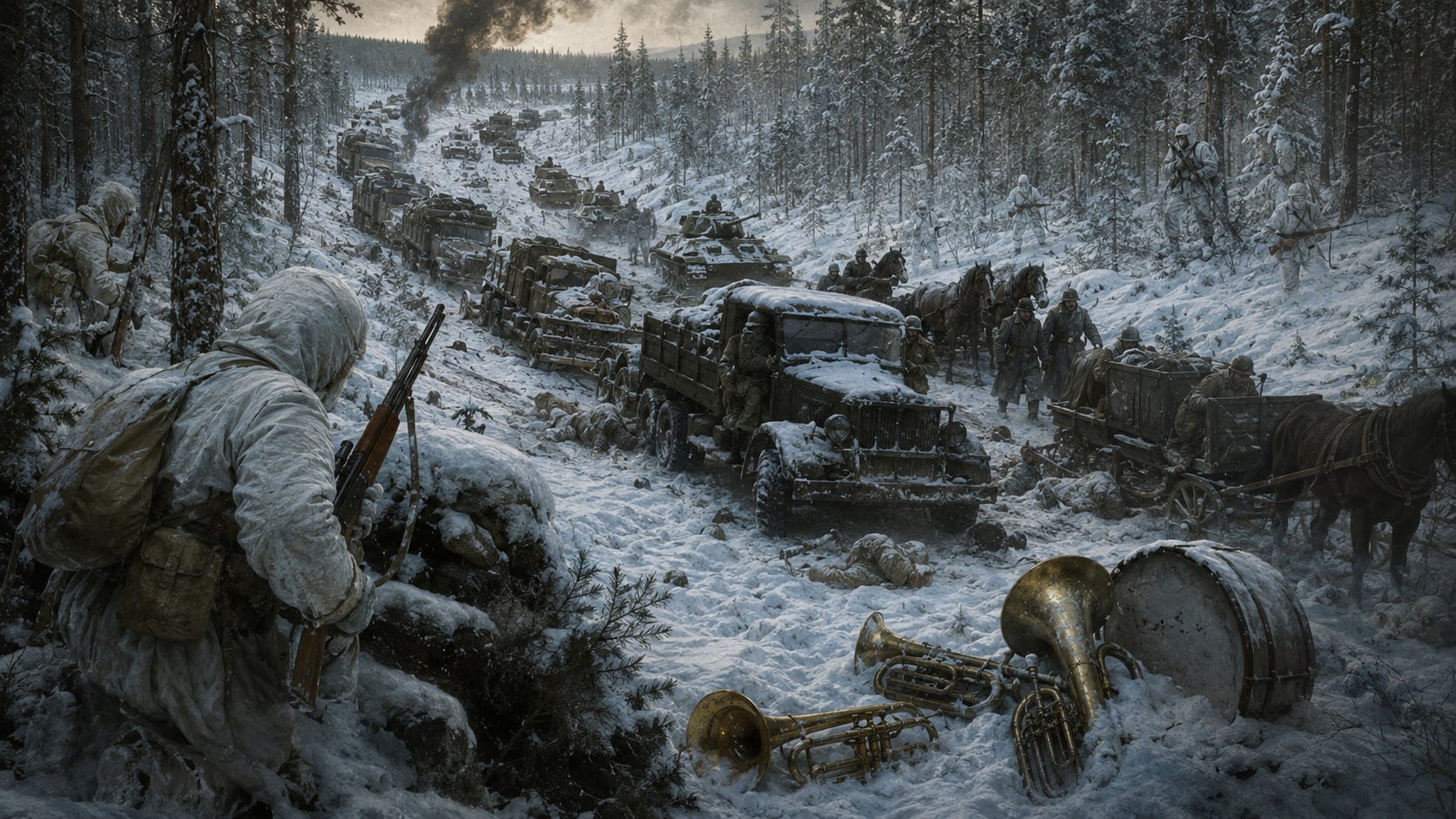
The Soviets brought the band instruments.
They simply never got to play them.
A War to “Protect” Leningrad
Leningrad sat uncomfortably close to the Finnish border. Stalin claimed that the Soviet Union needed additional territory to create a defensive buffer around the city. He demanded that Finland move its border westward, surrender several islands in the Gulf of Finland, and lease the Soviets a naval base.
The Finns understood the strategic concern.
They also understood Russia.
A concession that allowed Soviet forces onto Finnish soil might not remain a concession for long. Finland had declared its independence from Russia only in 1917. Its leaders had no intention of voluntarily placing the country back within Moscow’s grasp.
Negotiations failed.
On November 30, 1939, the Soviet Union invaded.
The odds were preposterous. The Soviets possessed overwhelming advantages in manpower, tanks, aircraft, artillery, ammunition, and industrial capacity. Finland had a small standing army supported by reservists—farmers, loggers, hunters, shopkeepers, teachers, and laborers called away from ordinary lives to defend a country of fewer than four million people.
Many Finnish soldiers arrived with little more than their rifles, winter clothing, and familiarity with the land.
The Soviets expected resistance to collapse.
Instead, they encountered Finland.
Stalin Had Already Shot Many of His Best Men
The Red Army was enormous, but Stalin had spent the preceding years terrorizing its officer corps.
During the Great Purge, experienced commanders were dismissed, imprisoned, deported, or executed. Those who remained understood that independent judgment could be fatal. Officers learned to follow orders rigidly, conceal bad news, and avoid decisions that might later be interpreted as disloyalty.
Stalin had created an army in which initiative could get a man killed before the enemy had the opportunity.
That mattered enormously in Finland.
The Soviets were advancing into a country of forests, lakes, swamps, narrow roads, deep snow, short days, and temperatures that could fall far below zero. A mechanized army required roads, fuel, field kitchens, maintenance, communications, and reliable command.
The Finnish soldier required considerably less.
He knew how to ski.
He knew how to stay alive in the cold.
He knew the forests.
And he knew that a Soviet division confined to a narrow road was not necessarily one large army.
It was a long piece of wood waiting to be cut.
The Road to Suomussalmi
One Soviet objective was breathtakingly ambitious.
The Red Army would drive westward through central Finland toward Oulu on the Gulf of Bothnia. If successful, the advance would cut the country roughly in half and sever Finland’s northern connections with Sweden.
On a staff map in Moscow, it must have looked straightforward.
On the ground, the route passed through a wilderness in which the available roads were little more than narrow logging tracks. Forests pressed closely against both sides. Deep snow prevented tanks and trucks from maneuvering freely away from the road.
The Soviet 163rd Rifle Division advanced into this country and captured the village of Suomussalmi in December.
The Finns had burned much of the village before withdrawing, denying the invaders warm shelter. Soviet soldiers occupied the ruins while Finnish patrols moved around them through the forests and across the frozen lakes.
The Russians controlled the road.
The Finns controlled almost everything beyond it.
Colonel Hjalmar Siilasvuo was given the job of stopping the advance. His Finnish force was initially much smaller than the Soviet formation it faced. But Siilasvuo recognized that the Soviet division’s numerical strength existed mostly on paper.
Its soldiers, vehicles, guns, supplies, and kitchens were strung out along narrow roads. They could not easily deploy. Units near the front could not necessarily help units farther back. Every additional truck lengthened the column and deepened its dependence on the road.
The Finns did not have to defeat the entire Soviet formation at once.
They only had to prevent its pieces from helping one another.
The Motti
In Finnish, a motti was a measured stack of cut firewood—roughly a cubic meter of logs prepared for collection.
The Finns turned the word into a method of war.
Ski troops slipped silently through the trees wearing white camouflage. They crossed terrain the Soviets regarded as nearly impassable. They appeared beside the road, struck quickly, and disappeared.
They cut communications.
They felled trees and constructed roadblocks.
They attacked fuel trucks, supply vehicles, command posts, and field kitchens.
They severed the Soviet column in front and behind.
Then they cut it again.
And again.
The great Russian log became a series of separate stacks.
Mottis.
Once isolated, each pocket could be surrounded, harassed, starved, frozen, and eventually destroyed. The Finns could concentrate their limited strength against one section while the soldiers in the next section—sometimes only a short distance away—were unable to help.
The Soviet division had more men.
The Finns decided how many of them would be allowed to fight at one time.
That was the genius of the motti.
The Finns did not recklessly throw themselves against the strongest Soviet positions. Direct attacks came after a pocket had been isolated and weakened, or when a decisive blow could finish it.
First, the Finns deprived the Russians of movement.
Then reinforcement.
Then food, fuel, warmth, communication, and confidence.
They were not simply killing soldiers.
They were systematically removing the things that made those soldiers an army.
The First Division Breaks
Around Suomussalmi, the 163rd Rifle Division became increasingly isolated. Its supply routes were threatened, its soldiers were cold and hungry, and the relief force expected from the east had failed to reach it.
The Finns tightened the pressure.
By late December, the Soviet position had become untenable. The 163rd attempted to withdraw, much of it escaping northeastward across frozen lakes and through the surrounding forests.
The retreat disintegrated into confusion.
Men abandoned equipment. Units lost contact with one another. Finnish troops attacked the fleeing columns and captured large quantities of weapons and supplies.
The first Soviet division had been driven out.
But the larger drama was still waiting to the east.
Coming to rescue the 163rd was the Soviet 44th Rifle Division, advancing along a narrow track called Raate Road.
It was walking directly into the same trap.
Raate Road
The 44th was a substantial formation with infantry, artillery, tanks, trucks, horses, ammunition, supplies—and a road-bound tail extending for miles.
It had been sent westward to reinforce the Soviet troops at Suomussalmi. But the division moved slowly, and Finnish resistance prevented it from reaching the village in time.
By the time the 163rd was defeated, Siilasvuo was free to turn his forces against the 44th.
Raate Road ran through dense forest from the Soviet border toward Suomussalmi. In winter, it was less a route of advance than a narrow corridor through hostile country.
The Soviet commanders had placed a division inside it.
Finnish ski troops moved through the woods on both sides. They cut the road at multiple locations, established fortified roadblocks, and divided the long Soviet column into isolated pockets.
The 44th Rifle Division ceased to function as a division.
Its commanders could not maintain control over the entire formation. Supplies could not move freely. Units could not maneuver around the roadblocks. Heavy vehicles could not simply drive through the deep snow and dense forest.
Soviet soldiers attempting to escape on foot became vulnerable to exposure and Finnish patrols.
The cold did not merely cause discomfort.
It became another Finnish weapon.
Engines froze. Weapons malfunctioned. Wounded men died quickly. Soldiers crowded around fires that revealed their locations. Field kitchens became particularly valuable targets because destroying one meant that hundreds of men might receive no hot food.
The Finns knew exactly what the Russians needed in order to survive.
Then they took it away.
During the first week of January 1940, Finnish forces methodically broke the division apart.
Some Soviet positions resisted fiercely. Others collapsed. Men fled eastward through the forests, abandoning artillery, trucks, tanks, ammunition, and supplies. Raate Road became a frozen graveyard of wrecked vehicles, dead horses, discarded weapons, and bodies.
Casualty estimates vary, as they often do in battles transformed into national legend. But there is no dispute about the result: Soviet forces many times larger than the Finnish defenders had been shattered, and the planned drive across central Finland had been stopped.
The Soviets had arrived with nearly every material advantage.
Much of that material now belonged to Finland.
The Band Instruments
Among the equipment recovered along Raate Road were musical instruments belonging to the Soviet military band.
According to the story passed down from the battle, the 44th Division had brought the band to participate in the victory celebration after the Soviet advance reached Oulu and cut Finland in two.
The precise purpose of every instrument may be difficult to prove beyond all doubt. Armies routinely traveled with military bands, and history has a way of polishing irony into legend.
But the instruments were there.
The parade was not.
The image is almost too perfect: trumpets, drums, and tubas lying among the wreckage of an army that had expected to march triumphantly across a defeated country.
The Russians had prepared the music before winning the war.
The Finns supplied the silence.
Stalin’s Justice
Stalin did not respond to failure with introspection.
The commander of the 44th Rifle Division, Alexei Vinogradov, escaped the encirclement. That did not save him.
Vinogradov, his chief of staff, and the division’s political chief were blamed for the catastrophe. On January 11, 1940, only days after the defeat, all three were executed before surviving members of the division.
Vinogradov’s failure was real.
But so was the system that had placed a mechanized formation on a narrow forest road, denied its commanders freedom of action, and punished bad news more reliably than bad planning.
The men held responsible for the defeat were shot.
The man responsible for the system remained in the Kremlin.
Finland Won—and Lost
The victories at Suomussalmi and Raate Road were extraordinary.
They did not win the Winter War.
After its early humiliations, the Soviet Union adjusted. Stalin replaced commanders, concentrated overwhelming artillery and manpower on the Karelian Isthmus, and eventually broke through Finland’s principal defensive positions.
Finland could destroy Soviet divisions in favorable terrain.
It could not indefinitely replace its own dead, replenish its ammunition, or match the industrial resources of the Soviet Union.
In March 1940, Finland accepted peace terms.
It surrendered substantial territory, including much of Finnish Karelia. Hundreds of thousands of Finns left their homes rather than live under Soviet rule.
Yet Finland remained independent.
That was not the outcome Stalin had expected when the invasion began. The Soviet Union had envisioned an easy victory and had even prepared a puppet Finnish government. Instead, it gained territory at a shocking cost while leaving the Finnish nation, army, government, and spirit intact.
The Finns lost land.
They did not lose Finland.
Hitler Learns the Wrong Lesson
The Winter War produced one final and terrible consequence.
Adolf Hitler watched.
He saw the Red Army struggle against a country with a tiny fraction of the Soviet Union’s population and resources. He saw Soviet columns immobilized, Soviet commanders outmaneuvered, and Soviet soldiers surrendering or fleeing through the snow.
The performance confirmed what Hitler already wanted to believe: Stalin’s purges had hollowed out the Red Army, and the Soviet state would collapse when struck hard.
The Winter War was not the sole cause of Operation Barbarossa. Hitler’s desire to conquer the Soviet Union arose from ideology, racial obsession, territorial ambition, and his longstanding hatred of Bolshevism.
But Finland helped make the impossible appear easy.
On June 22, 1941, Germany invaded the Soviet Union.
Hitler expected another rapid campaign. Instead, Barbarossa led Germany into a continental war of annihilation it could not win. Like Napoleon before him, Hitler discovered that defeating Russian armies near the frontier was not the same thing as defeating Russia.
The Red Army that invaded Finland in 1939 was not the same force that eventually fought its way into Berlin. The Soviets learned from disaster, reorganized, and replaced equipment and commanders on an enormous scale.
Hitler remembered the Soviet humiliation.
He failed to account for the Soviet capacity to recover from it. The Red Army’s failure in Finland reinforced his expectation that the Soviet Union could be destroyed in a short campaign.
Finland’s Second War
The Finns had not forgotten either.
The peace settlement left Finland bitter, displaced, and vulnerable. When Germany invaded the Soviet Union in 1941, Finland entered what Finns call the Continuation War, seeking to recover the territory lost in 1940.
Finland fought beside Germany against the Soviet Union, although it maintained its own government, democratic institutions, command structure, and war aims. Finland never signed the Tripartite Pact and described itself as a co-belligerent rather than a formal Axis ally.
That distinction remains debated because Finnish military cooperation with Germany was substantial.
The decision was understandable.
It was also dangerous.
Finland had been attacked by the Soviet Union, had received little effective help from the Western democracies, and saw Germany as the only available power capable of helping it recover Karelia.
Small countries beside empires rarely receive clean choices.
They receive choices between dangers.
Finland eventually made peace with the Soviet Union in 1944 and was then required to drive German forces out of northern Finland during the Lapland War.
Through all of it—Winter War, Continuation War, and Lapland War—the central Finnish objective remained survival as an independent nation.
Finland survived.
The Oldest Engineering Principle
The motti was more than a battlefield tactic.
It was the most basic engineering advice ever given:
When a problem is too large to solve, break it into smaller problems. Then solve them one at a time.
The Finns could not defeat the entire Red Army.
They could not match Soviet manpower, armor, artillery, aircraft, or industrial production.
But they did not have to solve the entire problem at once.
First, they reduced an army to a division.
Then they reduced the division to a column.
Then they cut the column into mottis.
Once that was done, the impossible problem had become a series of possible ones.
Isolate one pocket.
Deny it food, fuel, warmth, communication, and reinforcement.
Destroy it.
Then move to the next.
It was battlefield engineering in its purest form: decomposition, isolation, and sequential solution.
The Soviet commanders continued thinking in terms of divisions.
The Finns kept reducing those divisions into smaller and smaller problems until each could be solved.
The Russians saw an army.
The Finns saw pieces.
Sisu
The story of Suomussalmi and Raate Road is often reduced to snow, skis, white uniforms, and the romance of Finnish soldiers vanishing into the forest.
Those things mattered.
But the deeper lesson was about character.
The Finns refused to fight the war Stalin had designed for them.
The Soviet Union brought mass, armor, artillery, and numbers. Finland did not attempt to manufacture a smaller Red Army and meet it symmetrically.
The Finns changed the terms of the contest.
They turned roads into traps.
They turned forests into avenues of movement.
They turned cold into a weapon.
They turned Soviet numbers into congestion.
They turned a division into a column.
Then they turned the column into mottis.
A powerful aggressor often mistakes superiority on paper for control on the ground. It assumes the smaller nation will calculate the odds, recognize the inevitable, and submit.
Finland did none of those things.
The Finnish word for what remained when rational calculation said there was nothing left is sisu.
The word is often translated as courage, endurance, determination, or grit. None is quite sufficient.
Sisu is what appears after ordinary courage has been exhausted.
It is the refusal to stop when stopping would be understandable.
It is not the belief that victory is certain.
It is the decision that surrender is unacceptable.
The men at Suomussalmi and Raate Road did not know that their story would become legend. They did not know that military historians would study their tactics or that generations of Finns would repeat their achievements with pride.
They knew only that the Russians were coming through the forest and that Finland stood behind them.
A nation of farmers, hunters, loggers, laborers, and reservists looked at one of the largest armies on earth and asked a distinctly Finnish question:
How do we cut it down to size?
Then they picked up the axe.
And somewhere along Raate Road, beneath the snow and wreckage, lay the instruments of a brass band that had crossed the border expecting to play for Finland’s defeat.
They never played a note.
Finland did not surrender.
That is sisu.
Wow! This was a history lesson I somehow missed. Very powerful. Thank you, Jim.
Great story about the Winter War. In some respects, it reminds me of the American Revolution against Britain. Different tactics of warfare. Thanks for sharing, Jim.
BTW, I like the format you are using. Good letters and not necessary to read them completely because of your short narrative explaining the content.