


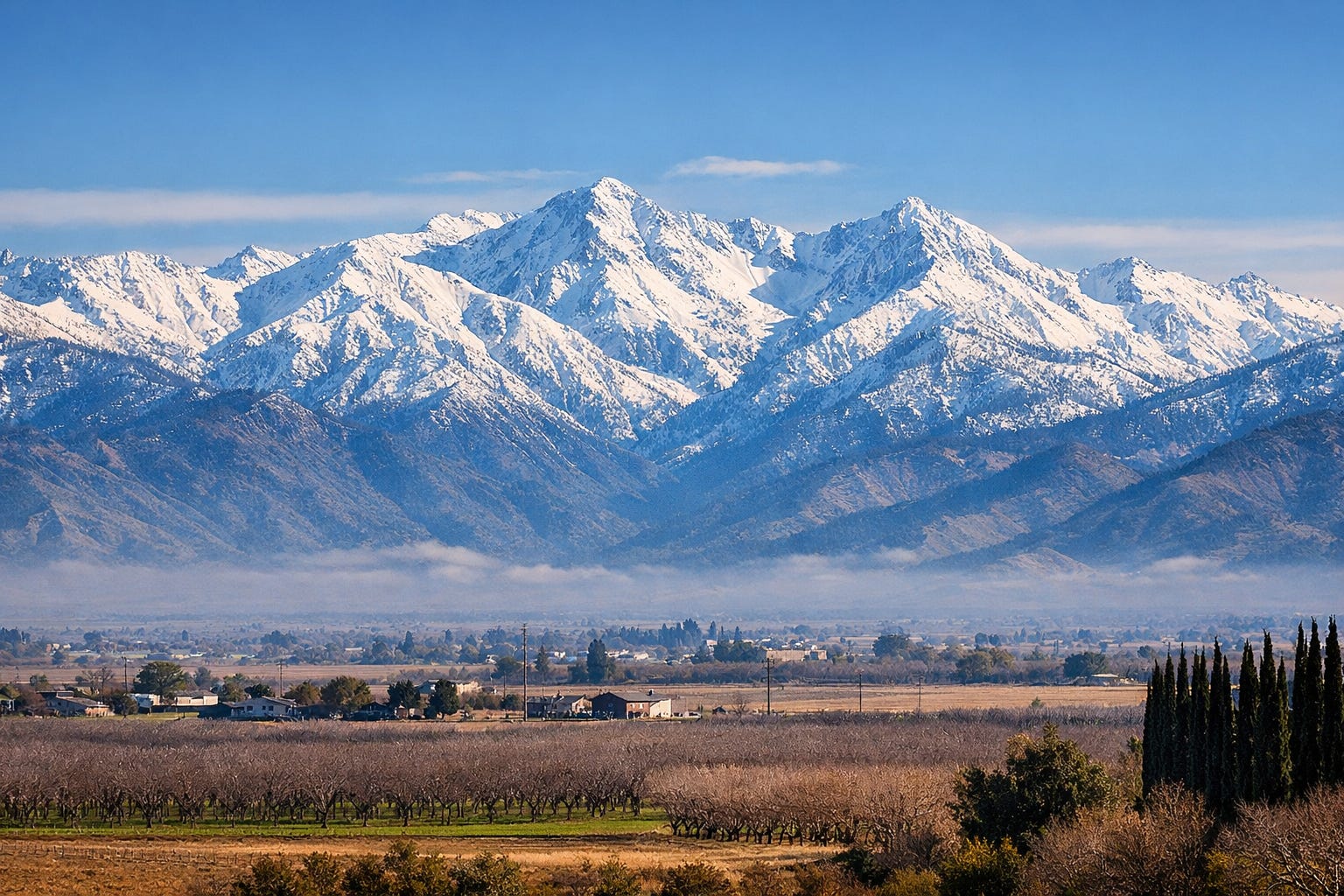
[Sierra Nevada as seen from California’s Central Valley.]
The Capture of Maduro and the Return of American Statecraft
By Jim Reynolds | www.reynolds.com
Dedicated to Victor Davis Hanson,
who taught a generation that history is not opinion,
and that order, once abandoned, must eventually be restored.
History does not usually announce its turning points with trumpets. More often, it whispers—through an event that seems isolated at first, even shocking, before its logic becomes unavoidable in retrospect. The capture of Nicolás Maduro by U.S. forces on January 3, 2026, will eventually be understood as one of those moments.
Not because it was spectacular—though it was. Not because it was unprecedented—because it was not. But because it marked the quiet return of an older American habit: enforcing order in its own neighborhood when disorder metastasizes into danger.
For a generation, the United States pretended otherwise.
We told ourselves that sovereignty was absolute, even when regimes ceased to function as states. We told ourselves that sanctions, communiqués, and multilateral theater were substitutes for action. We convinced ourselves that instability exported northward—drugs, crime, migration, foreign influence—was somehow disconnected from the regimes that produced it.
Venezuela shattered that illusion.
Under Hugo Chávez and then Nicolás Maduro, Venezuela was not merely a failed socialist experiment. It became something more dangerous: a criminalized state. A narco-regime. A logistics hub for cocaine, a haven for Hezbollah operatives, an Iranian drone workshop, and a pressure valve for mass migration. Its sovereignty was performative. Its flag flew, but its institutions served cartel logic.
The United States did not “invade” Venezuela. It executed an arrest.
That distinction matters—and it places the operation firmly within a long American tradition.
A Familiar Pattern, Long Forgotten
The capture of Maduro fits a pattern older than the Cold War and far older than the globalist hesitations of the last thirty years. It echoes Theodore Roosevelt’s corollary to the Monroe Doctrine, when the United States intervened not to conquer, but to stabilize failing Caribbean states whose dysfunction invited European encroachment and criminal predation.
It recalls the 1914 seizure of Veracruz—not to annex Mexico, but to prevent arms deliveries to a collapsing regime. It resembles the 1989 removal of Manuel Noriega in Panama, when a dictator who had become a drug trafficker in uniform was treated not as a peer head of state, but as a criminal actor abusing sovereignty as camouflage.
Even earlier, it rhymes with the Barbary Wars, when the young republic rejected the logic that American commerce and citizens must forever pay tribute to predatory regimes simply because those regimes claimed legitimacy.
In each case, the same principle applied: sovereignty is not a suicide pact.
Maduro had already crossed the line years ago—formally indicted by the U.S. Justice Department for narco-terrorism, with a multimillion-dollar bounty on his capture. What changed in 2026 was not the legal framework. It was the willingness to act on it.
Why Now?
The operation was not impulsive. It was methodical.
Months of intelligence collection tracked Maduro’s routines, security gaps, and internal fractures. The strike itself was narrow by design: no occupation force, no mass bombardment, no attempt to dismantle Venezuela’s military wholesale. Power disruptions were temporary. Civilian chaos was minimized. The objective was singular—remove the node that had fused criminality and governance.
This restraint is the tell.
Imperial adventures do not end in under an hour. They do not fly prisoners to courtrooms. They do not stop at the arrest.
This was law enforcement conducted at the scale required by reality.
And reality had shifted.
By late 2025, Venezuela had become an intolerable convergence point: Iranian influence pushing into the Caribbean basin, Chinese naval ambitions probing the hemisphere, Russian opportunism exploiting decay, and cartel networks flooding U.S. cities with narcotics and violence. The costs were no longer abstract. They were measured in overdoses, gang infiltration, and overwhelmed municipalities from El Paso to Chicago.
At some point, deterrence must be demonstrated—or it ceases to exist.
Not Nation-Building—Neighborhood Enforcement
Critics immediately reached for the familiar vocabulary: imperialism, precedent, escalation. But those terms ring hollow because they misunderstand what this was—and what it was not.
The United States did not attempt to remake Venezuela. It did not draft a constitution, install a viceroy, or promise utopia. It acknowledged a harder truth: failed regimes exporting harm cannot be granted perpetual immunity simply because fixing them is inconvenient.
This is not idealism. It is triage.
The administration has spoken of a temporary transition framework, focused narrowly on preventing collapse, restoring oil infrastructure, and blocking cartel recapture. That emphasis on energy is not mercenary—it is structural. Venezuela’s oil sector is the keystone of any viable future. Without it, reform is fiction.
Here again, history instructs. Stability precedes democracy; it does not follow it. Athens did not flourish amid chaos. Neither did Rome.
The Signal Beyond Caracas
The capture of Maduro sent messages far beyond Venezuela.
To Havana, it signaled that the old model—outlasting sanctions through inertia and external subsidies—has arithmetic limits.
To Managua, it suggested that isolation combined with criminality is no longer sustainable.
To Mexico, it reinforced an uncomfortable truth: public denunciations can coexist with private cooperation, because geography leaves no alternatives.
And to Beijing and Tehran, it restored a doctrine they had assumed dead: the Western Hemisphere is not an open laboratory for foreign power projection.
This was the Monroe Doctrine stripped of rhetoric and restored to practice.
Where This Is Going
The most important consequence of the Maduro operation is not what happened in January—but what happens next.
Expect no cascade of invasions. Expect instead a narrowing of tolerance. Regimes that manage their disorder will be left alone. Governments that attempt reform will be given time. But actors that criminalize sovereignty and export harm will find the margin for evasion shrinking.
This is enforcement, not evangelism.
For decades, American foreign policy oscillated between paralysis and overreach—between doing nothing and attempting everything. The Maduro operation suggests a third path: limited objectives, overwhelming competence, and moral confidence without messianism.
That approach is sustainable. And sustainability, not sentiment, is what restores credibility.
The American Thread
Victor Davis Hanson has often reminded readers that American power is most effective when it is least apologetic—not cruel, not reckless, but unembarrassed by its own legitimacy.
The United States did not become a continental power by waiting for permission. It did not secure its sea lanes by issuing statements. It did not defeat fascism or communism by pretending that predators could be reasoned into virtue.
It acted—selectively, decisively, and with an eye toward order.
The capture of Nicolás Maduro belongs in that lineage.
Years from now, historians will argue about details. They always do. But they will not argue about the inflection point. January 2026 marked the end of an era in which the United States treated its own neighborhood as an abstraction.
This was not nation-building.
It was not imperialism.
It was not war.
It was the reassertion of a boundary.
And boundaries, once enforced, tend to clarify everything else.
⸻
We can only hope for the best. I had my cancer fight 3 decades ago. Guess what? The “photo” of the Sierra Nevada mountains is not a photo. It was produced by chatGPT. I prompted with: “Depict the western slope of a snowy Sierra Nevada mountains range as seen from a viewpoint around Selma, California. Include farmland in the foreground.”
I guess we can’t even believe our eyes any longer.
Hopping for the best for VDH.
I’ve been through CA twice. Most recently a decade ago. So far, so good.