


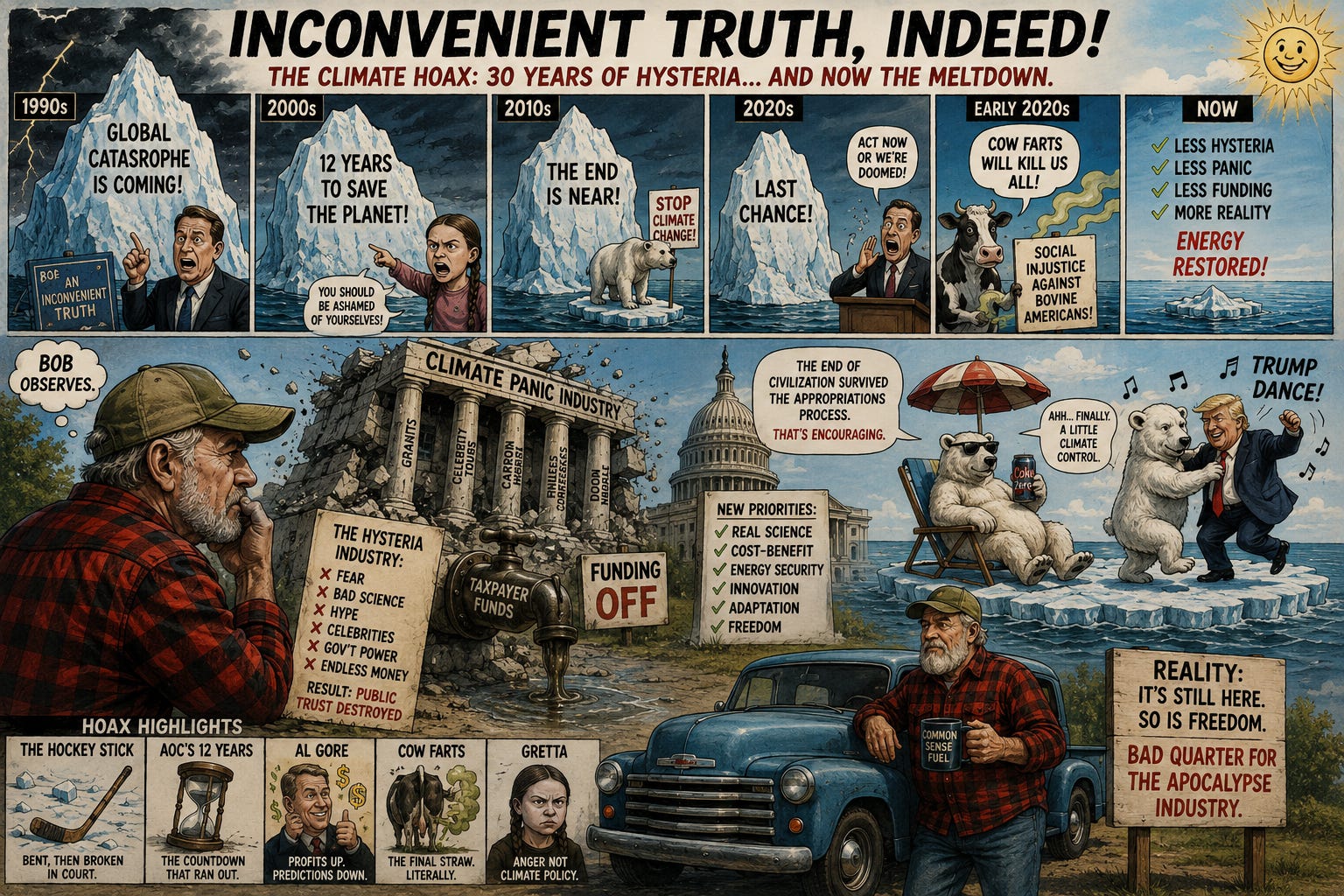
The Climate Mirage 2026
The End of the Hysteria Autopsy
By Jim Reynolds | www.reynolds.com
May 24, 2026
The climate is changing.
Of course it is.
The climate has always changed.
Ice ages existed before SUVs.
Glaciers advanced and retreated before coal plants.
The Sahara was once green.
Vikings farmed Greenland during warmer periods.
Civilizations froze, flooded, migrated, adapted, collapsed, and reinvented themselves beneath changing skies long before Al Gore discovered PowerPoint.
So let’s stop pretending the argument was ever about whether climate changes.
It was always about something else.
Fear.
Money.
Control.
Prestige.
Certainty.
And perhaps most importantly:
Trust.
Because after thirty years of climate panic, ordinary people have started asking a dangerous question:
Why do the experts always miss in the same direction?
The apocalypse deadlines come and go.
The glaciers disappear slower than advertised.
The islands remain inconveniently above water.
The famines fail to arrive on schedule.
The polar bears stubbornly refuse to vanish.
The hurricanes refuse to cooperate consistently enough with the narrative.
And every few years the countdown clock quietly resets itself another decade into the future.
Meanwhile the funding never declines.
That’s the tell.
At some point ordinary people began noticing that modern climate activism increasingly resembled a permanent institutional ecosystem rather than a purely scientific enterprise.
Governments.
Universities.
NGOs.
Climate czars.
Corporate ESG divisions.
Carbon markets.
Green investment funds.
Academic departments.
International conferences featuring celebrities arriving on private jets to explain why your lawn mower is destroying civilization.
Entire careers now depend on the continuation of climate alarm.
And like most large bureaucratic ecosystems, it adapts remarkably well to permanence.
Now before the usual screaming begins, let’s be clear:
This does not mean every climate scientist is corrupt.
Many are sincere people trying honestly to understand extraordinarily complicated systems.
But sincerity does not eliminate incentives.
And incentives matter.
Especially once the models arrive.
Now here is where ordinary people quietly stop nodding.
Because once a system contains enough variables, assumptions, weighting functions, historical reconstructions, probabilistic scenarios, smoothing mechanisms, calibration targets, and feedback loops, the average citizen instinctively understands something important:
The outputs become negotiable.
Anyone who has ever written complex simulations knows this.
Tiny assumptions compound.
Boundary conditions matter enormously.
Input weighting changes outcomes dramatically.
Omitted variables reshape entire projections.
And somehow — almost magically — the overwhelming majority of public climate models, institutional summaries, media headlines, and political speeches always land in the same place:
Man is causing catastrophic warming.
Man must surrender more economic freedom.
Man must consume less energy.
Man must drive less.
Man must eat differently.
Man must pay more taxes.
Man must trust the experts immediately.
Curiously, the models almost never drift toward:
“the system may be less sensitive than projected,”
or
“human adaptation may outperform the forecasts,”
or
“the effects may prove manageable.”
No.
The errors almost always move in one political direction.
After thirty years, ordinary people stopped viewing that as coincidence.
Bob looked at the latest climate projection.
“So once again…”
Long pause.
“…civilization ends in twelve years?”
Another pause.
“Interesting how the grant renewals always arrive first.”
Then came the Hockey Stick.
Michael Mann’s famous graph became one of the most powerful propaganda images of the modern era:
a long flat climate history suddenly exploding upward into catastrophe precisely as modern industrial society arrived.
The graph appeared everywhere:
schools,
documentaries,
media reports,
political speeches,
global conferences.
It became sacred.
Then critics challenged the methodology. Lawsuits followed. Institutions circled the wagons. The public watched scientists, activists, journalists, politicians, and universities suddenly behave less like detached truth-seekers and more like a coordinated priesthood defending holy scripture.
Ordinary people drew their own conclusions.
If the science is unquestionably settled, why does scrutiny produce panic instead of confidence?
And then there was Al Gore.
Perhaps no modern public figure better symbolizes the transformation of climate anxiety into a profitable moral-industrial complex.
An Inconvenient Truth was not merely a documentary.
It was a traveling apocalypse revival meeting.
Flooded coastlines.
Drowning cities.
Melting ice caps.
Doom clocks.
Existential countdowns.
Children terrified in classrooms.
Teachers presenting speculative timelines as settled destiny.
News anchors speaking like junior clergy.
Meanwhile Gore became extraordinarily wealthy and influential through climate-related investments, speaking circuits, green funds, carbon markets, and institutional prestige.
And eventually ordinary people noticed something deeply strange:
The men predicting catastrophe always seemed to become richer when the catastrophe deadlines failed.
That destroys trust.
Especially among working people now being told:
gasoline is immoral
air travel is selfish
suburban life is unsustainable
meat consumption is dangerous
and affordable energy itself may be a moral problem
Then the climate movement finally crossed into self-parody.
Cow farts.
That was the moment millions of ordinary Americans quietly exited the theater.
The same civilization that split the atom, mapped the genome, invented the microchip, built the modern world, and landed men on the moon was now being informed that Bessie from Oklahoma represented an existential planetary threat.
Tyrus called it “social injustice against bovine Americans.”
Honestly, the cattle may still have a case.
And somewhere in the middle of all this, Alexandria Ocasio-Cortez informed the country that the world might end in roughly twelve years if dramatic action was not taken immediately.
For a while the countdown became cultural law.
Children panicked.
Activists glued themselves to highways.
Corporations performed carbon rituals.
Politicians spoke in emergency language.
News organizations treated skepticism itself as moral deviance.
Then, rather quietly, the countdown faded away.
The world did not end.
Miami did not disappear beneath the Atlantic.
Civilization stubbornly continued operating.
And the same people who once spoke with absolute certainty simply drifted toward newer slogans and newer emergencies.
That’s when millions of ordinary people stopped hearing science and started hearing theater.
Science is supposed to tolerate skepticism.
Models are supposed to admit uncertainty.
Predictions are supposed to face accountability.
Complex systems are supposed to humble experts.
Instead climate discourse increasingly became moral performance wrapped around institutional incentives.
Questioning assumptions became “denial.”
Skepticism became heresy.
Doubt became immorality.
And once science becomes fused with politics, censorship, career incentives, celebrity culture, financial interests, and ideological tribalism, public trust collapses very quickly.
That is where we are now.
Not in a debate about whether climate changes.
But in a collapsing argument about whether the institutions managing the narrative still deserve public trust.
And then came perhaps the strangest development of all:
Even parts of the federal government itself quietly began admitting that much of the public climate rhetoric had become exaggerated, politicized, and disconnected from realistic cost-benefit analysis.
Not “human extinction.”
Not “the end of civilization.”
Not “twelve years left.”
Just another extraordinarily complicated environmental and economic problem requiring tradeoffs, adaptation, engineering, resilience, and realism.
Which, after thirty years of apocalypse marketing, sounded almost revolutionary.
Bob flipped through the latest reassessment.
“Interesting.”
Long pause.
“So now the emergency is having an emergency about the emergency.”
Another pause.
“That’s a tough business model.”
Bob looked around the latest emergency climate summit.
“They keep announcing the end of the world…”
Long pause.
“…from five-star resorts.”
One final pause.
“And somehow the cows are the villains.”
Afterword: Where We Are Now
The strangest part of the climate saga may be what happened after Donald Trump returned to the White House.
The funding machinery suddenly encountered resistance.
Budgets were reviewed.
Programs were frozen.
Climate offices faced cuts.
Environmental-justice grants came under scrutiny.
Federal agencies quietly began reassessing whether endless apocalypse spending actually matched measurable public benefit.
And suddenly the tone changed.
Not “human extinction.”
Not “the final twelve years.”
Not “the end of civilization.”
Just another very complicated environmental and economic challenge requiring tradeoffs, engineering, adaptation, infrastructure, realism, and adult cost-benefit analysis.
Which, after three decades of theatrical panic, sounded almost shocking.
The same institutions that once spoke with near-religious certainty suddenly rediscovered words like:
“resilience,”
“pragmatism,”
“energy transition timelines,”
and
“balanced approaches.”
Translation:
The hysteria market softened.
That alone tells you something important.
If the threat were truly immediate, existential, and mathematically unavoidable, budget reductions would not alter the emotional temperature of the movement at all.
But somehow the rhetoric cooled remarkably fast once the money pipelines and political leverage came under pressure.
That’s another tell.
None of this means climate concerns are fake.
None of it means pollution is good.
None of it means humans have zero environmental impact.
It simply means millions of ordinary people no longer trust the institutional performance surrounding the issue.
That trust was not destroyed by skeptics.
It was destroyed by exaggerated certainty, failed countdowns, emotional manipulation, celebrity hypocrisy, political opportunism, censorship, and a permanent stream of predictions that somehow always required more money, more control, and less questioning.
The climate may continue changing for centuries.
But the hysteria appears to be changing already.
Bob looked over the latest federal budget cuts.
“Interesting.”
Long pause.
“So the end of civilization survived the appropriations process.”
Another pause.
“That’s encouraging.”
One final pause.
“Bad quarter for the apocalypse industry, though.”
Bob’s Final Assessment
“The climate may keep changing forever.”
Pause.
“The panic market, though…”
Another pause.
“…that thing finally looks seasonal.”
Beautifully done. Bravo. 👏