


Grook
They braid themselves in circles
And call the comfort “truth.”
A chorus feels like courage
When no one plays uncouth.
“My colleagues” warms the silence,
Makes solitude a sin.
But density is hunger —
And freedom starts alone.
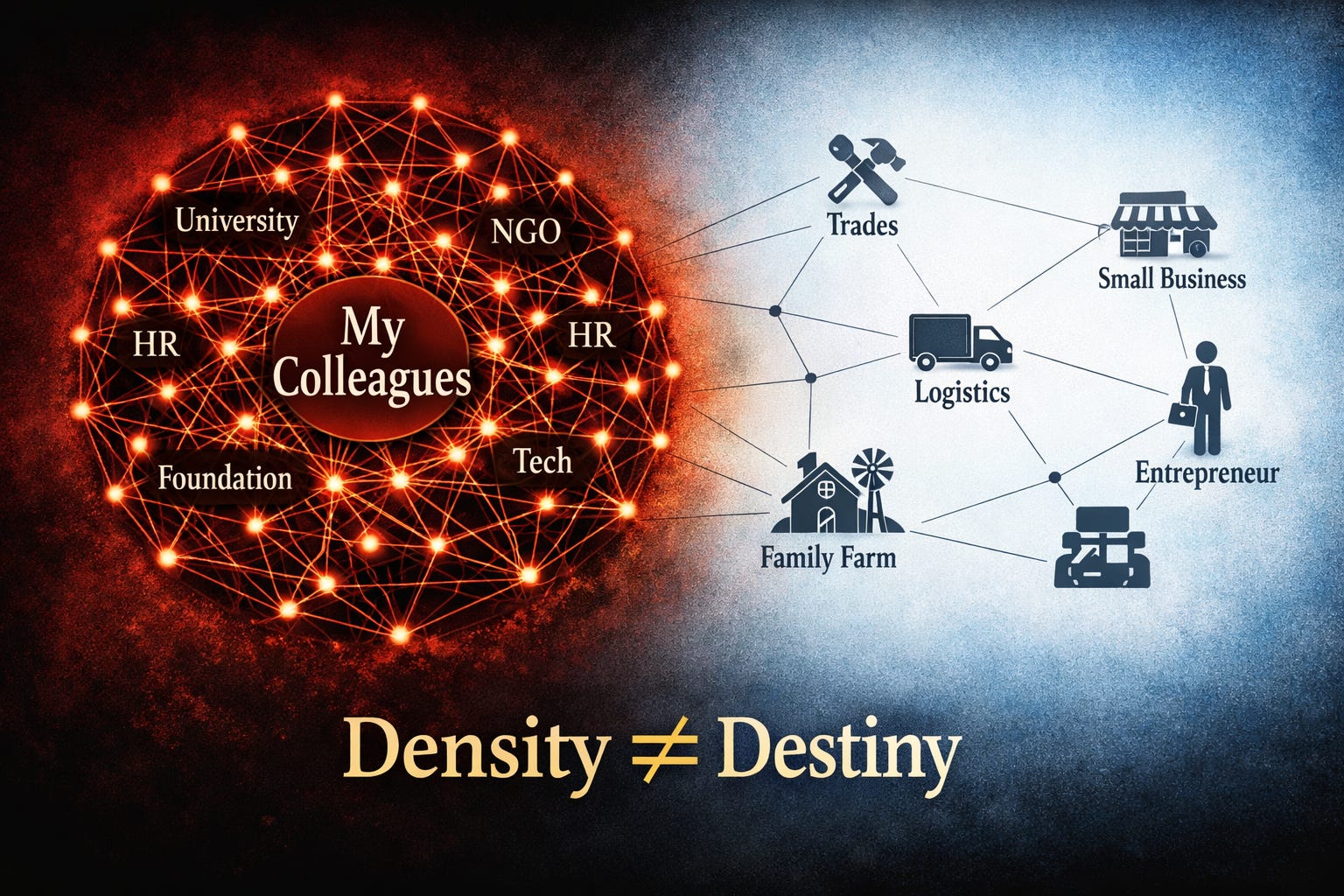
The Colleague Effect
Why Institutional Leftism Feels Ubiquitous
By Jim Reynolds | www.reynolds.com
You’ve probably noticed it.
Progressives always seem to “have colleagues.”
Not just coworkers.
Colleagues who agree.
Colleagues who circulate the same articles.
Colleagues who sign the same letters.
Colleagues who appear, instantly, in coordinated clusters.
It can feel like moral consensus.
It’s usually network density.
Bob: “If everyone around you agrees, check the wiring.”
This isn’t about intelligence. Or goodness. Or even persuasion.
It’s about structure.
But it’s also about something subtler — the psychology of belonging.
“My colleagues and I…”
Listen to the possessive. My.
That word does emotional work. It signals membership. Safety. Shared standing. It implies that your views are not just personal opinions but validated positions within a credentialed circle. “Colleagues” carries the quiet subtext: we are the serious people. The informed class. The adults in the room.
The phrase doesn’t just describe agreement.
It performs it.
And when that performance is backed by a dense institutional graph, it feels like power.
⸻
I. Where the Left Lives
Highly educated, left-leaning voters are overrepresented in sectors that are:
• credential-gated
• collaborative
• reputational
• institutionally thick
Universities.
Schools.
NGOs.
Foundations.
Media organizations.
HR departments.
Knowledge-work firms.
Large tech environments.
These fields are built out of committees, cross-functional teams, grant collaborations, editorial boards, Slack channels, affinity groups, and professional associations.
All of these groups require an abundance of agreeable “colleagues.”
The job is the network.
When your daily workflow requires consensus, signaling, and shared language, ideology doesn’t float loosely. It embeds.
Politics becomes ambient. An environment where the weather never changes.
And the language of “my colleagues” becomes both shield and amplifier — reassurance that you are not alone and reminder that deviation would not go unnoticed.
⸻
II. When Payroll and Politics Share a Graph
Modern progressive politics is mediated through dense, always-on digital systems.
Email lists.
Signal groups.
Slack workspaces.
Discord servers.
Social media layered over all of it.
These aren’t just mobilization tools. They’re reinforcement systems.
At the same time, progressive ecosystems deliberately build civil-society infrastructure: NGOs, advocacy groups, think tanks, campus orgs, media projects. Staff circulate between them. Funding streams intersect. Messaging cross-references.
The ecosystem behaves less like scattered firms and more like a federated web.
If your HR chain, your grant committee, your coalition partner, and your activist Slack channel all overlap, deviation carries relational cost.
Not theoretical cost.
Network cost.
Bob: “If your tenure committee reads your tweets, that’s not free speech. That’s choreography.”
In that environment, “my colleagues” is more than a phrase. It’s a signal that your social capital and your livelihood travel on the same rails.
⸻
III. Why It Feels So Total
In dense institutional environments:
• Reputation is currency.
• Alignment is legible.
• Silence is interpreted.
You don’t just hold a view. You are seen holding it.
Ideological clustering compounds quickly. The appearance of unanimity grows faster than the underlying population.
Agreement looks universal because dissent exits quietly.
What remains is a tightly interlinked circle where affirmation loops back on itself. The satisfaction of saying “my colleagues agree” is partly intellectual — but largely relational. It confirms that the circle is intact.
The result isn’t necessarily coercion.
It’s topology reinforced by belonging.
⸻
IV. Structural Contrast
Right-leaning voters are more overrepresented in:
• trades
• logistics
• small business
• dispersed private-sector roles
entrepreneurial environments
rural enterprises
These fields are more:
• market-facing
• individually structured
• geographically spread
• less credential-centralized
Politics may be strong. It may be loud. But it is less fused to your formal performance review.
A conservative may listen to aligned media daily.
That media is not his compliance department.
Bob: “It’s one thing to share a podcast. It’s another thing to share a payroll.”
In those spaces, saying “all my colleagues think this” carries less structural weight — because your colleagues are less likely to be a synchronized ideological unit tied to your professional survival.
⸻
V. The Visibility Gap
This creates asymmetry.
In institution-centric professional environments, politics feels omnipresent because it is woven into daily collaboration.
In more dispersed environments, politics is present but not structurally fused to employment.
One side experiences ideology as oxygen.
The other experiences ideology as affiliation.
So when someone says, “All my colleagues think this,” they may be telling the truth.
But they are describing a graph, not a country.
They are describing density, not dominance.
Bob: “Don’t confuse density with destiny.”
⸻
VI. What This Explains
This framework helps explain:
• Why workplace polarization feels uneven.
• Why dissent appears riskier in elite institutions.
• Why conservatives report feeling isolated in universities yet numerically strong nationally.
• Why progressive messaging can propagate rapidly across professional networks.
• Why the phrase “my colleagues” carries emotional force far beyond its literal meaning.
This isn’t a morality play.
It’s network topology plus human psychology.
Belonging feels like consensus.
Consensus feels like inevitability.
Inevitability feels like power.
But a dense circle is still a circle.
And circles can mistake themselves for the whole map.
An entire civilization of “colleagues” exists within the DEI world. Without “my colleagues”, the emperor would indeed be naked. That’s how it works. Would any of my colleagues wish to opine?
When you are worth $75,000 per and you are making $100,000 per you keep your mouth shut.