


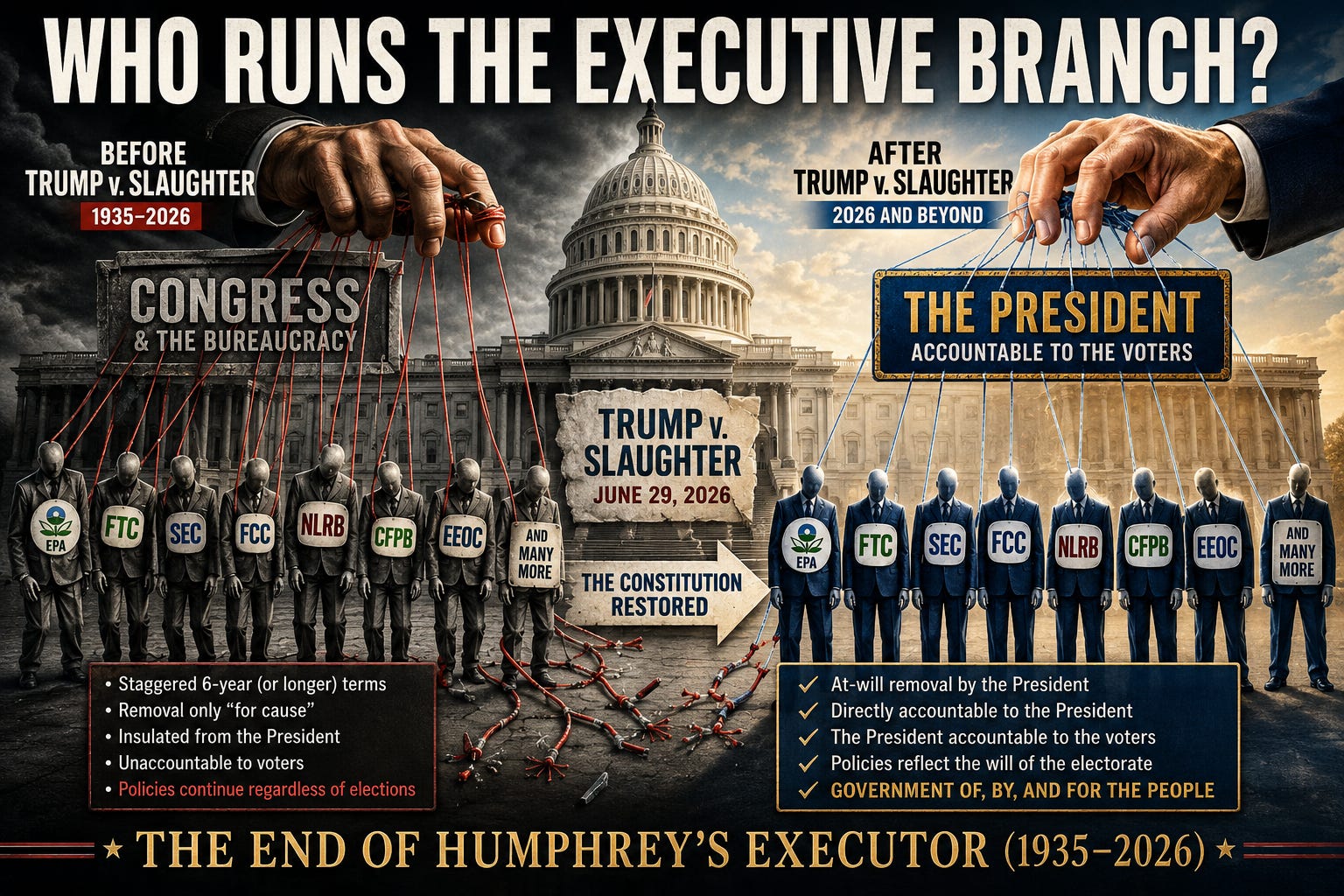
The Decision That May Have Ended the Deep State
How one forgotten Supreme Court case quietly changed America—and why another may have just changed it back.
By Jim Reynolds | www.reynolds.com
June 30, 2026
For nearly a century Americans have argued about taxes, immigration, energy, education, environmental regulation, and labor law.
Most assumed the answer depended on elections.
Elect a president.
Elect Congress.
Change policy.
That was the theory.
It wasn’t always the reality.
Yesterday the Supreme Court may have restored the original constitutional design.
Not by writing a new law.
By erasing a ninety-one-year-old judicial invention.
It Started With Franklin Roosevelt
In 1933 President Franklin Roosevelt wanted to remove William Humphrey from the Federal Trade Commission.
Humphrey opposed Roosevelt’s New Deal agenda.
Roosevelt fired him anyway.
The dispute reached the Supreme Court.
In Humphrey’s Executor v. United States (1935) the Court unanimously ruled that Congress could protect members of certain federal commissions from being removed by the President except “for cause.”
At the time it looked like a narrow administrative dispute.
It wasn’t.
It became one of the most consequential constitutional decisions of the twentieth century.
Congress Learned the Trick
Once Humphrey’s Executor was on the books, Congress understood the formula.
Create an agency.
Place it under a multi-member commission.
Give commissioners staggered six-year—or longer—terms.
Allow removal only for misconduct.
Repeat.
The result was elegant.
Or troubling.
Depending on your point of view.
Every president inherited agencies that often reflected the priorities of previous administrations. Even after voters demanded change.
The Six-Year Terms Were the Secret
This is the part almost nobody explains.
Suppose an agency has five commissioners serving staggered six-year terms.
A new president takes office.
He may only have one or two vacancies to fill.
The other commissioners remain.
Some were appointed six years earlier.
Others were appointed by presidents long gone.
Meanwhile those commissioners continue writing regulations, enforcing federal law, investigating companies, suing businesses, and issuing rules carrying the force of law.
They answer to no election.
They often cannot be removed.
That wasn’t an accident.
It was the system.
The Commissioner Who Outlasted Five Presidents
The design was not theoretical. It produced exactly what it was built to produce.
Consider Paul Rand Dixon.
Appointed to the FTC by John F. Kennedy in 1961. A New Deal Democrat through and through. He believed in aggressive federal regulation of American business.
Kennedy was assassinated. Dixon stayed.
Lyndon Johnson kept him. Dixon stayed.
Richard Nixon was elected on a mandate to rein in the regulatory state. Dixon stayed.
Gerald Ford inherited the presidency. Dixon stayed.
Jimmy Carter—a Democrat, but of a very different era—took office. Dixon stayed.
On September 25, 1981, Ronald Reagan finally saw Dixon’s term expire. Twenty years. Five presidents. Three changes of party control. And through all of it, one man continued writing rules and casting votes that carried the force of law, on the authority of an electorate that had repudiated his worldview multiple times over.
This was not corruption. Dixon was not a villain. He was serving in the role as Congress had designed it. The structure itself was the problem.
And Dixon was not unique.
Mary Azcuenaga joined the FTC as a Reagan appointee in 1984. She remained through the entire George H.W. Bush administration. She remained through the first five years of Bill Clinton’s presidency, casting votes on antitrust enforcement and consumer protection long after the country had elected a Democrat to take the agency in a different direction. She did not resign until 1998. Fourteen years. Three presidents. Two parties.
These were not outliers. They were the system working as intended—if your intention was to insulate regulatory power from electoral accountability.
Elections Changed. The Bureaucracy Didn’t.
Americans often wondered why presidents struggled to deliver on campaign promises.
One answer was Congress.
Another was the courts.
But another answer was the permanent bureaucracy—commissioners like Dixon and Azcuenaga, serving terms that spanned administrations, pursuing regulatory agendas that no living voter had endorsed.
An administration could change.
The regulatory state often did not.
Republicans complained about Democratic agencies.
Democrats later complained about Republican appointees.
The structure itself insulated large portions of executive power from electoral accountability.
Critics called it the administrative state.
Others called it the Deep State.
Supporters called it agency independence.
Whatever label one prefers, the underlying constitutional question remained the same:
Who ultimately controls executive power?
A Brief Moment When the System Worked
There is a telling exception.
In 1949, President Truman nominated Leland Olds for a third term on the Federal Power Commission. Olds had served since 1939—a decade of energy regulation through the Roosevelt and Truman years.
But this time the Senate actually did its job. The Commerce Committee examined Olds’s record, determined his views no longer reflected the public interest, and blocked his nomination.
The system worked precisely because Congress exercised its constitutional role rather than treating renomination as a formality. But that required scrutiny. That required public attention. That required a Senate willing to say no.
Most commissioners never faced that test. Most simply stayed, term after term, insulated by the very structure Humphrey’s Executor had created.
The Constitution Gives One Answer
Article II begins with remarkably simple language.
“The executive Power shall be vested in a President…”
Not in five-member commissions.
Not in independent boards.
Not in insulated bureaucracies serving terms that outlast the presidents who appointed them.
The President.
That constitutional argument built for decades through cases such as Seila Law—which struck down the CFPB’s single-director removal protections as unconstitutional—before culminating in Trump v. Slaughter.
Yesterday Changed Everything
The Court concluded that officials exercising executive authority generally must remain accountable to the President, who in turn remains accountable to voters. It overruled the central holding of Humphrey’s Executor that had protected FTC commissioners from at-will removal.
This is not merely an employment dispute.
It is a restructuring of executive power.
Dozens of agencies could now become directly accountable to the elected President instead of operating with substantial insulation created by Congress. The Dixon scenario—a commissioner regulating for twenty years across five presidencies—becomes constitutionally impossible.
The Critics Are Right About One Thing
Even the dissent recognized the magnitude of the decision.
Justice Sonia Sotomayor warned that the Court had fundamentally reshaped the federal government.
On that point, both sides largely agree.
This is historic.
Where they disagree is whether that change restores constitutional accountability or dangerously concentrates presidential power.
This Was Never Really About Trump
Donald Trump benefits immediately.
The next Democratic president will inherit exactly the same authority.
That is worth remembering.
The Court didn’t create a Republican presidency.
It strengthened the presidency itself.
The political consequences will depend entirely on who occupies the Oval Office.
The Larger Question
For almost a century Americans voted believing they were choosing the nation’s chief executive.
The Framers designed a system where executive power flows from the people, through the President, to the agencies that govern daily life. Humphrey’s Executor broke that chain. For ninety-one years, commissioners like Paul Rand Dixon regulated Americans on authority granted by presidents long departed and electorates long since overruled.
Yesterday’s decision asks a more fundamental question.
If the President cannot direct the executive branch…
Who can?
Congress?
Independent commissioners?
Career bureaucrats serving terms that span decades?
Or the voters, acting through the one official elected by the entire nation?
The Supreme Court has now answered that question very differently than it did in 1935.
Whether history remembers Trump v. Slaughter as the beginning of the end of the administrative state—or simply the next chapter in an ongoing constitutional struggle—will depend on what happens over the next few years.
But one thing seems clear.
The rules governing Washington have changed.
And they changed in a very big way.
Jim Reynolds writes on constitutional law, institutional accountability, and the architecture of American government. | www.reynolds.com
The infographic is part of the brand now. Of course, these are produced by AI. There would be no other practical way to do this. We will test several options before settling on the final. Since AI knows the complete context of the story, producing a relevant graphic is achievable. The graphic should tell the story in one shot. When that happens, you know that you have a winner.
Great explanation of the gravity and by impo