


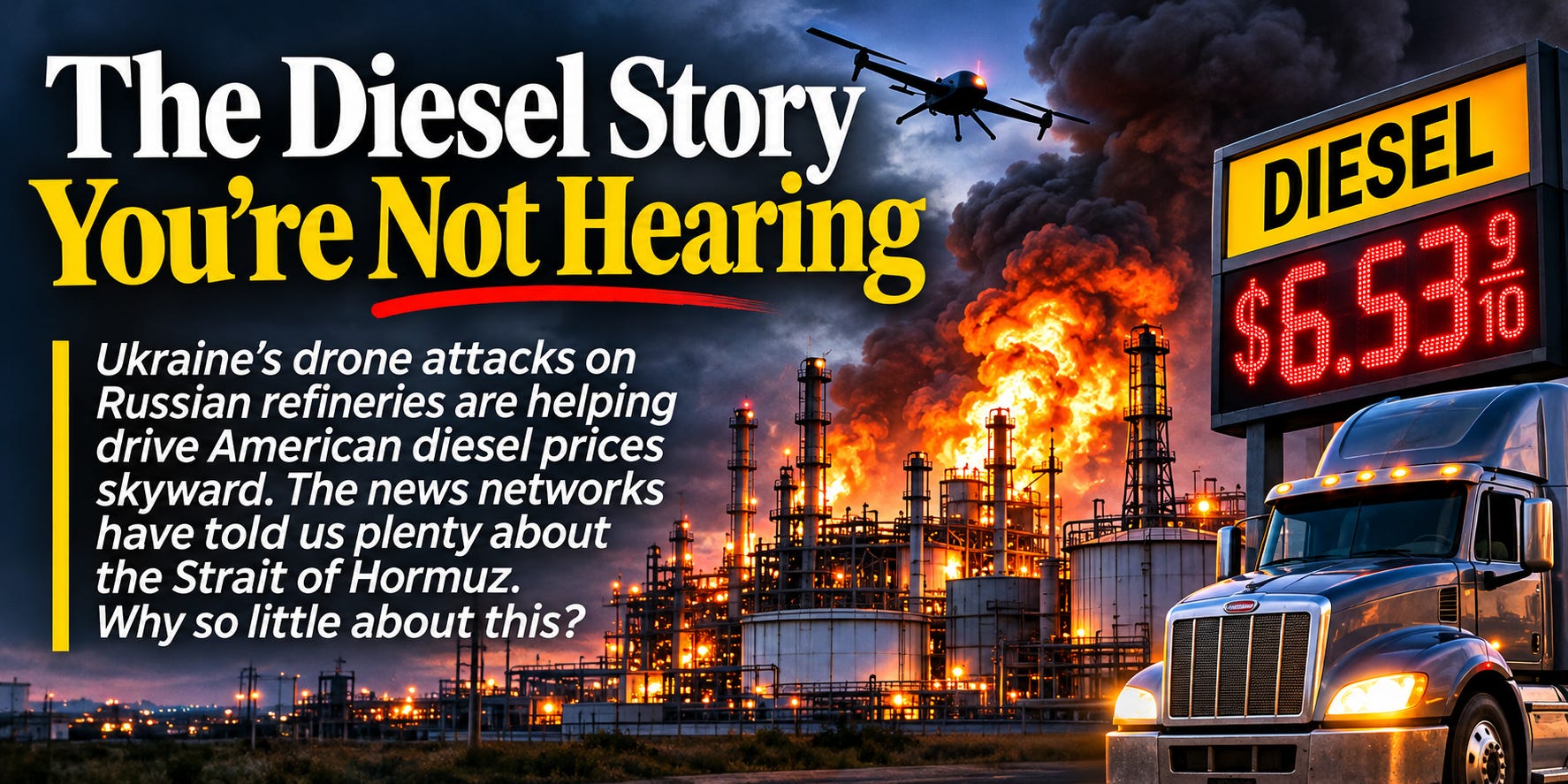
The Diesel Story You’re Not Hearing
Ukraine’s drone attacks on Russian refineries are helping drive American diesel prices skyward. The news networks have told us plenty about the Strait of Hormuz. Why so little about this?
By Jim Reynolds | www.reynolds.com
November 16, 2026
Americans know why gasoline prices have been climbing. Turn on the evening news and you will hear about the Strait of Hormuz, Iranian attacks on shipping, disrupted oil supplies, and the consequences of President Trump’s war with Iran.
There is another story, however, that has received remarkably little sustained attention. It concerns the fuel that powers America’s trucks, tractors, construction equipment, and much of its industrial economy.
Diesel.
And one of the major reasons for its extraordinary price increase has nothing to do with the Strait of Hormuz. It has to do with Ukraine.
More precisely, Ukraine’s increasingly successful campaign to destroy Russian oil-refining capacity.
The Other War
The numbers are astonishing.
According to the International Energy Agency, Ukrainian drones struck Russian refineries an average of once every three days during the first eight months of 2026. By late August, only five of Russia’s 32 major refineries had escaped attack.
Russian diesel production had fallen nearly 30 percent from the previous year. Russia, historically one of the world’s largest suppliers of refined petroleum products, was restricting exports to protect its own domestic fuel supplies.
This was not an incidental consequence of the fighting. Ukraine had deliberately targeted the infrastructure that converts Russian crude oil into usable fuel. Its drones were becoming more sophisticated, traveling farther and striking increasingly valuable refinery components.
The strategy was straightforward: damage Russia’s capacity to finance and sustain its war.
And it was working.
But there was a consequence beyond Russia’s borders. The world’s supply of diesel was shrinking, and prices were rising.
Why Americans Pay
Diesel is an internationally traded commodity. The United States does not need to purchase Russian diesel directly to experience the consequences of Russian production disappearing from world markets.
When foreign buyers cannot obtain Russian diesel, they seek alternative suppliers, including American refiners. Competition increases, inventories tighten, and prices rise.
By September 22, the average American diesel price had reached a record $6.53 per gallon. A year earlier, it was approximately $3.69.
On November 16, the national average finally slipped below $6, but the underlying supply problem remained.
This is not merely a problem for truckers.
Diesel powers the machinery that plants and harvests crops, the trucks that deliver groceries, the equipment that builds houses, and much of the transportation system that moves merchandise across America.
When diesel becomes dramatically more expensive, nearly everyone pays.
Now consider something remarkable.
Patrick De Haan, head of petroleum analysis at GasBuddy, estimated in September that 60 to 65 percent of the recent American diesel price spike was attributable to Ukrainian attacks on Russian oil facilities.
That is one analyst’s estimate, not an established consensus. Other analysts attribute a larger share to Middle Eastern disruptions. But even a substantially smaller Ukrainian contribution would represent an enormous economic consequence.
And the International Energy Agency’s November 13 report leaves little doubt about the underlying mechanism: continuing attacks on Russian energy infrastructure are restricting diesel supplies to international markets, compounding losses from the Middle East.
Both wars matter.
So why does the public hear so much more about one than the other?
Two Wars. Two Stories.
We examined reporting by ABC, CBS, NBC, CNN, and Fox News.
The Strait of Hormuz has received extensive coverage. Television audiences have seen repeated reports explaining its importance, detailing interrupted shipping, interviewing energy specialists, and connecting the disruption to prices at American gasoline stations.
CBS devoted a 60 Minutes report to the economic threat from Hormuz in March. Fox has aired numerous discussions of the same connection. ABC, NBC, and CNN have repeatedly covered it.
Now compare the Ukrainian refinery story.
Fox aired a dedicated five-minute segment on September 14 explaining the connection between Ukrainian drone strikes and diesel prices.
CNN interviewed energy specialists and subsequently explained how the loss of Russian refining capacity was aggravating shortages.
CBS MoneyWatch published several substantive articles, including reports explicitly identifying Ukraine’s attacks as a major factor. However, CBS aired nothing similar on broadcast television.
ABC and NBC acknowledged the connection, but the coverage we located was principally framed around Trump’s criticism of Ukraine rather than sustained independent examination of the diesel market.
The story was not completely ignored. But the difference in emphasis is difficult to miss.
We have not conducted an exhaustive minute-by-minute audit of every broadcast, so there is no defensible numerical ratio yet. Nevertheless, the available coverage reveals a marked difference in editorial attention.
And that raises an uncomfortable question.
The Politics of Explanation
When President Trump launched military operations against Iran, the consequences for American energy prices became an important political story. The public deserved to understand them, and the press was right to report them.
But when Ukrainian drones began systematically disabling Russian refineries, the economic consequences were often treated as secondary to the military story.
Ukraine was successfully damaging Russia’s war economy. That was the headline.
The resulting damage to the world’s diesel supply was another matter.
When Trump complained that Ukrainian attacks were driving up prices, some coverage focused on whether he was attempting to shift blame away from the Iran war.
Think about that.
Instead of beginning with the economic question—how much Russian refining capacity had been destroyed, and what was that doing to diesel prices—the story sometimes began with Trump’s motives for mentioning it.
The economic facts did not change because Trump had called attention to them.
Here is my suspicion: The Hormuz story fits comfortably into a political narrative about Trump’s responsibility for rising fuel prices. The Ukrainian refinery story complicates that narrative.
I cannot prove that newsroom editors consciously made decisions for that reason. But political framing can influence which questions get pursued, which facts are emphasized, and which stories return night after night.
Sometimes the most consequential editorial decision is not what gets reported. It is what does not become a continuing story.
The Missing Explanation
None of this means Ukraine should stop attacking Russian refineries. That is a separate military and diplomatic question. Ukraine has its reasons for trying to cripple the Russian economy, just as the United States has its reasons for confronting Iran.
Nor does it mean the Strait of Hormuz is unimportant. The disruption there has been enormous.
But Americans deserve an explanation of both forces driving their fuel costs.
When diesel rises to extraordinary levels, the public should know that Ukrainian military operations are part of the reason. When those operations succeed, the economic consequences should be reported alongside the military successes.
That is not an argument against Ukraine. It is an argument for telling the complete story.
We have heard a great deal about how Trump’s war with Iran affects the price of fuel.
We ought to hear just as much serious economic analysis about how Ukraine’s war against Russian refineries affects the price of diesel.
The American consumer pays for both. The American consumer deserves to understand both.

Jim, all true, but you still missed the bullseye. What changed since the election to drop fuel prices? They've come down 15-20% around here in the past week. Did Putin suddenly stop the Ukrainian drones? Did Iran stop oil coming from the Persian Gulf? No to both. What changed was that the London Globalists stopped driving up oil futures-- against their own short-term interests-- to thwart Trump's & the Republicans' nation-first plans which end perpetual wars and help countries all over the world to become self-sufficient and reduce their wealth going to China and other manufacturing (and now, beef) sources while the Globalists siphon off their cuts.
Accomplishing their mission, the London globalists can let prices fall to where the markets control it, without their interference.