


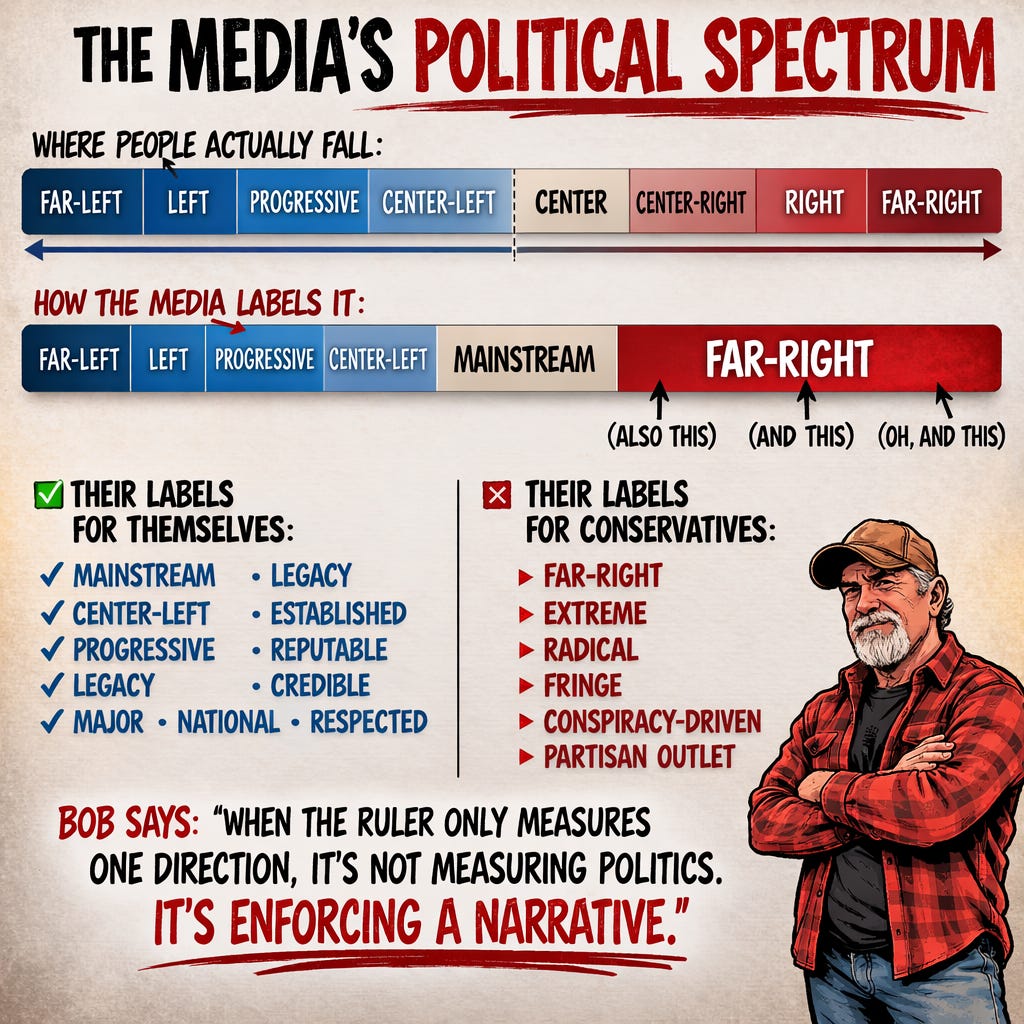
The “Far-Right” Trick
By Jim Reynolds | www.reynolds.com
There is a small linguistic trick that shows up in the news every day. Once you notice it, you can’t unsee it.
Conservative outlets are routinely labeled “far-right.”
Progressive outlets are almost never labeled “far-left.”
Instead they are described as:
“mainstream”
“center-left”
“liberal-leaning”
“legacy”
That alone should raise an eyebrow. If one side is “far,” the other side should occasionally be “far” too. But somehow that symmetry never appears.
Not convinced? Try these on for the home team: “liberal-leaning, established, reputable, credible, professional, trusted, major, national, respected, authoritative.”
These labels are uniformly NEVER attributed to American conservatives.
Interesting, isn’t it?
Bob noticed it years ago.
Bob says when a rule only runs in one direction, it’s not a rule. It’s a trick.
And in this case the trick is obvious. If conservatives are “far-right,” then the press covering them must be standing in the sensible middle. The label quietly establishes who the normal people are.
Spoiler: it’s them.
This isn’t a mystery once you start looking for patterns.
Patterns matter.
If an outlet occasionally leans left, that’s just bias. Humans lean. But when coverage becomes predictable across story after story after story, something else is happening.
Predictability is the tell.
If I can already predict the headline before the event even occurs, that outlet isn’t “center-left.” It’s operating inside a narrative lane.
And the lane is obvious.
If a conservative does something good, the coverage will include warnings, caveats, or moral suspicion.
If a progressive does something bad, the coverage will include context, explanation, or mitigation.
Bob calls this the Pattern Test.
But let’s stop and look at a few more favorite self-assigned labels of the Far-Left:
“progressive” (they’re making progress — you’re not)
“left-of-center” (the ‘center’ part is the nudge; the ‘left’ part is the truth)
“urban-based” (because that is where America lives in their world)
“policy-focused” (because that is what is “best” for America)
“fact-driven” (close cousin of “settled science”)
“data-oriented” (quality and interpretation optional)
“expert-informed” (experts often rented on an hourly basis)
But back to predictability.
If the audience can predict the story before it happens, the newsroom isn’t exploring reality.
It’s coloring inside ideological lines.
Now here’s the interesting question.
Are they lying?
Or are they so culturally captured that they don’t even realize what they’re doing?
Both possibilities exist.
Some journalists clearly know the game. The language choices are too precise, the framing too careful, the omissions too convenient. That looks a lot like intentional persuasion.
But many others probably believe they’re being fair. Newsrooms today are culturally homogeneous environments. When everyone around you shares the same assumptions, the assumptions stop feeling ideological.
They start feeling like common sense. To them — the captured Left.
Bob has a simple response to that.
“If everyone in the room agrees with you politically,” Bob says, “you’re not in the center. You’re in a club.”
And clubs develop house rules.
One of those rules is the labeling system.
Conservative outlets: far-right.
Progressive outlets: mainstream.
The effect is subtle but powerful. It quietly moves the center of gravity. Once the progressive press becomes “normal,” ordinary conservatives can be pushed to the margins — without changing a single policy position.
The vocabulary does the work.
Not convinced? Try these labels they often use for conservatives:
far-right
right-wing
hard-right
extreme
radical
fringe
conspiracy-driven
partisan outlet
And that’s why the pattern matters so much.
Because patterns don’t lie.
An isolated headline might be a mistake. A bad editor. A rushed decision.
But a thousand headlines pointing in the same direction aren’t accidents.
They’re a map.
Bob looks at that map and shrugs.
“Call it whatever you want,” he says.
“But if I can predict every move you’re going to make, you’re not reporting the news…
You’re running a playbook.”
”
I have a flannel shirt that looks just like Bob’s. Amazing.
The same phenomenon occurs regularly in any Wikipedia search. Its so obvious, but alternatives are less convenient.
Encyclopaedia Brittanica subscription is pricey.
PM