


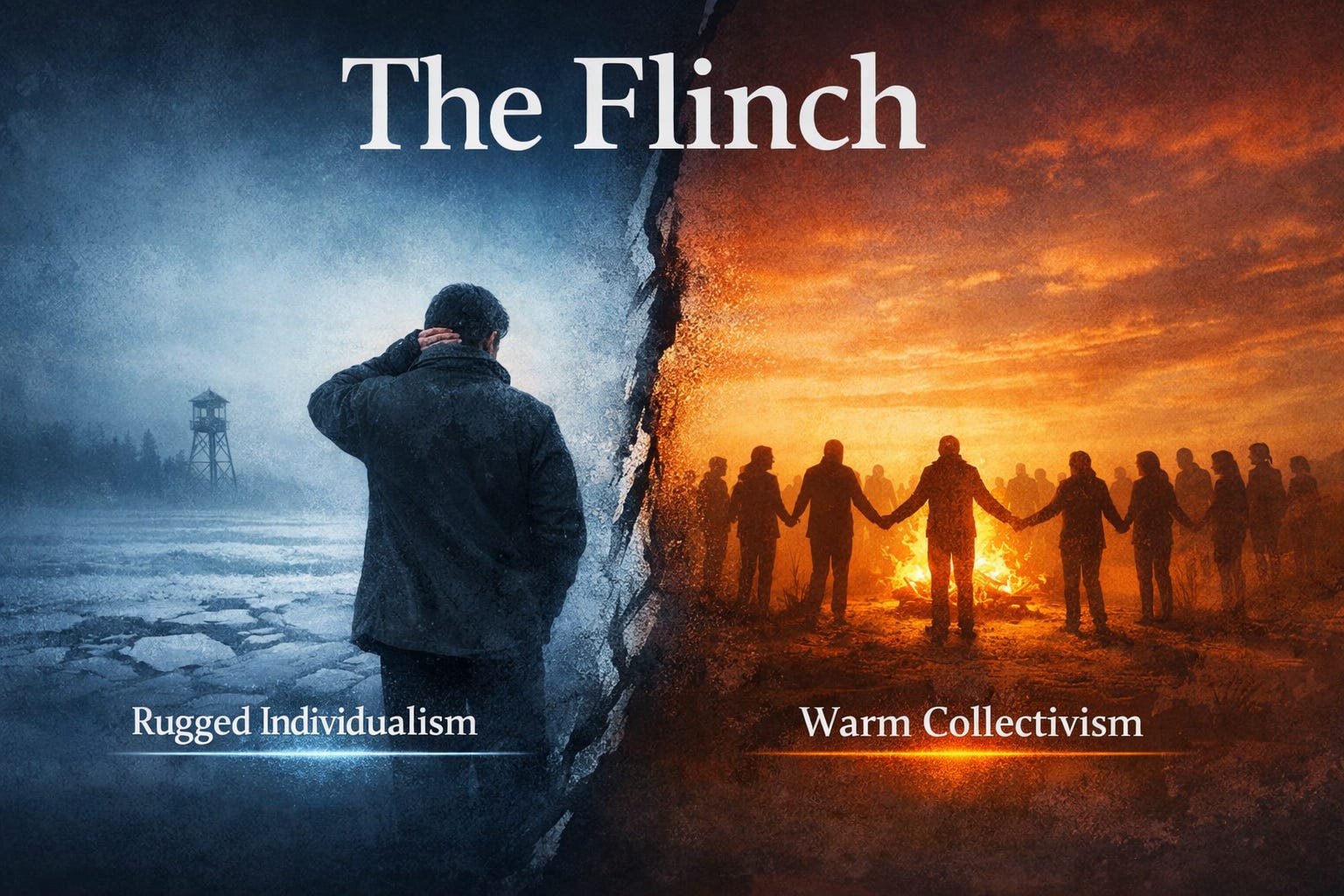
The Flinch
Why One Sentence Quietly Changed the Conversation
By Jim Reynolds | www.reynolds.com
There was a moment—brief, almost casual—when many people felt it without quite naming it.
When Zohran Mamdani spoke about replacing “the frigidity of rugged individualism with the warmth of collectivism,” something tightened. Not outrage. Not panic. A flinch.
That reaction wasn’t partisan. It wasn’t even fully conscious. It was cultural—almost physiological.
When a sentence makes people flinch before they argue, it’s hitting something older than politics.
The phrase didn’t argue policy. It passed moral judgment. Individualism was recast not as a civic value but as an emotional defect—cold, brittle, inadequate. Collectivism, by contrast, was offered as a moral upgrade—warm, humane, corrective.
That inversion is the signal.
⸻
What That Language Is Really Doing
Words like warmth and frigidity don’t describe systems. They describe people.
They quietly reframe personal agency—self-reliance, responsibility, ownership, decision-making—as something antisocial that must be softened before it can be trusted. Traits long associated with independence and initiative are treated not as virtues to be balanced, but as pathologies to be cured.
This is why the response was not primarily political. For most Americans, individualism isn’t an ideology—it’s an assumption. It’s the belief that adults are responsible for their choices, that effort precedes reward, that ownership precedes redistribution.
Calling that assumption “cold” feels like an accusation.
“If independence has to be softened before it’s allowed, it isn’t independence anymore.”
⸻
Responsibility vs. Delegation
This is where history matters—not as rhetoric, but as diagnosis.
Solzhenitsyn’s enduring insight was not simply that collectivist systems kill. It was how they kill: by relocating moral responsibility from the individual to the system.
Collectivism offers a quiet trade:
• You don’t have to decide—the framework already has
• You don’t have to judge—the structure will
• You don’t have to own outcomes—responsibility is shared
That promise feels humane. It feels relieving.
It is also the point at which coercion becomes inevitable.
“Any system that promises to carry your conscience will eventually decide what it weighs.”
⸻
Not Left vs. Right
This is where many critiques lose the plot.
This isn’t fundamentally about socialism versus capitalism, or left versus right. It’s about where responsibility lives.
A society can provide social support without dissolving agency. It can value community without erasing ownership. It can be compassionate without infantilizing adults.
The danger begins when outcomes replace effort, identity replaces behavior, and warmth replaces accountability. At that point, governance stops being supportive and becomes parental.
“The real divide isn’t left and right. It’s between people who want to decide—and people who want the decision made for them.”
Why the Quote Matters
That sentence mattered because it revealed instinct, not policy.
It suggested a worldview in which independence is morally suspect, dependence is reframed as care, and strength must be managed before it is trusted. That worldview doesn’t require malice to produce harm. It only requires consistency.
History shows that systems rarely begin by confiscating property or suppressing dissent. They begin by redefining virtue.
“Freedom rarely gets taken. It usually gets reclassified.”
⸻
Watching Closely
None of this is an argument against helping people. It’s an argument against dissolving responsibility in the name of help.
Early signals matter. Rhetoric matters. So do early appointments and early instincts. So far, the pattern suggests not moderation, but acceleration. We’re watching closely.
Not with hysteria. With memory.
Because America’s experiment rests on a stubborn idea: that free adults, burdened with responsibility, build more humane societies than protected dependents guided by benevolent planners.
You can debate how well we live up to that idea. But when leaders speak as if the idea itself is the problem, the flinch is justified.
Not loud.
Not theatrical.
Just clear.
And once you see the pattern, it becomes hard not to notice it everywhere.
Sharon, yes, that man changed a lot of things. I thought race relations had somewhat settled down by the time he was elected. Then that all changed. He inflamed the fire, apparently, purposefully. I was deeply disappointed because I thought there was chance that he could have been a great model for the country. He was hardly that, in my opinion.
Wonderfully thoughtful article