


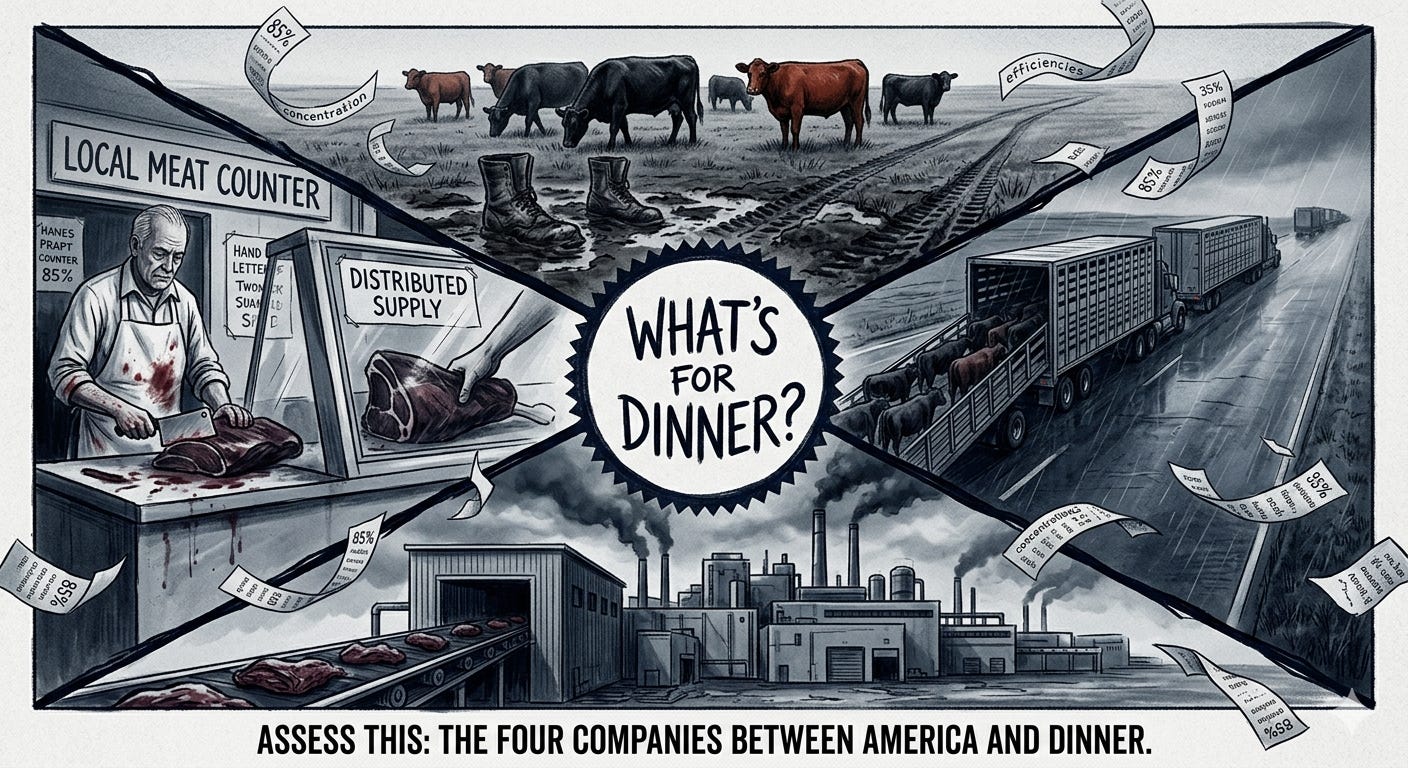
The Four Companies Between America and Dinner
By Jim Reynolds | www.reynolds.com
May 9, 2026
Most Americans know only two things about beef right now:
1. It costs too much.
2. Somebody is blaming somebody else.
That is where the public conversation usually stops.
But behind the rising steak prices and disappearing family ranches lies a much bigger story — one that touches globalization, consolidation, national resilience, supply-chain fragility, and a simple question most Americans have never really considered:
Who actually controls America’s food supply?
The answer is more concentrated than most people realize.
Today, four giant meatpacking companies control roughly 85 percent of the American beef-processing market:
- JBS
- Tyson
- Cargill
- National Beef
Two of those firms are heavily Brazilian-owned.
That did not happen overnight.
And it did not happen because somebody sat in a smoke-filled room one evening and decided to “take over beef.” The real story is more complicated, more modern, and in many ways more unsettling.
America slowly optimized itself into fragility.
The old system was messy.
Decades ago, America had a far more distributed cattle-processing network:
- regional slaughterhouses
- smaller processors
- local competition
- multiple buyers
- localized pricing ecosystems
That system was less efficient. But it was also more resilient.
Then came the age of optimization.
Over time:
- economies of scale
- environmental compliance costs
- transportation efficiencies
- Wall Street financing
- merger waves
- export globalization
- automation
- centralized logistics
…all favored larger and larger processors.
The logic looked irresistible.
A massive centralized plant could process cattle more cheaply than dozens of smaller regional operations. Investors loved the margins. Retailers loved the pricing. Economists loved the efficiency curves.
And slowly, quietly, the local system disappeared.
A fifth-generation rancher in western Kansas or eastern Colorado might still own land, still raise cattle, still work fourteen-hour days — but increasingly he was selling into a funnel controlled by a tiny number of gigantic buyers.
That changes everything.
Because a market with many sellers but very few buyers does not function like the “free market” most people imagine.
The rancher still carries enormous risk:
- weather
- feed costs
- fuel
- disease
- labor
- insurance
- regulation
- drought
But at the end of the chain, there may only be one or two economically viable processors within practical hauling distance.
At that point, bargaining power changes.
The rancher negotiates less.
He accepts terms more.
And once consolidation reaches extreme levels, the system itself begins to behave differently.
A fire at one large processing facility can ripple through national pricing.
A cyberattack on one company can disrupt supply chains across multiple states.
A labor dispute or plant closure can affect grocery prices hundreds of miles away.
Efficiency starts turning into fragility.
In software engineering — my field — we call that a ‘single point of failure.’
That is where the meat-processing industry increasingly finds itself today.
The system has become highly optimized for efficiency, but in doing so, it has also become optimized for cascading failure throughout the processing chain.
And that is exactly what we are beginning to observe.
That is why the Trump Administration’s recent investigation into meatpacking concentration is attracting attention far beyond agriculture circles.
The Department of Justice is investigating whether anti-competitive behavior exists inside the protein industry. Officials have pointed specifically to the enormous concentration ratios in beef processing and to systems that allegedly allowed processors to exchange sensitive pricing and production information.
Whether criminal conduct is ultimately found remains unknown.
But the broader structural issue is harder to dismiss:
America’s food system has become extraordinarily centralized.
And the Brazilian angle matters not because Brazil is inherently sinister, but because it highlights how globalization changed ownership itself.
Companies like JBS grew aggressively during the great consolidation era through acquisitions, scale advantages, access to financing, and international expansion. Over time, firms operating across borders accumulated enormous influence over processing capacity, export flows, and pricing leverage.
Again, this was not a Hollywood conspiracy.
It was modern capital markets doing what modern capital markets do:
rewarding scale relentlessly.
But scale has side effects.
The more centralized the system becomes:
- the fewer redundancies exist
- the more vulnerable supply chains become
- the harder it becomes for small producers to survive
- the easier coordinated behavior becomes
- the more political influence giant firms accumulate
Eventually, an uncomfortable question emerges:
At what point does efficiency begin undermining resilience?
That question now extends far beyond beef.
Americans are beginning to notice similar patterns everywhere:
- banking
- airlines
- media
- technology
- pharmaceuticals
- shipping
- fertilizer
- seeds
- food distribution
Everywhere the same pattern appears:
more consolidation,
fewer players,
greater scale,
less redundancy.
Everything works beautifully —
until something breaks.
Then suddenly an entire nation discovers how much depended on a handful of chokepoints nobody had been paying attention to.
This is why the current debate is really not about hamburgers at all.
It is about whether a modern nation can remain genuinely resilient after optimizing away local capacity, distributed ownership, and regional redundancy in pursuit of maximum efficiency.
There are no easy answers here.
Large-scale processors also brought real benefits:
- lower costs
- standardized production
- export competitiveness
- modern logistics
- nationwide distribution
The challenge is that systems built entirely around efficiency often become brittle over time.
Nature itself rarely works that way.
Healthy ecosystems usually contain:
- redundancy
- diversity
- decentralization
- backup pathways
- local adaptation
Modern industrial systems often remove those “inefficiencies” in pursuit of optimization.
Until suddenly the inefficiencies turn out to be survival mechanisms.
The cattle story may ultimately become one of the clearest examples yet of a larger American realization:
A nation can become very rich while quietly losing resilience underneath the surface.
Remember the baby formula fiasco a few years back?
As a once upon a time pediatrician I pulled the old recipe for making formula out and posted it on the Internet, one can of condensed milk, 17 ounces of water and a couple of tablespoons of Karo syrup. Generations, including ours, were raised on this.
Falls in line with the introduction of BOTTOM LINE ACCOUNTING