



THE FRIDAY STORY: Seeing “the number”
By Jim Reynolds | www.reynolds.com
I was scrolling the other day when one of those static-filled eye tests popped up — the kind that looks like a 1970s television wrestling with its antenna. A gray snowstorm, nothing more. But supposedly there was a number hidden inside the noise if you knew how to look. Not at it. Through it.
It took me ten seconds. My wife got it in less than 5 seconds.
And that moment sent me down a trail — one that ran through Seinfeld, American trackers, M.C. Escher, and a stroke I had in one eye. Yes, really. Stay with me.
——
Back in the ’90s, these “Magic Eye” things were everywhere. Entire bookshelves of them. Kids stood in mall kiosks, faces inches from glossy posters, waiting for a dinosaur or a schooner to materialize. If you stared directly, you saw nothing. But the moment you relaxed — the moment you softened the gaze and let the picture drift — boom, the hidden shape popped out like a message smuggled across the screen.
This time, the message was there — I’m not telling you. Find it yourself.
Before the punchline, I kept thinking of Justin Pitt — Elaine’s aristocratic boss from Seinfeld. The man who hired her with a single “Charmed!” because she looked like Jackie Kennedy, right down to the eyes. Pitt could take a Snickers bar — the most democratic food on Earth — and turn it into a museum piece requiring silverware. He’d focus so intensely on a pretzel rod that he’d miss a number floating in plain sight. A true connoisseur of minutiae: socks, pretzels, stationery. He could spend an afternoon removing salt from a single snack with the precision of a Swiss watchmaker. Hand him a static-filled image and he’d never see the hidden figure — he’d be too busy aligning the frame.
That’s the thing with these illusions: if you approach them like Justin Pitt approaches socks, you’ll never see a thing. Seeing the number requires the opposite instinct — not inspection, but surrender.
And that takes us to the old Indian trackers. A friend once told me that the great trackers — the ones who could follow a trail across rock, desert, or tall grass — didn’t stare at the ground. They didn’t analyze every pebble like Pitt would have. Instead, they widened the gaze. They relaxed. They let the disturbance in the pattern rise on its own. A blade bent wrong. A smudge where the sand looked smooth a second ago. A faint arc in the dust. They saw “through” the ground the way Magic Eye fans saw “through” the poster.
Pattern detection, not pattern obsession.
And then there’s Escher. I dropped in Relativity because it captures the entire idea. Nothing moves in the picture. Nothing changes. And yet the world flips on you depending on how you decide to see it. The staircases lead everywhere and nowhere, and your brain obediently reorganizes reality as many times as Escher asks it to. He wasn’t drawing illusions. He was drawing perception.
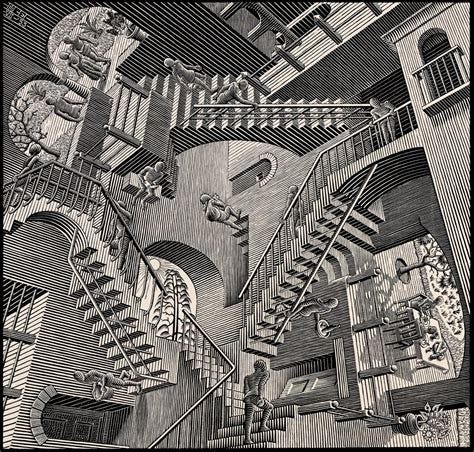
Which brings me back to that eye test — and to something I haven’t talked about much.
A few years ago, I had CRAO — a central retinal artery occlusion. A stroke… in the eye. One moment of blockage, and the retina went silent. Just like that, I became a one-eyed man. My depth perception? Different now. My peripheral vision? Compromised. One whole channel of visual information, gone. This happens in only one out of fifty thousand — lucky me.
So when I saw this static test floating around online, I assumed the hidden number was now someone else’s game. Magic Eye stereograms absolutely require two eyes. The old binocular dance. Without stereo vision, the 3-D illusions vanish.
But this wasn’t that kind of trick. This was something deeper, older. It didn’t depend on binocular cues. It depended on the mode of seeing — the same shift trackers used, the same shift Escher exploited, the shift Justin Pitt never managed once in nine seasons on NBC.
So there I was, one working eye, looking at chaos.
I relaxed the focus.
Let the field soften.
Let the noise settle.
And then — like a footprint surfacing on a trail — the number came forward:
“- - -“. First, a single digit. Then its two neighbors.
Ten seconds. One eye. Still got it.
So here’s the Friday question for you:
Can you see the hidden number? Tell me in the comments what jumps out of the static.
Happy Friday. Let’s see who’s got tracker vision.
Mr. Pitt is still trying to see it. He’s almost got it. He thinks he sees a battleship.

5,then 7, then 1
Did it again, just a 7