


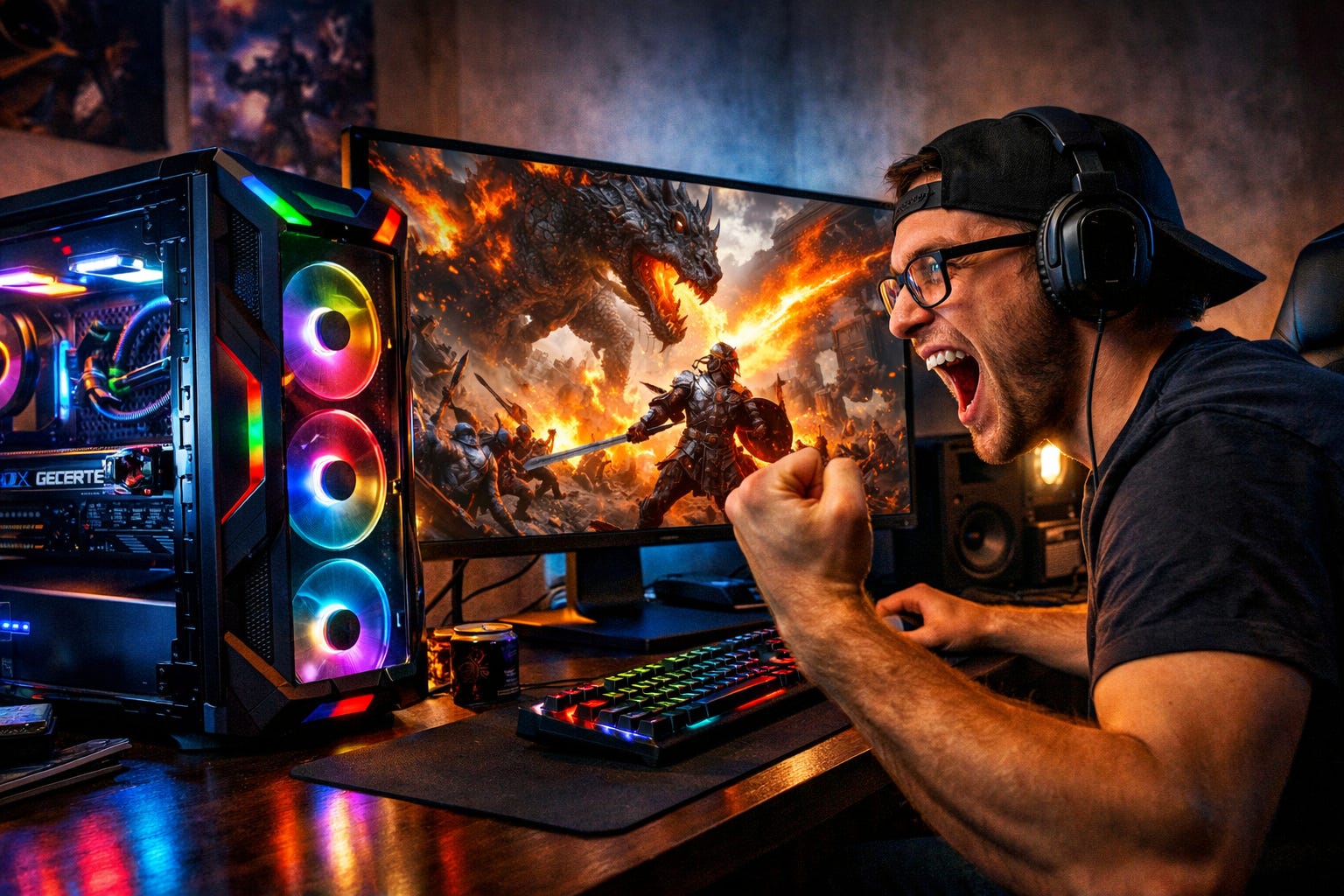
The Gamers Built the AI Machine
By Jim Reynolds | www.reynolds.com
April 7, 2026
⸻
If you want to understand how we got here—how a person can now run serious AI in a home office—you have to start in an unlikely place:
Gamers.
Not scientists.
Not government labs.
Gamers.
⸻
What Gamers Actually Wanted
A gamer doesn’t talk about “parallel compute” or “tensor operations.”
He talks about one thing:
What’s on the screen.
Is it smooth?
Is it sharp?
Does it respond instantly?
⸻
Take a simple example.
You turn your character in a game.
The entire world has to redraw—trees, shadows, reflections, lighting—everything.
And it has to happen:
60 times per second.
Or 120. Or more.
If it doesn’t, you feel it immediately.
Lag. Stutter. Break in immersion.
⸻
So gamers pushed for three things:
• More cores → do more at once
• More memory (VRAM) → hold bigger worlds
• More bandwidth → move data instantly
They didn’t call it that.
They just said:
“I want it faster.”
Bob: “Which is engineer-speak for ‘I don’t care how — just make it work.’”
⸻
What That Really Means
Every frame you see on a screen is:
• millions of tiny calculations
• happening at the same time
• over and over again
That’s what a GPU — the graphics processor — does.
It doesn’t think.
It calculates—fast, in parallel, endlessly.
⸻
Now Switch Lenses
What does AI do?
At a basic level:
It takes input
runs it through a massive set of weighted calculations
and produces output
⸻
A token.
A word.
A prediction.
Then the next one.
Then the next.
⸻
Sound familiar?
It should.
Because what AI calls:
“inference”
is just:
a different kind of frame
⸻
The Turning Point
For years, “serious computing” went in a different direction.
• Supercomputers
• Massive clusters
• Distributed systems
Rooms full of machines.
Millions—sometimes billions—of dollars.
⸻
And yet…
They weren’t optimized for this specific problem:
Do an enormous number of small calculations, all at once, very fast.
⸻
Gamers had already solved it.
They just didn’t know it.
Bob: “Of course they did. They were the only ones getting punished instantly when it didn’t work.”
⸻
The Surprise
The same hardware that draws a dragon in real time—
can run a language model.
• Textures → model weights
• Frames per second → tokens per second
• VRAM — the memory on the card — → model memory
Different surface.
Same engine.
⸻
A Walk Into Micro Center
Walk into a place like Micro Center.
At first glance, it’s exactly what you’d expect:
RGB lights
Glass cases
Stacks of GPUs
People arguing about cooling setups
⸻
It looks like a habitat for hardcore gamers.
And it is.
⸻
But stay a few minutes longer.
Listen.
⸻
You’ll hear a different conversation.
Not about frame rates.
About:
• VRAM limits
• model sizes
• inference speed
• batch processing
⸻
Someone at the counter asks:
“Can this handle a 70B model?”
The guy behind the counter doesn’t blink.
He answers like he’s done it before.
Because now, he has.
⸻
The Shift
The build-your-own gaming rig—
quietly became:
the build-your-own AI workstation
⸻
No announcement.
No press release.
No central plan.
⸻
Just a shift.
⸻
Why the Big Systems Missed It
Enterprise thinking went big:
• more machines
• more coordination
• more complexity
⸻
Gamers went the other way:
Make one machine insanely fast.
Bob: “Turns out, thinking doesn’t like waiting in line.”
⸻
And it turns out:
For many AI workloads—
that’s exactly what you want.
⸻
What This Means
We didn’t just get faster computers.
We got:
local capability
⸻
You don’t have to send everything to the cloud.
You don’t have to wait in line.
You don’t have to batch your thinking.
⸻
You can run it.
Right there.
⸻
The Real Shift
This is the part people are just starting to understand:
When the machine gets fast enough—
it stops being a tool you use occasionally
and becomes something you think with.
⸻
That’s the difference.
⸻
The Button
“Gamers wanted smoother worlds on a screen.
They ended up building machines that can think in real time.
They didn’t know it.
But they solved the problem before anyone else knew what the problem was.”